


 42 / 68

42
Australian Journal of Dementia Care
October/November 2016 Vol 5 No 5
prescribers and aged care workers to
make positive changes to the way they
approach BPSD right now.
Families also have a role to play in
facilitating this change. Managing
expectations of family members is a
challenge for residential care staff and often
individualised approaches to care are
compromised to meet these expectations.
Good information for families and people
with dementia is needed to help
understand the complexities of the issues
surrounding BPSD.
Finally, the HALT Project team has
developed targeted, evidence-based
training materials to up-skill GPs and aged
care home staff in this area, as well as in the
quality use of medicines. It is hoped that
future funding will be available to promote
and circulate these resources to clinicians
and aged care facilities.
For more information about accessing the
HALT resources, contact Dr Tiffany Jessop
at
t.holmes@unsw.edu.au.An educational webinar to educate GPs
about antipsychotics and BPSD, as part of
the HALT Project, is also available on the
DCRCs’ DementiaKT Hub website at
dementiakt.com.au/resource/webinar-halt-bpsd. The webinar,
How you can
understand, prevent, and remedy
Behavioural and Psychological Symptoms
of Dementia (BPSD),
is presented by
Professor Henry Brodaty and Dr Allan Shell.
Acknowledgments
The HALT Project is funded by the Australian
Department of Health through the Aged Care
Service Improvement and Healthy Ageing
Grants Fund. The HALT team comprises
Professor Henry Brodaty, Dr Tiffany Jessop, Dr
Allan Shell, Fleur Harrison, Monica Cations,
Linda Nattrass and Professor Lynn
Chenoweth.
Dr Tiffany Jessop is
HALT Project research
coordinator with the
Dementia Collaborative
Research Centre:
Assessment and Better
Care, UNSW Australia.
Contact her at:
t.holmes@unsw.edu.auReferences
Maust DT, Kim HM, Seyfried LS, Chiang C,
Kavanagh J, Schneider LS, Kales HC (2015)
Antipsychotics, other psychotropics, and the
risk of death in patients with dementia: number
needed to harm.
JAMA Psychiatry
72(5) 438-
445.
Schneider LS, Tariot PN, Dagerman KS, Davis
SM, Hsiao JK, Ismail MS, Lebowitz BD,
Lyketsos CG, Ryan JM, Stroup TS, Sultzer DL,
Weintraub D, Lieberman JA (2006)
Effectiveness of atypical antipsychotic drugs in
patients with Alzheimer’s disease.
New England
Journal of Medicine
355(15) 1525-1538.
C
ognitive Stimulation Therapy (CST) is
a program of multisensory
stimulation for people with mild to
moderate dementia aimed at improving
cognition and social functioning.
Developed in the UK by Dr Aimee Spector,
Professor Martin Orrell and Professor Bob
Woods, it has been endorsed by the UK’s
National Institute for Health and Care
Excellence as an evidence-based and cost-
effective intervention. It aims to improve
cognition and social functioning by
focusing and building on a person’s
retained abilities and strengths.
CST typically runs twice weekly in a
structured group setting. It involves 14
sessions of themed activities such as
current affairs, art discussion, categorising
objects, life history, physical activities,
number and word games. This is followed
by longer-term, or ‘maintenance CST’.
Sessions aim to actively stimulate and
engage people with dementia, whilst
providing an optimal learning
environment plus the social benefits of a
group. Participation in CST is reported to
show results comparable to the effects of
dementia-specific medications currently
prescribed (see
www.cstdementia.com/page/the-evidence-base).
CSTmanuals* provide user-friendly
instructions for multidisciplinary team
members to facilitate the program. Care
workers, diversional therapists,
occupational therapists, social workers,
nurses, psychologists etc can deliver CST in
a range of settings such as residential aged
care, hospitals, day centres and community
venues.
Australian prompts
In 2015 our team of multidisciplinary
clinicians at theAged Care Psychiatry
Service (ACPS), Eastern Suburbs Mental
Health Service, Sydney, developed an
Australian guidebook called
1 2 3
Australian CST
(Kanareck
et al
2015) to
assist CST facilitators who plan to
incorporateAustralian prompts in their
group sessions. The guidebook is a
compendium of Australian content to
complement the CST training manuals*
Making a difference
(Spector
et al
2006) and
Making a difference 2
(Aguirre
et al
2012).
1 2 3 Australian CST
is available for free
download from the Dementia
Collaborative Research Centres’ new
DementiaKT Hub website
(www.dementiaKT.com.au). Along with an
explanation of CST, the guidebook
includesAustralian historical facts and
dates, well-known personalities, iconic
landmarks, popular culture, brands,
television shows and detailed outlines of
24 activity sessions which reinforce the CST
key principles (see box p43). There are also
links to online information and video
content and easily accessed economical,
everyday equipment, such as household
objects, that are relevant toAustralian
participants and can be used to trigger
reminiscence and discussion.
The guide suggests topics for discussion
and tips for facilitators to be cautious of
when planning sessions, such as emotional
triggers and activities that might be
confrontational. For example, in the
‘Current Affairs’ session, facilitators are
advised to “be mindful of headlines that
DCRC SPEC I AL I SSUE : THE B I G P I CTURE I N DEMENT I A RESEARCH
CST guide designed
for Australian use
Daniella Kanareck
,
Natalie Narunsky
and
Brian Draper
have developed an Australian guide to complement the
Cognitive Stimulation Therapy (CST) manuals used in
residential and community care settings in the UK
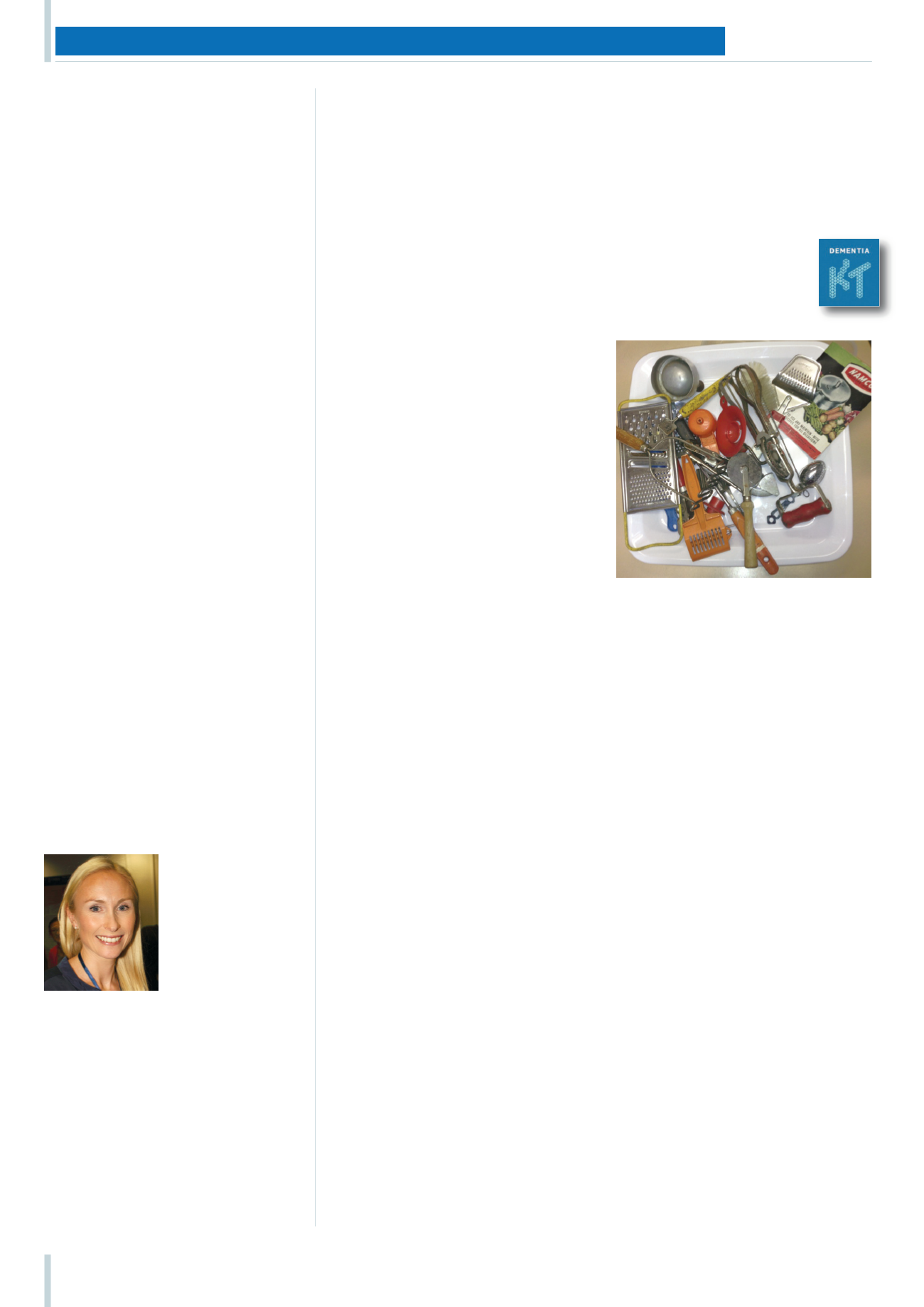
‘Household treasures’ are used to encourage
reminiscence and generate discussion
among participants about times past
* Footnote: The CST training manuals
Making a difference
and
Making a difference 2
can be ordered at
www.cstdementia.com/page/the-manuals.