


 13 / 16

February 19th - March 4th
iNarrabri Magazine 13
after illustrator amongst Sydney’s ma-
jor comic book publishing companies.
Australian comics and short graphic
novels were booming, this was well before
television and at the time there were re-
strictions on importing American comics.
Australian comics were very popular with
boys and young men and were a major
source of escapism entertainment.
Between Frank Johnson Publications and
his time at Frew publications, Peter wrote
and illustrated ‘
Captain Lester Burton,
G-Man’
for Famous Yank Comics; created
Bulldog Brandon Comics
, a spy thriller/
science-fiction series for Lilliput Produc-
tions; and succeeded Virgil Reilly as the
writer and illustrator on
The Invisible
Avenger
, a Cold War-era science-fiction
series featuring a malevolent Chinese
scientist intent on conquering Australia.
Peter began a decade long association
with Frew publications in the early 50’s
after being approached by the company’s
joint founder and publisher Ron Forsyth to
assume creative control of
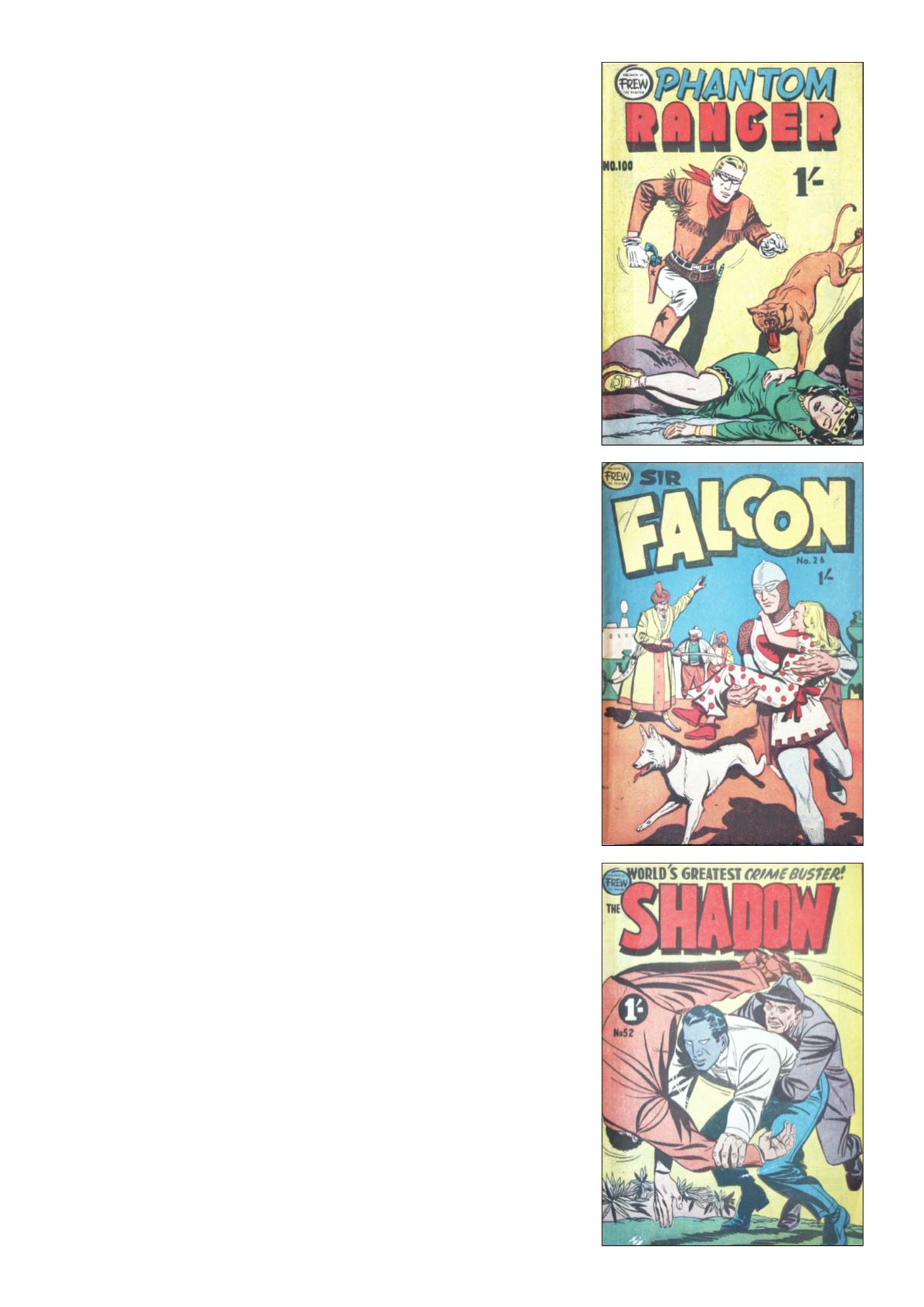
The Phantom
Ranger
.
“I was working with an overseas bloke
(the
famous French writer Eddie Brooker -
Ed)
who used to write stories and he was
always looking for work. He was a writer
but I had to rewrite them because he was
foreign and the translation was often too
long”.
“He’d give you a script but I had to rewrite
the whole damn thing but he was a nice
bloke... I remember if we didnt have any
work, he would go around looking for
work for us and we were always doing
stuff like that. It never stopped...”.
In those days we used to get 95 pounds
for a comic. He used to take 20 pounds
for his writing and I used to do the rest,
cover and everything. It was a lot of work.
Through this association Peter ended up
writing and illustrating the
The Phantom
Ranger
for Frew, taking over from Brooker
who wrote some of the early issues.
I wrote about 100... over a period of
about ten years... They just continued to
sell... I had a knack for doing comics... I
used to just draw four or five pictures...
a lot of the time I didn’t know what was
going to happen on the next page... but
I’d worked out how to write comics... In
the last panel you’d have the Phantom
Ranger hanging off a cliff and then you’d
turn the page... “Meanwhile back at the
ranch”... and it went like that right through
the book... No-one told me that but I
worked it out... I was very fast and I did all
the work myself... It got to the point that I
was able to do the lettering without using
guidelines... but I’d be working to the early
hours of the morning...”.
The Phantom Ranger
was Frew’s first
locally based comic book and went on to
become a great success, being syndicated
in the UK and South Africa, as well as be-
ing adapted into a popular radio program
with Charles “Bud” Tingle.
While at Frew, Peter was also chosen as
writer and illustrator on
The Shadow
which was another long running and suc-
cessful publication and developed his own
creation,
Sir Falcon
. Frew Publications also
had the rights to publish an Australian
version of the US Comic,
The Phantom
,
which Peter also worked on as a produc-
tion assistant and occasionally drew the
covers.
By the 1960s and the advent of televi-
sion and American comic imports, Frew
Publcations had significantly scaled back
its range of comic books, pulp novels,
and paperback books, prompting Peter to
embark on new commercial opportunities.
Peter produced a series of eight-page
promotional comics for Coca-Cola (Aus-
tralia) and found himself in demand as a
children’s book illustrator from the mid-
1960s to the early 1970s.
In 1965, Peter joined John Sands as an
illustrator and designer and produced art-
work for a wide range of greeting cards,
board games and calendars.
“When I first started I was working in their
commercial side and was actually drawing
the lines on cheques to begin with as well
as other commercial work. At one end of
the building you had commercial work,
and at the other end you had the illustra-
tive or creative work. One day when I was
waiting for a job to come in, one of the
managers asked if I could provide some
work for greeting cards and by the time
he came back, I had six designs waiting
for him... he couldn’t believe it. He ended
up taking them off and all of them were
approved, so I soon was working at both
ends of the building.”
In the early 1970s, Peter left Sydney and
moved to the Narrabri area and was
hanging off a cliff somewhere in the
Nandewar Ranges... but we will continue
his amazing story in the next issue...
With thanks to Kevin Patrick whose 2007
interview with Peter has been an invalu-
able resource. Find his excellent interview
with Peter at
www.chroniclechamber.comthen type in Peter Chapman in the search
box (top right). You can check out Kevin at
comicsdownunder.blogspot.com
amazing-australia.blogspot.com
For a comprehensive list of Peter Chap-
man’s work visit
www.austlit.edu.auand
visit the NSW Library website to find out
more about the current exhibition.