


 22 / 32

Feature
Interview by Chris Jollow
Where are you originally from?
The late Dr Bob Anderson delivered me to this world in the old Nar-
rabri hospital, Christmas Eve, 1967. (Apparently I was considered an
acceptable Christmas gift). My Mum was also born here. Between Mum
and I, we share 116 years of life experience based in this wonderful
town. It’s a great thing to live in a place where you can still meet the
nurse who was there at your birth and have her give you cheek and
cheek her back in return. I love Narrabri and its people.
What do you do for work?
I am now a visual artist, alongside my work as a piano teacher. Over the
past ten years there has been a cumulative growth of interest in my art.
It is an odd thing to call it work, I enjoy it so much! And yet, the work of
an artist is the same as that of any other: we put in the hours, the pen
strokes, the dedication. Ultimately – hopefully - for the increased joy of
others. So, work it is, but joyful work. I remain devoted to my piano stu-
dents too, practising the work I hand them to study, and guiding them
through the challenges of learning music. For those who are learning
out of interest, I attempt to make it fun. For those who are seriously
keen, I give guidance on technique and aspiring to musicality. Music is
one of the most significant creations of the human mind and playing
a musical instrument physically changes and enlarges certain areas of
the human brain. The piano is one of the most challenging instruments
to learn, both mentally and physically, and I am happy to understand a
little of how it works and help others with my knowledge. I hope that it
improves their lives in some way.
When and why did you start producing art?
At around five years of age I remember producing a card for my
neighbour. In school years I filled sketch pads at home and my exercise
books at school with drawings. When I left school I was advised to take
on some real work, shearing and wool-classing, to earn money. I then
began to work hard at another artistic pursuit, learning piano, which
led to becoming a piano teacher. Seeing the comedy in some of the
excuses kids used for not having practised, I started drawing humorous
cartoons for my students, to encourage them to practise their pianos
and guitars. I frequently drew (and still draw) pictures in their books as
a reward for effort. At home I had about five sheets of paper and some
graphite pencils – a paucity of resource which strangled inspiration.
Donna kicked me off by urging me to buy more paper. I drew a portrait
of her and someone noticed, commissioned me, and so the real work,
my life’s work began. I bought more paper, more pencils, brushes,
canvas, paints, and books, shelves and shelves of books on art, which I
have read and re-read. Three years ago Pat Clarke contacted me and
my other career as an illustrator of children’s books began. Life is all
beginnings.
Who are your favourite artists and why?
Crikey, how many pages do you have to spare? Klimt for his incredible
versatility, and his cosmic sense of communication through metaphor.
Rembrandt for his humanity. Leonardo for his native genius. Dali for
his inward-searching voyeurism. Escher for his mathematical antics.
Ernst Fuchs for his early penwork. HR Giger for alien-strange eroticism.
Hokusai studied humanity and his environment with exquisite line-
work. Magical Realism is kept alive by the likes of Michael Parkes and
Daniel Merriam. Van Gogh eternally wrings the emotions with his living,
frenetic strokes.
A myriad of comic artists have enthused me since I purchased my
first ‘Hot Stuff’ at age four or five – a vibrant memory! – but Hergé
the creator of Tintin and Uderzo of Asterix fame are two monumental
influences in my life. I have also recently discovered the collected works
of Floyd Gottfredson, who drew Mickey Mouse back in the early Disney
days, and Carl Barks, who pencilled Donald Duck around the same
time.
I’m fascinated by ancient Hindu and Buddhist art and the hieroglyphs
of the Egyptians and the Mayans. Sci-fi, Surrealism, Digital Animation
- there is so much to visually imbibe! There are so many brilliant artists
in this world. And Narrabri has no lack – Johanne Hannaford, Robin
Steiger and Judy Nobilo are all highly accomplished artists. We are a
fortunate town to have their strength of imagination and their commit-
ment to the arts.
Where do you draw your inspiration from?
Inspiration is a mysterious and volatile force. It springs from odd places.
A knot in a plank of timber. An eddy in a gushing stream. The shift from
one soaring set of vibrations to the next in a Bach sonata for solo violin.
Any phenomenon subtle and earthy or invented and surreal can set it
off. Or, I can just find myself drifting off to sleep, comfortably nestled
into bed, and ZAP – there’s this freaky, amazing image in my head and
I just have to scramble out of bed, grab a pencil and start sketching it
before it fades. Inspiration can also be a fickle beast, if you ever think
you can rely on it. Mostly I just need to sit down to the drawing board
and thresh out the ideas until I have something that works. Inspira-
tion is the grain of sand. The pearl takes years to form. The intriguing
discovery I have made is this collaborative inspiration, working with
authors. It is fascinating to sit and read someone else’s words and
ideas and to see the pictures form, as though they have been there
all along, to sketch these little ideas in the margins, and then to work
them up into illustrations. And then to see these published in thou-
sands of books, to be viewed by tens of thousands of people – that is
an extraordinary sensation and inspires me with great enthusiasm to
continue making art.
What have you been working on lately?
Most of 2015 has been devoted to illustrations for children’s books. Five
children’s books were published this year featuring my illustrations: Fred
Strassberg’s ‘How Santa Arrived at the North Pole’; Alec Trost’s ‘The
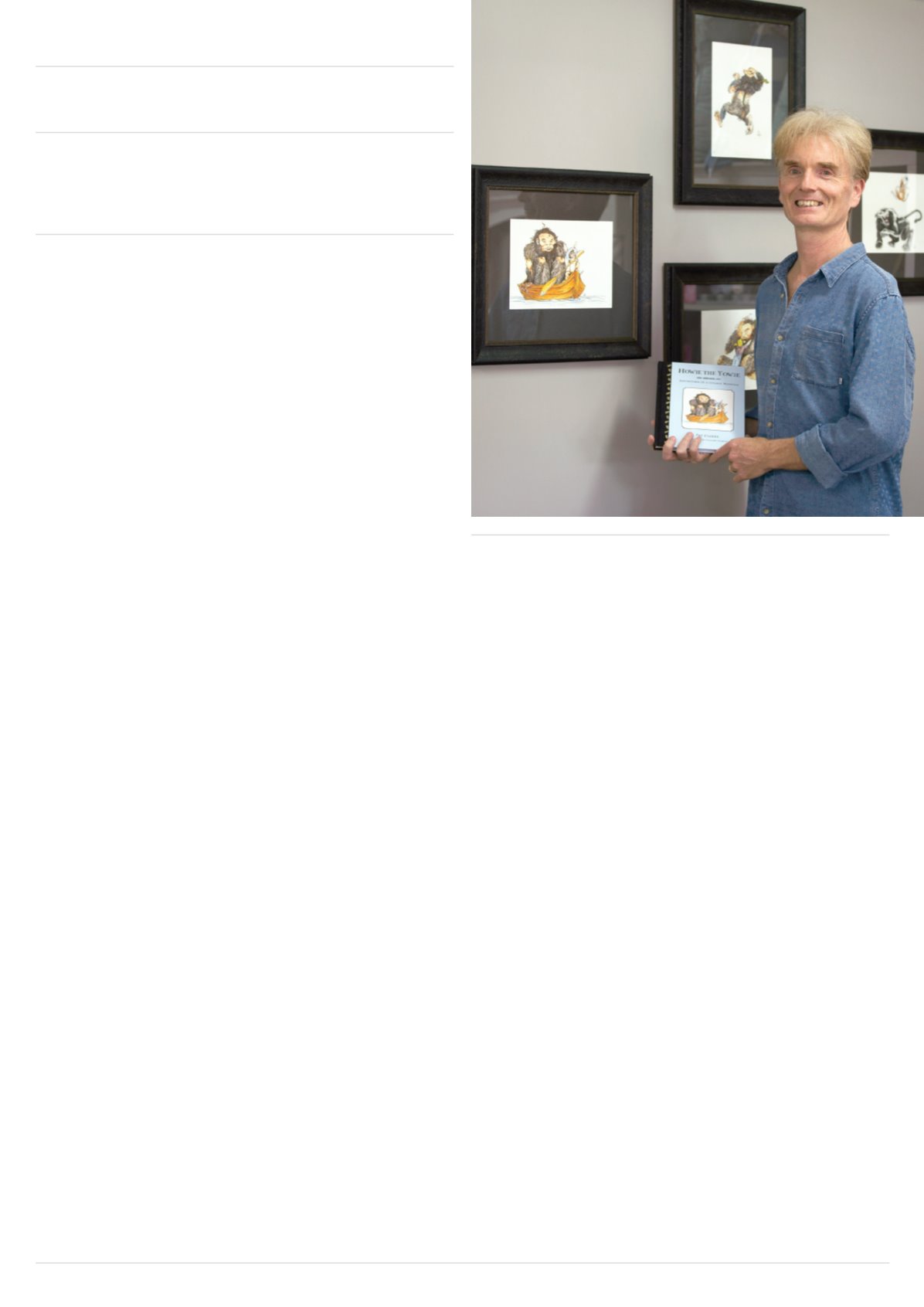
graeme compton
One of Narrabri's most talented artists, Graeme has a zest for life
and a gift for finding enjoyment out of the little things...
photo: john burgess
22 | iNarrabri Magazine