


 19 / 68

Research
Volume 12 No 4
I
September 2016
19
Think. Check. Submit.
Pitfalls and Perils of Open Source Publishing
There has been much discussion
recently in academic publishing circles
about publishing articles under ‘Open
Access’ or ‘OA’ terms. So what is OA,
and how can you as an author stay
informed about your options? Firstly,
there are two forms of OA publication:
gold and green.
In gold OA, articles are made freely
available by the publisher immediately
upon publication (typically under
a liberal licence, such as Creative
Commons Attribution – CC-BY), in return
for payment of an Article Publication
Charge (APC) that is usually covered by
the author’s funding source. The author
retains copyright of their gold OA article
and it may appear in a completely OA
journal or in a hybrid journal mixing
both OA and subscription content, such
as the
Journal of Medical Imaging and
Radiation Oncology
(JMIRO).
The appeal to authors of immediate,
free access to their work in a prestigious
journal is compelling and payment of
APCs is not necessarily an obstacle,
particularly in better-funded disciplines,
such as health and life sciences.
In green OA, the author’s accepted
manuscript (the peer-reviewed, but
otherwise not-yet-finalised version of an
article) is deposited in an institutional
repository or a subject archive, such
as PubMed Central and made freely
available, typically following an embargo
(usually between six to 36 months) after
the article’s formal publication in an
academic journal. Again, this is typically
under a creative commons licence.
Many journals, including JMIRO,
have recognised that authors need
the flexibility of a green OA option in
order to comply with funder mandates
and have adjusted their self-archiving
policies to make it easier for authors to
do so.
The OA movement represents a
significant change to the traditional
journal subscription model but, within
a complex, shifting landscape, it is
also opening up opportunities for new
relationships between publishers and
authors and new ways to add value for
researchers, funders, and libraries.
The publication of OA content begins
with you, the researcher. As the OA
publishing landscape continues to
evolve, valuable resources for helping
you learn about the process have never
been more important. Cue Think. Check.
Submit.—a new cross-industry initiative
designed to support researchers on the
road to publication.
As the output of scholarly content
grows, so does the risk of deception and
malpractice. Think. Check. Submit. seeks
to combat both issues. According to a
recent Scientific Technical Medical (STM)
Report, the number of academic journals
grows by 3.5 per cent each year—nearly
1,000 journals were launched in 2014
alone and new ones are launched daily.
Since March 2014, the Directory of Open
Access Journals (DOAJ) has processed
6,000 applications, of which 2,700 have
been rejected, 1,800 are in progress
and 1,500 have been accepted. That
makes choosing the best journal for your
work a difficult task, especially for those
less experienced with the process. Now,
more than ever, it is essential that you
have the right tools and services to help
you make informed decisions.
The mission of Think. Check. Submit. is
to help researchers identify high-quality
journals which would be appropriate
for submitting their research. Think.
Check. Submit. is an easy-to-use online
checklist built on indicators that allow
you to thoroughly investigate individual
journals, ensuring that whichever
publication you choose is the right fit
for you and your work. The campaign
is led by representatives from various
organisations, including ALPSP, DOAJ,
ISSN and SPARC (see boxed text over
for details).
continued over...
“The mission of Think.
Check. Submit. is to help
researchers identify high-
quality journals which
would be appropriate
for submitting their
research.”
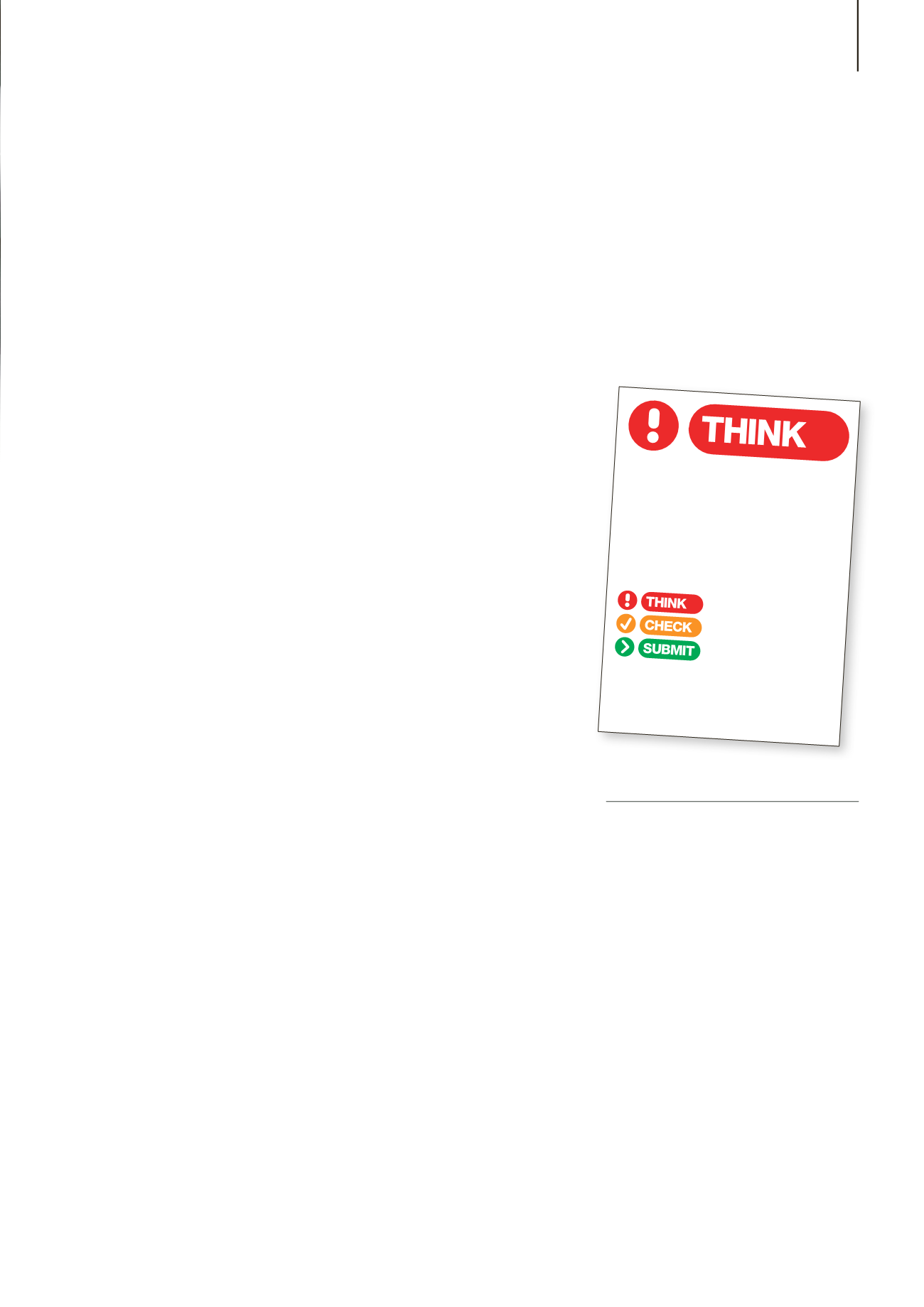
Are you submitting your
research to a trusted journal?
Publishing your research results is key to
advancing
your discipline
– and your
career
– but with so
many journals in your field, how can you be sure that
you’re choosing a
reputable
,
trustworthy
journal?
Take control of your career at
think
check
submit
.org
Tips to
confirm
a journal’s
credentials and decide if it
will help you
reach
the right
audience with your research,
and make an
impact
on
your career.
Poster from
thinkchecksubmit.orgunder
Creative Commons Attribution 4.0 licence