


 7 / 24

iNarrabri Magazine | 07
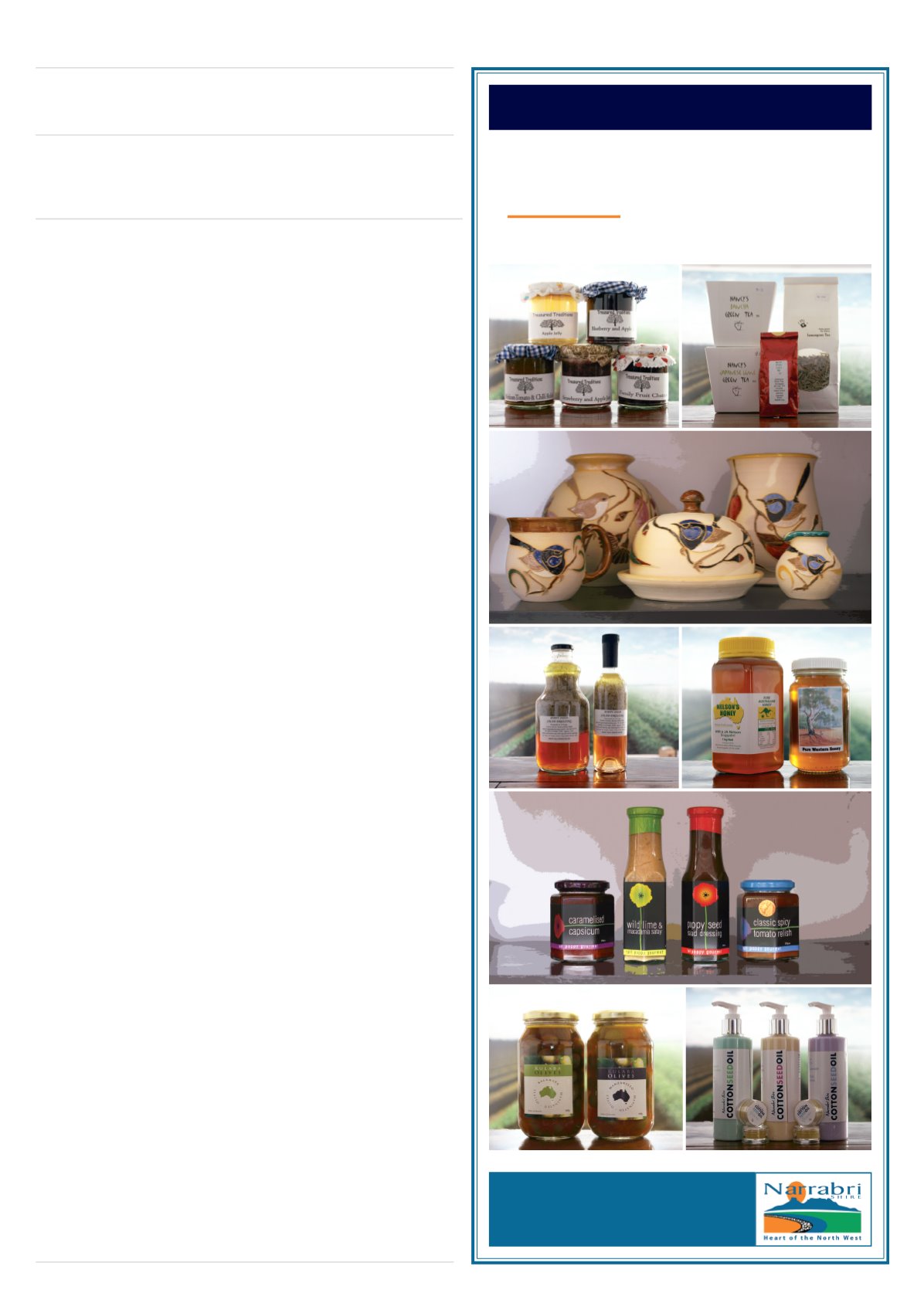
Narrabri Shire Visitor Information Centre
Open 9am - 5pm Weekends 9am -2pm 1800 659 931
www.visitnarrabri.nsw.coWith our extensive range of local gift ideas including boutique tea, lavende
cottonseed oil skincare products, soft toys and souvenirs, theVisitor Cen
ideal for all your Christmas shopping needs.
Open 9am -5pm. Weekends 9am - 2pm.
1800 659 931 |
www.visitnarrabri.nsw.gov.aulocal
gift ideas
SANTA
The legend of Santa Claus can be
traced back hundreds of years to
a monk named St. Nicholas. It is
believed that Nicholas was born
sometime around 280 A.D. in
Patara, near Myra in modern-day
Turkey. Much admired for his piety
and kindness, St. Nicholas became
the subject of many legends. It
is said that he gave away all of
his inherited wealth and travelled
the countryside helping the poor
and sick. Over the course of many
years, Nicholas’s popularity spread
and he became known as the
protector of children and sailors.
The name Santa Claus evolved
from Nick’s Dutch nickname,
Sinter Klaas, a shortened form
of Sint Nikolaas (Dutch for Saint
Nicholas). In France, he was then
known as 'Père Nöel'; in Germany,
the 'Christ Kind'. In the early USA
his name was 'Kris Kringle'. Later,
Dutch settlers in the USA took
the old stories of St. Nicholas with
them and Kris Kringle became
'Sinterklaas' or as we now say
'Santa Claus'!
Different names for Santa
throughout the world include:
Indonesia - Sinterklass
In Brazil - Papai Noel & Bom
Velhinho (Good Old Man).
In France - Père Noël (Father
Christmas). In eastern France he is
accompanied by Le Pere Fouet-
tard, a man dressed in black.
In Japan -santa-san (Mr Santa).
In the Philippines - 'Santa Klaus'
In Pakistan -'Christmas Baba'.
In the Basque country (which
is a part of northern Spain and
southern France), on Christ-
mas Eve, children's presents are
delivered by a magical man called
Olentzero
REINDEER
The reindeers were first given
their names in 1823 when the
famous poem 'A Visit from St.
Nicholas' or 'T'was the Night
before Christmas', was published.
Dr Clement Clarke Moore later
claimed that he had written it
for his children. However, some
scholars now believe that it was
actually written by Henry Living-
ston Jr, who was a distant relative
of Dr Moore's wife. The poem
describes eight reindeer and gives
them their names.
They became really well known
in the song 'Rudolph the Red
Nosed Reindeer', written in 1949.
Rudolph was added to Santa’s
reindeer team on one Christmas
Eve during a bad snowstorm.
Santa’s 8 reindeer could not see
to fly through the storm. Rudolph
with his glowing red nose lit the
way for Santa’s sleigh. The eight
reindeer are: Donner, Dancer,
Dasher, Blitzen, Cupid, Prancer,
Vixen and Comet.
CHRISTMAS TREE
The evergreen fir tree has tradi-
tionally been used to celebrate
winter festivals (pagan and
Christian) for thousands of years.
Pagans used branches of it to
decorate their homes during the
winter solstice, as it made them
think of the spring to come. The
Romans used fir trees to decorate
their temples at the festival of Sat-
urnalia. Christians use it as a sign
of everlasting life with God.
Nobody is really sure when fir
trees were first used as Christmas
trees. It probably began about
1000 years ago in Northern Eu-
rope. Many early Christmas Trees
seem to have been hung upside
down from the ceiling using
chains (hung from chandeliers/
lighting hooks).
According to Christian lore, the
Christmas tree is associated with
St Boniface and the German
town of Geismar. Sometime in St
Boniface's lifetime (c. 672-754)
he cut down the tree of Thor in
order to disprove the legitimacy
of the Norse gods to the local
German tribe. St. Boniface saw
a fir tree growing in the roots of
the old oak. Taking this as a sign
of the Christian faith, he said "...
let Christ be at the centre of your
households..." using the fir tree as
a symbol of Christianity.
christmas icon origins
Do you know the name for Santa Claus in Pakistan? Can you name
Santa's original eight reindeer? What has Thor got to do with the
legend of the Christmas Tree? For these answers and more, read on.
Feature