


 28 / 64

Quality Practice
28
Inside News
Children are more sensitive to the
effects of radiation because their bodies
are still developing and the use of
CT scans in children has been linked
to a slight increase in the chance of
developing cancer later in life
1
. It is
estimated that more than 80,000 CT
scans are performed on people under
the age of 20 each year in Australia
2
.
The Australian Commission on Safety
and Quality in Health Care (the
Commission) and the Western Australian
Department of Health have developed
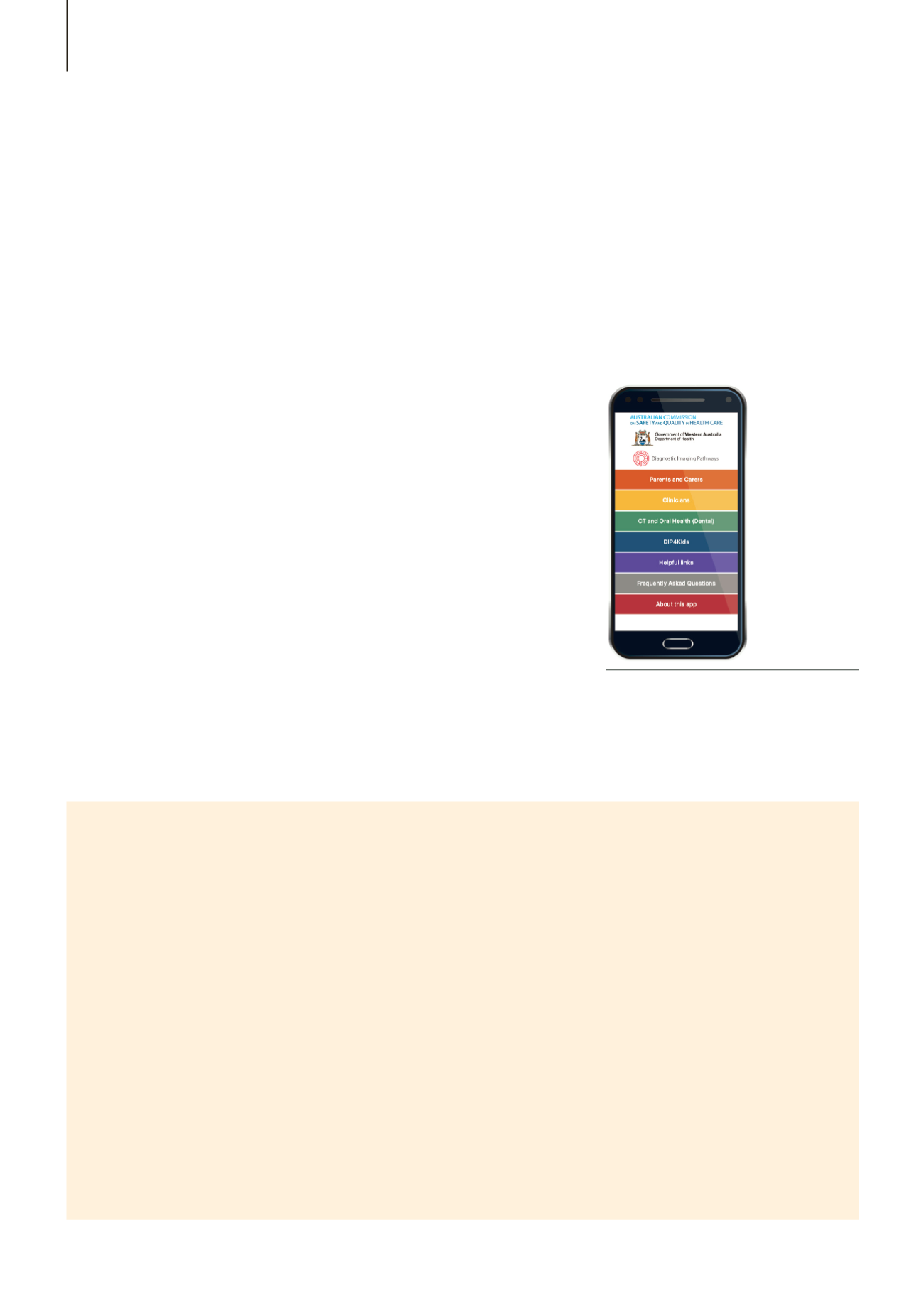
the DIP 4 Kids app to support a
reduction in unwarranted exposure to
radiation from CT scans for children.
The DIP 4 Kids app supports clinicians
in evidence-based decisions about
imaging options for young people
and children, including when to
use CT scanning. The app provides
clinicians and parents and carers with
assistance in decisions on paediatric
CT for over 20 clinical conditions and
injuries occurring in children and young
people, and provides links to a range
of other resources developed by the
Commission. It also includes information
on the level of radiation used by each
imaging type.
The app was developed by the
Commission, in partnership with the
Western Australian Department of
Health, and is based on the paediatric
decision aids in the Department’s
Diagnostic Imaging Pathways (DIP).
The DIP 4 Kids app is free and can be
downloaded from the app store on
iTunes or from Google Play.
More information on reducing radiation
exposure to children and young people
from CT scans, is available at: www.
healthdirect.gov.au/ctscansforkids.New App Supports Reduction
of Radiation Exposure from
CTs for Children
1
Mathews JD et al. Cancer risk in 680,000 people
exposed to computed tomography scans in
childhood or adolescence: data linkage study of
11 million Australians. BMJ.2013;346:2360.
2
2013/14 Medicare data. Figures include cone
beam CT used by dental practitioners.
‘Appropriateness’ is a hot topic in relation to medical
imaging. In essence, it is about providing the right test
or procedure to the right person at the right time in
a safe, efficient, and cost-effective manner. It is about
the patient, and sometimes the community in general,
receiving a net health benefit from the procedure.
• How do we define what is appropriate and who should
do that?
• Who is responsible for making decisions about
appropriate care when it comes to medical imaging?
• What are the best ways to change the culture,
behaviours and practices of the public, patients, referrers
and providers to improve appropriateness and thus
reduce expenditure that confers little health benefit?
• How can professional organisations that set standards
and governments that develop and enforce legislative
systems for healthcare delivery best influence
appropriate delivery of care that involves medical
imaging?
The answers to these questions are pivotal to the way
that the medical practice of clinical radiologists will
change over the next decade.
Get involved in the discussion and hear from a
multidisciplinary group of local and international
speakers on Saturday morning (8.30 am – 12.30 pm) at
the 2016 Annual Scientific Meeting.
Enrol when you register – attendance is free of charge
www.ranzcr2016.com/registration/Appropriate Use of Medical Imaging Forum
Saturday 15 October
at the Annual Scientific Meeting on the Gold Coast