


 5 / 64

Introduction
Volume 12 No 2
I
March 2016
5
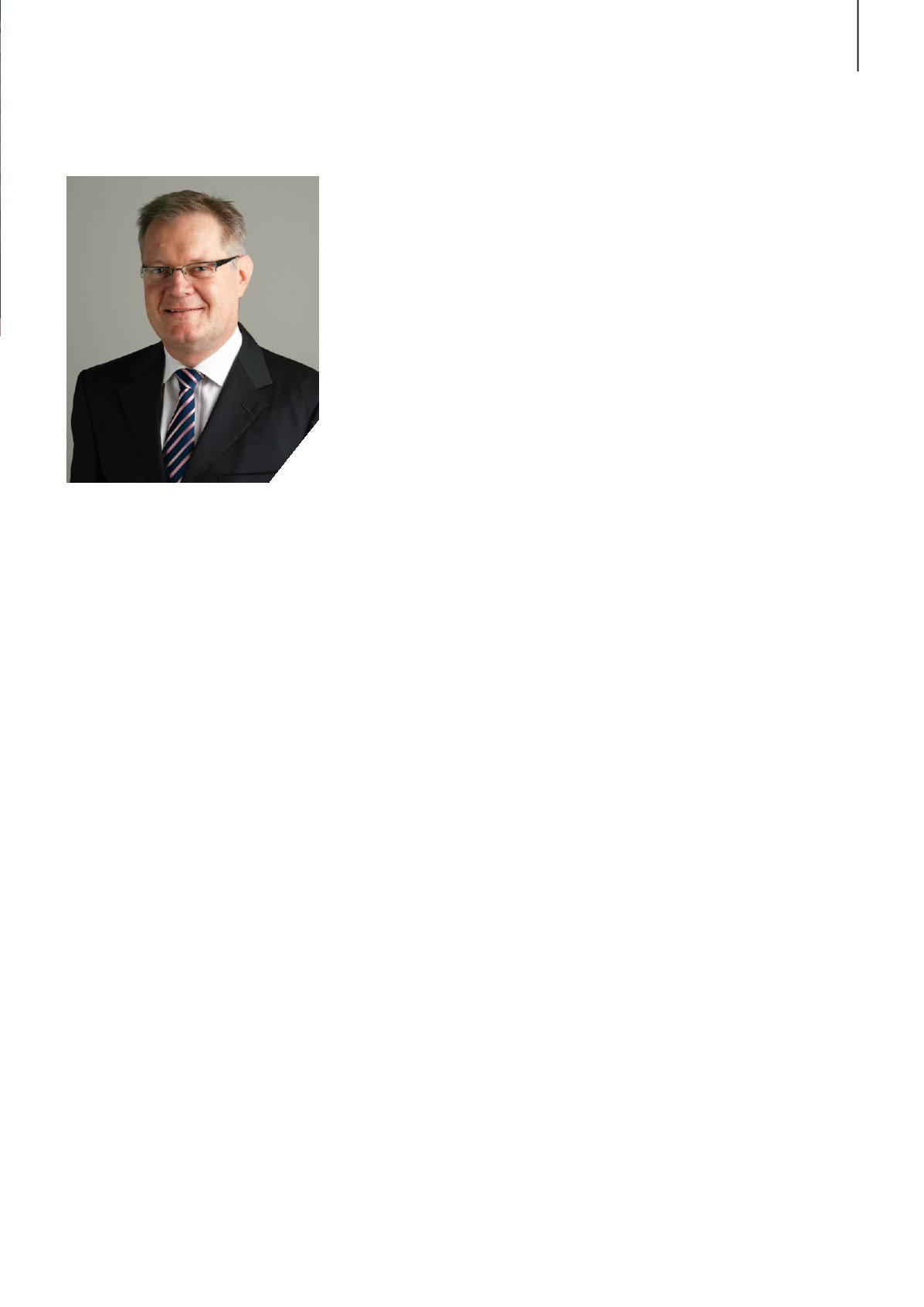
A Message
from the President
Dr Greg Slater
Last year, in my final message as Dean
of Clinical Radiology, I invited members
to take the time at year’s end to reflect
after a busy, exciting and occasionally
challenging year. I hope you did so and
you returned to work ready to take on
the opportunities and challenges that
2016 has in store for us.
As retiring Dean, I had plenty to reflect
on and, as the incoming President,
plenty to prepare for. A unique aspect
of my current role is the requirement to
represent all members for the next two
years and work with the Board across all
its activities.
In reflection, I came to the view that the
lesson of our 80-year history is two-fold:
first, the future is never as clear as it
seems; and second, as a stratagem for
managing uncertainty, working together
on common goals is the best way to
meet the challenges that lie ahead.
Some of you may be familiar with the
concept of stationarity. I don’t mean
the strict mathematical definition used
by statisticians but rather the broader,
philosophical assumption that the way
the world has changed in the past is
how it will continue to change in the
future. Stationarity is not the same as
standing still, rather a principle that puts
limits on how bumpy you can expect
the ride to be. It’s the assumption that
gives us terms such as a ‘one in 100
years’ flood and enables planners to
design infrastructure and services to
cope with extreme events. But change
is a slippery customer and many—
especially people working in areas such
as climate science, civil engineering,
design and economics—now believe
that stationarity doesn’t really work as a
guiding principle anymore.
Is stationarity also dead as a concept in
health and medicine? Can our health
planners and practitioners continue to
rely on the notion that the challenges we
will face in the future have predictable
impacts and will submit to solutions we
used in the past?
One thing is certain: our profession and
the healthcare system we serve faces
many challenges at this time.
Some, such as the MBS review, are
better understood than others, and
hence the impacts, however unsettling,
can be reasonably well anticipated.
But others are harder to grasp.
How well, for example, do we
understand the potential impacts
of the revived government plans to
privatise Medicare payments or,
closer to home, the recent cuts to
the Australian Clinical Dosimetry
Service and bulk-billing incentives
for diagnostic imaging and MRI?
These, and many others, are the
challenges that we face today, and they
remind me how uncertain the future has
become in our profession.
Can the College manage these
challenges? Yes, I believe so, and
we are well placed to do so. A lesson
we can take from the past is that our
founders were vigorous, committed
and focused in tackling big challenges.
They moved forward in uncertain times.
It is this spirit we need to strengthen
both within the membership and
beyond in those arenas where we
crave greater recognition.
If we work together on our common
goals and, as my predecessor put
it, ‘look outward with vision,’ we put
ourselves in the best position to cope
with the bumps on our journey and
ensure we get to our destination.
Looking ahead
in times of
uncertainty
“Working together
on common goals is
the best way to meet
the challenges that
lie ahead”