


 46 / 68

Clinical Radiology
46
Inside News
For many years, radiologists have
complained about our inability as a craft
group to gain government support. For
many years the problem was the same;
our tendency to splinter into special
interest groups which are not politically
relevant.
Finally, this has changed. In the recent
federal election, Australians made it
clear that they value bulk billing. They
want free health care, in and out of
hospital, which is in stark contrast to
what many diagnostic imaging patients
experience—low rates of bulk billing and
higher and higher gaps.
For the first time, diagnostic imaging—
under the “scans and tests” headline—
became politically relevant because bulk
billing was believed to be at risk.
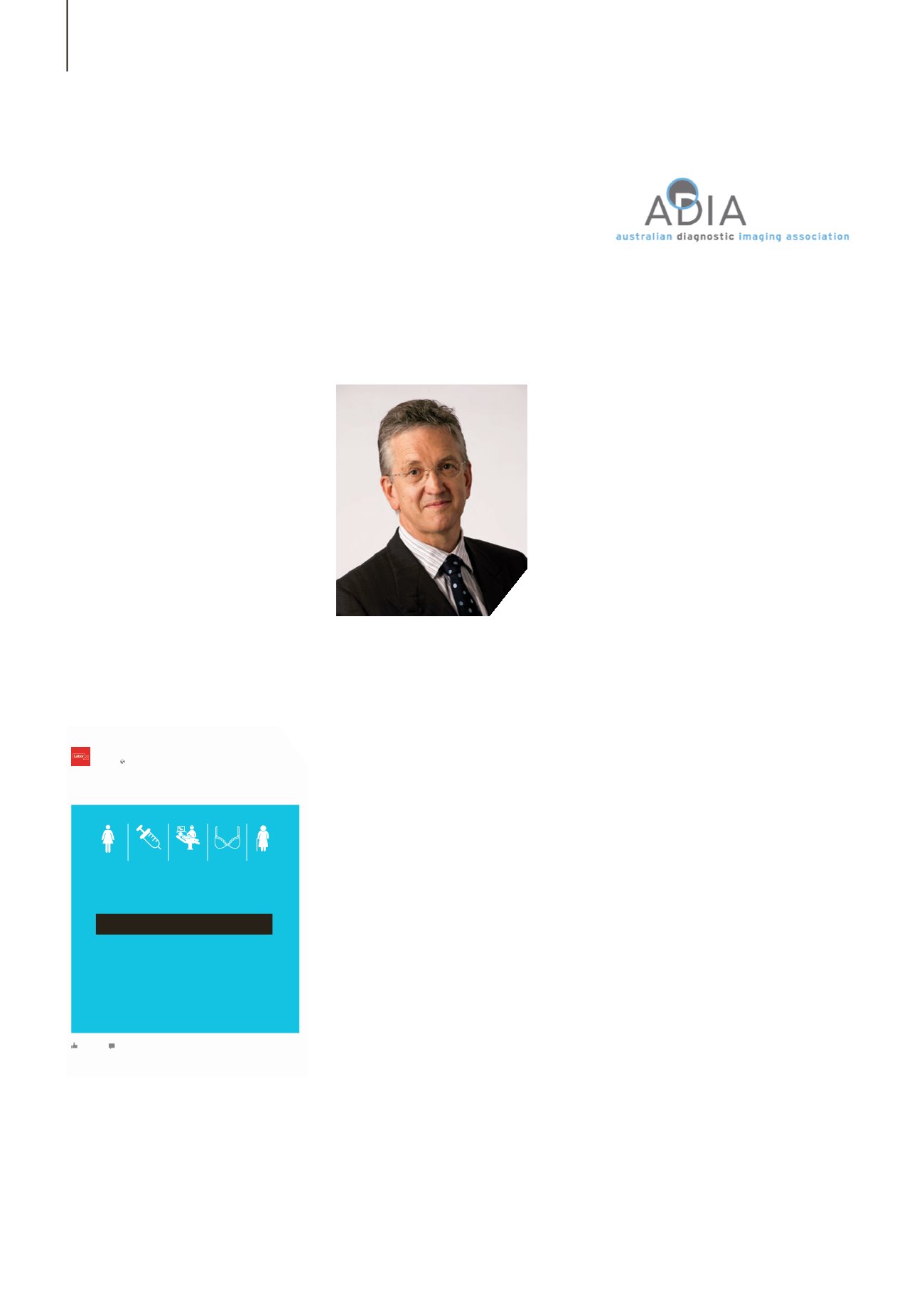
Mr Turnbull’s cuts to Medicare are set to push up costs for vital services
and have a devastating impact on women’s health. Labor will always
stand to protect Medicare.
Australian Labor Party
12 April ∙
Like
Comment
AUSTRALIAN WOMEN
CAN’T AFFORD
MALCOLM TURNBULL’S
$650 MILLION CUTS TO
TESTS AND SCANS
SHARE IF YOU THINK
THIS IS UNFAIR
PAPSMEARS BLOODTESTS ULTRASOUND MAMMOGRAMS X-RAYS
ADIA seized the opportunity to create
political headway and make meaningful
progress on issues important to the
sector. After many meetings with the
Health Minister Sussan Ley and her
office, the Prime Minister’s office and
other senior ministers, our arguments in
support of evidence-based policy were
recognised.
We achieved an agreement with the
Turnbull Government which ensures that
indexation of diagnostic imaging rebates
will resume when the current GP rebate
indexation freeze concludes. It will also
see the introduction of a long-awaited
Quality Framework, which is pivotal to
recognising the role of the radiologist as
a medical specialist.
The details of the agreement, announced
on 5 June, were published by the
Government, ADIA and RANZCR and are
available on ADIA’s website.
Of course, this outcome was only
possible due to the years, not months,
of collaboration, engagement and
trust between RANZCR and ADIA. In
particular, we would like to thank the
RANZCR President, Dr Greg Slater, Dean
of the Faculty of Clinical Radiology, Prof
John Slavotinek, as well as the College
management team including Mark
Nevin and Andrew Paine led by Natalia
Vukolova as CEO.
When challenged, all stakeholders
stood unanimously behind the Quality
Framework and the need for indexation
when the freeze was lifted on GPs.
We were united in our indignation when
Labor leader Bill Shorten referred to
medical specialists and didn’t include
radiologists. United, we will continue to
defend radiologists as medical specialists
with a vital role to play in the nation’s
health—a position supported by newly
reappointed Health Minister, Sussan Ley:
“Advancing technology in many areas of
the health system creates a much more
efficient and automated service, leading
to decreased costs. However this is not
the case for most diagnostic imaging
services which need specialist doctors to
supervise the examination and analyse
the results, not machines.”
Minister Ley played a crucial role in the
government’s commitment on diagnostic
imaging policy, and we are looking
forward to working with her to implement
what was agreed.
As a craft group and a health care sector,
this commitment by the government
provides us with a sound base from which
to continue our joint push for policies and
funding which support access to quality
radiology services for all Australians.
This is great news for radiologists and our
patients.
Dr Christian Wriedt
ADIA President
ADIA Update
United Stand
Dr Wriedt