


 41 / 68

Clinical Radiology
Volume 12 No 4
I
September 2016
41
A Message
from the Dean
Medicare Reforms in Australia
Last month I attended the Diagnostic
Imaging Advisory Committee meeting
in Canberra. Following the re-
election of the Turnbull Government,
as promised during pre-election
campaigning, the government
will progress implementation of
the Quality Framework measures.
Further consultation will follow on the
recommended path to implementation
which has been substantially influenced
by RANZCR and ADIA. The agreement
by government to re-instate indexation
of diagnostic imaging rebates when the
rebate freeze for general practitioners
ends is also most welcome and
represents a major achievement due
to joint advocacy by RANZCR and
ADIA. We will continue to share key
developments with members as they
arise.
Telehealth Standards in
New Zealand
The Medical Council of New Zealand
(MCNZ) has recently published its
revised Telehealth Standards which
govern telehealth both within and
beyond New Zealand’s borders. The
Faculty responded to outline the
provision of telehealth within the clinical
radiology setting and provided key
principles which should be adopted
to safeguard patients. We continued
to engage with the MCNZ, partner
medical colleges and the NZ Medical
Association right up to publication of
the revised standards. Several of the
Faculty’s recommended changes have
been included, however we are still
working through the implications of the
new standards, particularly in relation to
how the registration requirements will
work. The new Telehealth Standards are
available on the MCNZ’s website and
I encourage all Fellows to have a look
www.mcnz.org.nzChoosing Wisely
I would like to report back to members
that as one of the founding members,
RANZCR is provided with an opportunity
to comment on draft Choosing
Wisely recommendations from other
colleges and societies. We recently
worked closely and productively
with The Royal Australian and New
Zealand College of Obstetricians and
Gynaecologists (RANZCOG) on one of
their recommendations which relates
to diagnostic imaging and the place
of point of care ultrasound in obstetric
care. The final recommendation aligns
with RANZCR’s view on the distinction
between referred ultrasound and point
of care. I am grateful to Prof Stacy
Goergen, Chair of the Safety, Quality
and Standards Committee for her
assistance during this engagement with
RANZCOG.
Education Modules on
Appropriate Imaging
I had the pleasure of contributing to
the successful launch of education
modules and a phone app to support
appropriate referrals for diagnostic
imaging at the Royal Adelaide Hospital
last month. The education modules are
targeted to medical students and junior
referring doctors and the phone app
assists referring doctors at the point
of care. At this time it is anticipated
that the educational modules will
be incorporated into the curriculum
of medical schools at Adelaide and
Flinders Universities. I am grateful to
Prof Stacy Goergen and A/Prof Taryn
Bessen for leading the successful
presentation. This activity is part of a
joint initiative between RANZCR and
Choosing Wisely and follows on from
other such activity interstate. This
process also illustrates how the work of
the College and its Fellows can help to
shape appropriate and judicious use of
medical imaging in the future. I would
encourage Fellows with an interest to
seek to do likewise in their Branches. If
you would like to know more about this,
please contact jessica.brown@ranzcr.
edu.au.
Upcoming Annual
Scientific Meeting
I am very much looking forward to the
upcoming Annual Scientific Meeting
(ASM) at the Gold Coast. The ASM
Committee and convenors have put
together an exciting program of
speakers with national and international
leaders in both clinical radiology and
radiation oncology. I am particularly
looking forward to the Appropriate
Imaging Forum which will showcase
the work to date of the College in this
critical area of medical practice. The
forum will bring together policymakers,
regulators, public health academics,
consumers and clinicians to discuss ways
we can work together by using medical
imaging appropriately to improve the
health of our community.
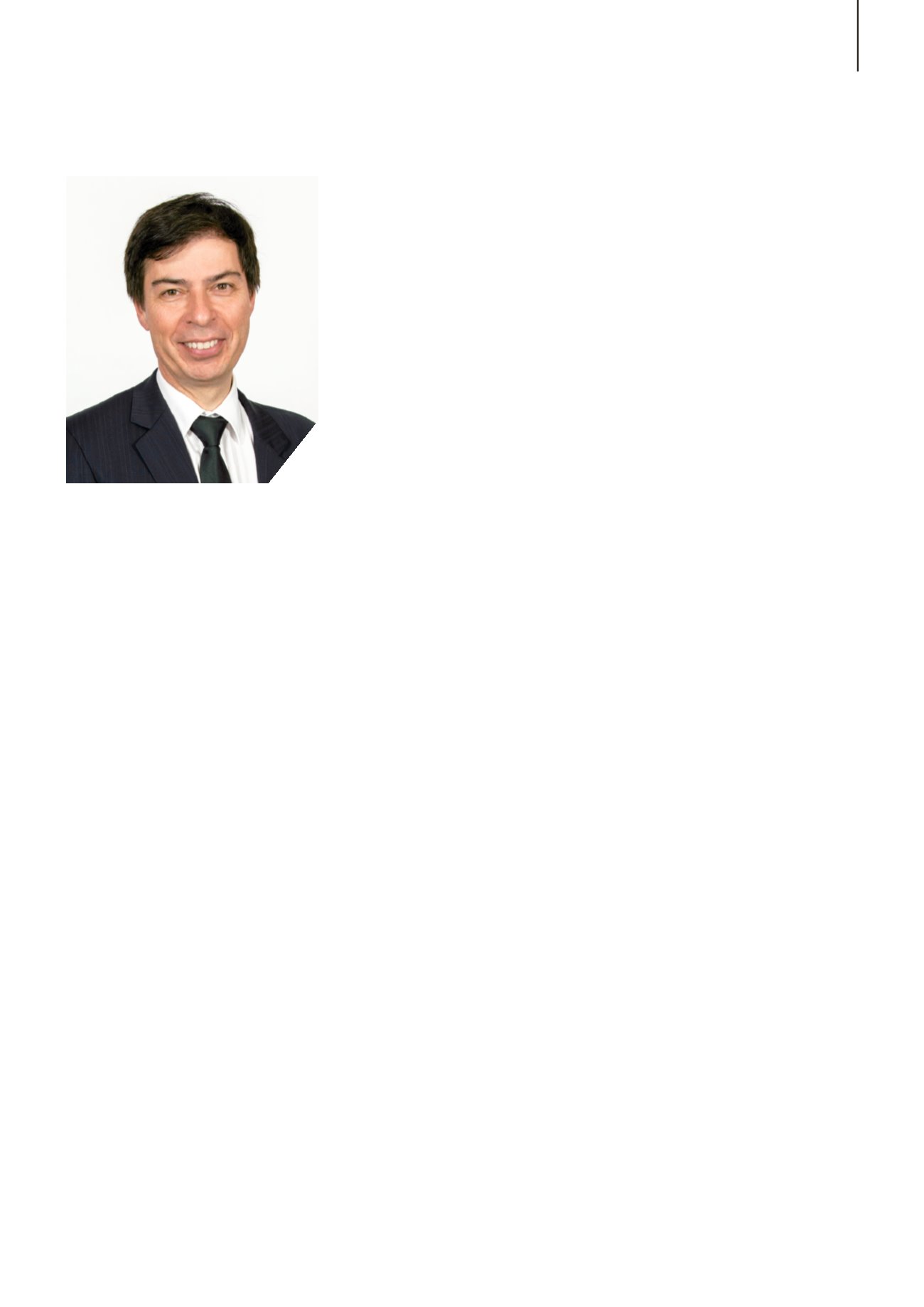
Prof John
Slavotinek