


 210 / 216

206
Copyright © 3P Learning – These resources have been created in partnership with Dr. Marian Small.
For more information visit
www.mathletics.comQuestions to facilitate the learning
•
How did you figure out your other expression?
•
Is it worth the same as 2
x
+ 3 for other values of
x
? Why or why not?
•
How does your model show that the expressions are equal when
x
= 10?
Scaffolding the learning
•
What is the value of 2
x
+ 3 when
x
= 10?
•
How else can you get 23 starting with a different number, not 10? How could you write what you
described in words as an algebraic expression?
Extending the learning
Students might explore how the choices of expressions that are equal to 2
x
+ 3 when
x
= 10 are alike and
different from those that are equal to 2
x
+ 3 when
x
= 20.
What’s the point of this task?
It is essential for students’ algebraic development that they realise that different expressions can be worth the
same amount when they are evaluated. In fact, solving an equation like 2
x
+ 3 = 3
x
+ 5 is a way to determine
when the two expressions 2
x
+ 3 and 3
x
+ 5 are worth the same.
Students might come up with expressions like 3
x
– 7 or
x
+ 13 or
x
2 + 18 which are worth the same as 2
x
+ 3
when
x
= 10, but not for other values of
x
. Other students might use an expression like
x
+ (
x
+ 3) or
(4
x
+ 6)
2
which are other names for 2
x
+ 3 and are not only the same as 2
x
+ 3 when
x
= 10, but for all values of
x
.
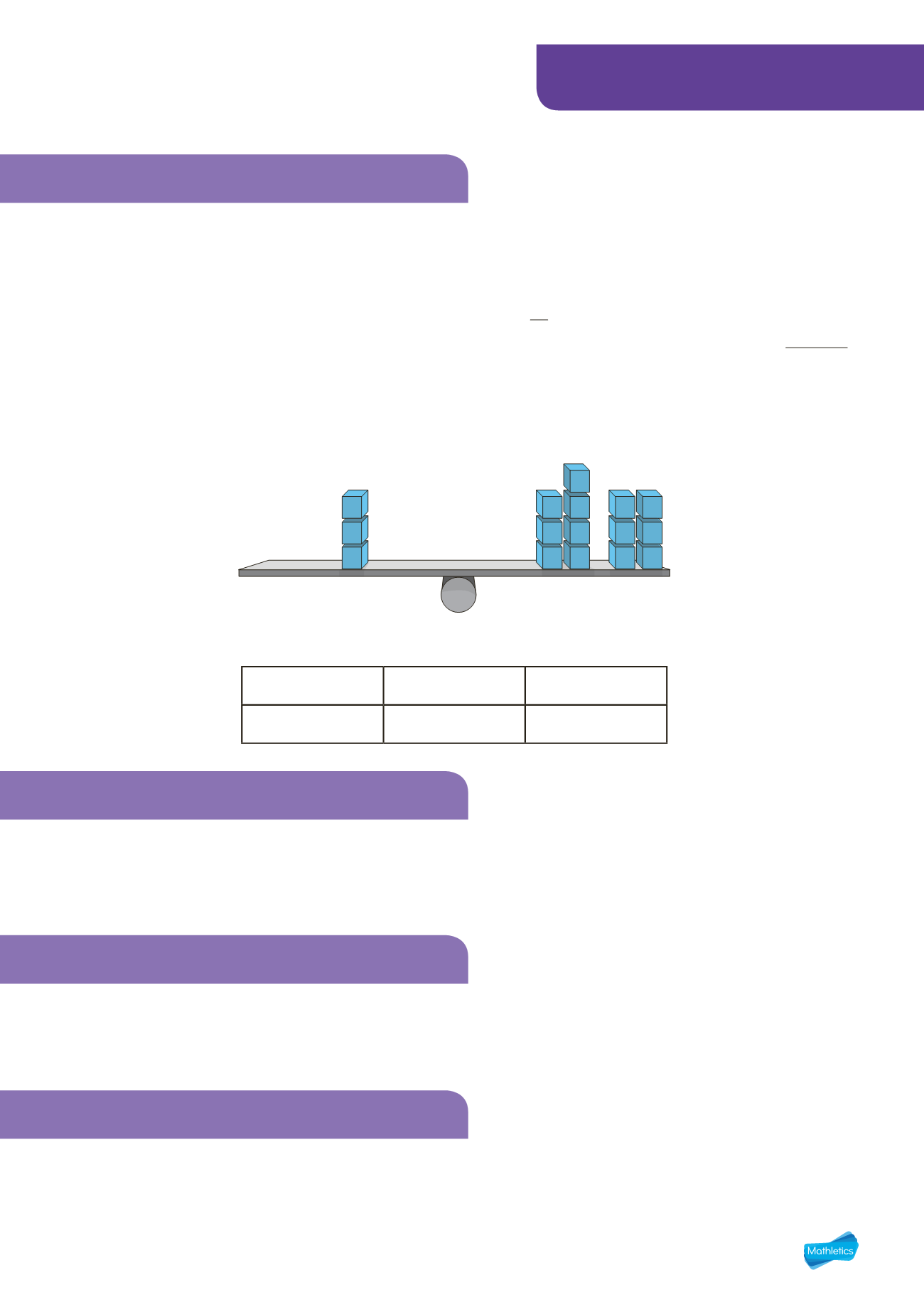
The use of the models is to help students see that algebraic equalities can be modeled visually. For example,
2
x
+ 3 =
x
+ 13 when
x
= 10 since the only way the sides below balance is if there are 10 cubes in each bag.
Equal for 10
2
x
+ 3 =
x
+ (
x
+ 3) since the two lengths are the same.
x
x
3
x
x
3
Patterns and Algebra