


 207 / 216

203
Copyright © 3P Learning – These resources have been created in partnership with Dr. Marian Small.
For more information visit
www.mathletics.comQuestions to facilitate the learning
•
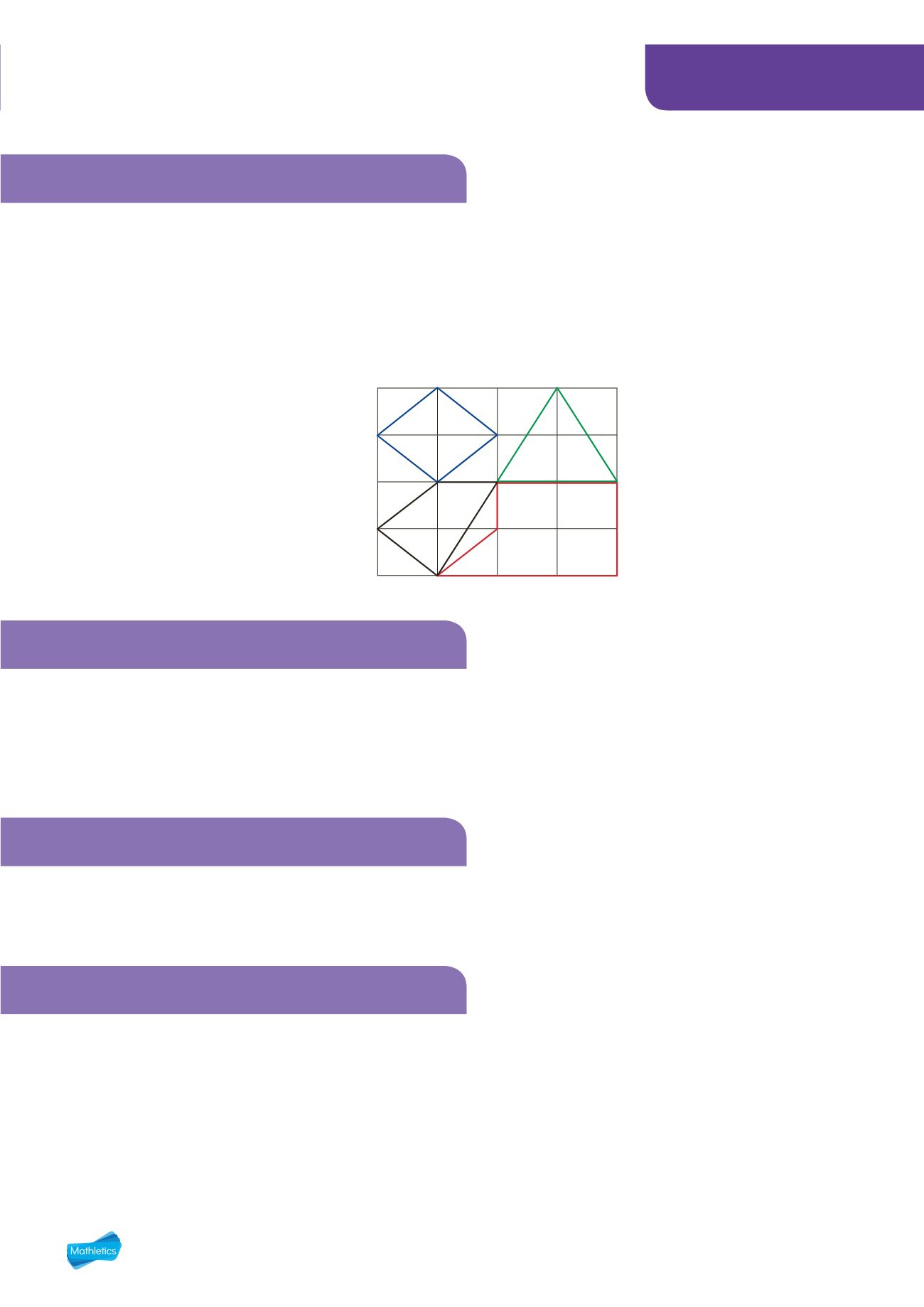
How were the shapes you created alike? How were they different?
•
Would a 5-sided shape be possible? If not, why not? If so, what would it look like?
•
What did you notice about the number of pegs on the boundary of your shapes?
•
What did you notice about all the areas?
Scaffolding the learning
•
How do you know that your shape cannot be too big?
•
Could your shape be a rectangle with horizontal and vertical sides? Why or why not?
What’s the point of this task?
Although most area formulas that students meet involve the use of lengths, widths, bases or heights of
shapes, there is an area formula related to shapes on grids that never mentions these sorts of dimensions.
It is called Pick’s (or Pic’s) formula and it says that the area of a shape on a geoboard is calculated by
dividing the number of pegs on the perimeter by 2, adding the number of inside pegs and subtracting 1.
Because the problem is set up requiring the number of inside pegs to be 1, the combined area of all of the
shapes for this task will be half of the number of pegs on the perimeter.
There are several possible shapes, not just one.
Extending the learning
Students might create shapes with exactly 2 pegs (or 3 pegs) inside and see how the areas do or do not
change from when there is 1 peg inside.
Predicting Area
Measurement