


 78 / 216

74
Copyright © 3P Learning – These resources have been created in partnership with Dr. Marian Small.
For more information visit
www.mathletics.comShape Puzzle
Questions to facilitate the learning
•
How did looking at the corners of the big shapes help you choose what went where?
•
The four separate shapes have 16 sides. Why don’t the combined shapes have 16 sides?
•
There were square corners in some of the original shapes. Why didn’t there have to be square corners in
the combined shape?
•
Was it easier to see where the triangles, the parallelogram or the square fit? Why do you think that?
Scaffolding the learning
•
Do you see the parallelogram inside the big shape? Where?
•
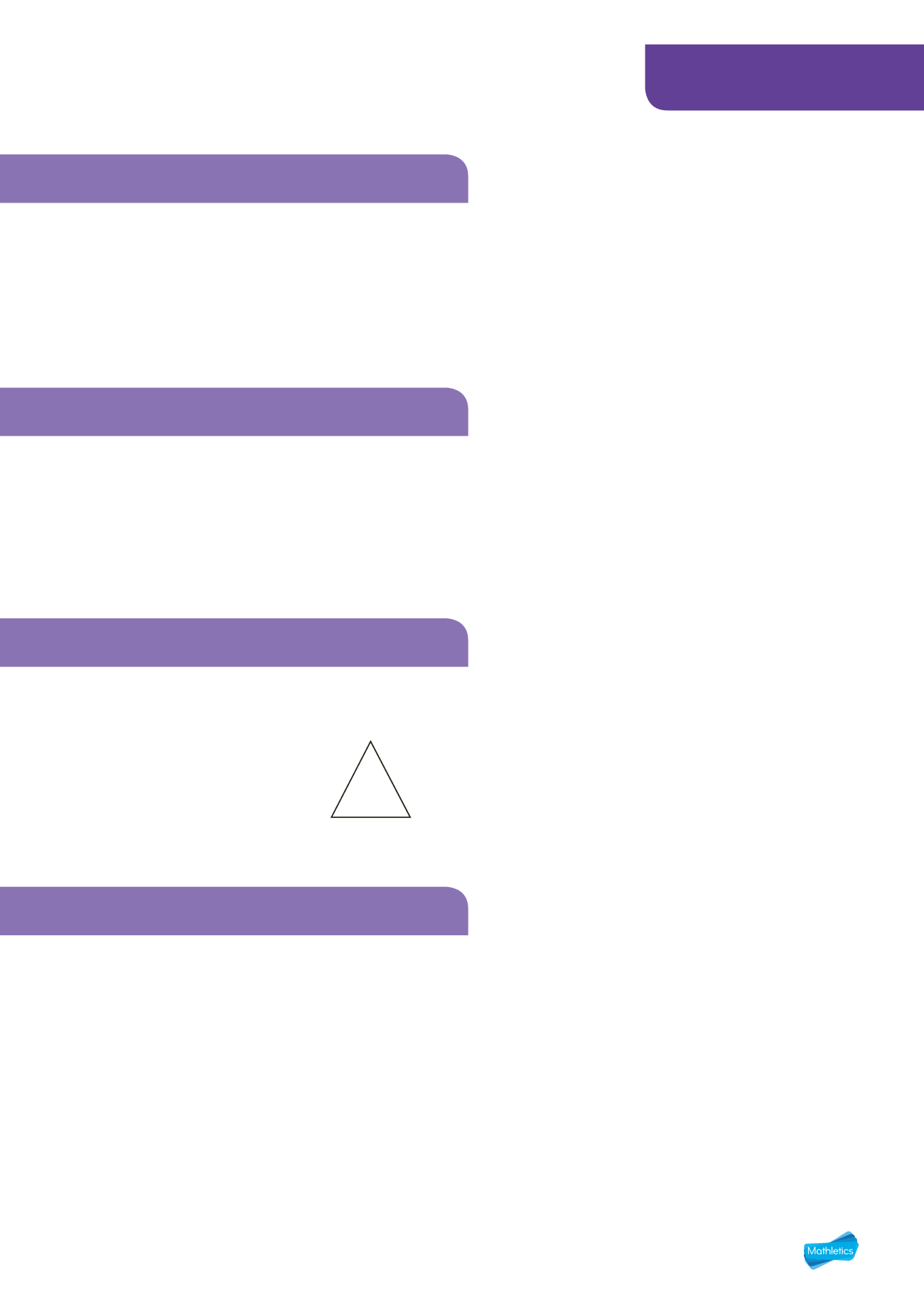
Do you see this triangle [point to the triangle shown below] inside the big shape? Where?
•
Maybe you could turn the shape or flip it over. Does that help you see it in the bigger shape?
Extending the learning
Two students might each use the four pieces to create their own puzzles for each other to try to figure out.
What’s the point of this task?
Students gain an opportunity to see how shapes can be fit together to create other shapes—a very
important geometric skill. They also observe that even if a shape is turned or reflected, it does not change
its size or its proportions.
Simple shapes were used as puzzle pieces to help students see that even very simple shapes can be
combined to create quite complex shapes. Some of the composite shapes make some placements easy
to see and some are not as obvious, to allow for better differentiation of instruction.
Geometry