


 82 / 216

78
Copyright © 3P Learning – These resources have been created in partnership with Dr. Marian Small.
For more information visit
www.mathletics.comWhat Goes Where?
Questions to facilitate the learning
•
What could be true about a square and a triangle that might make them belong together, other than colour?
•
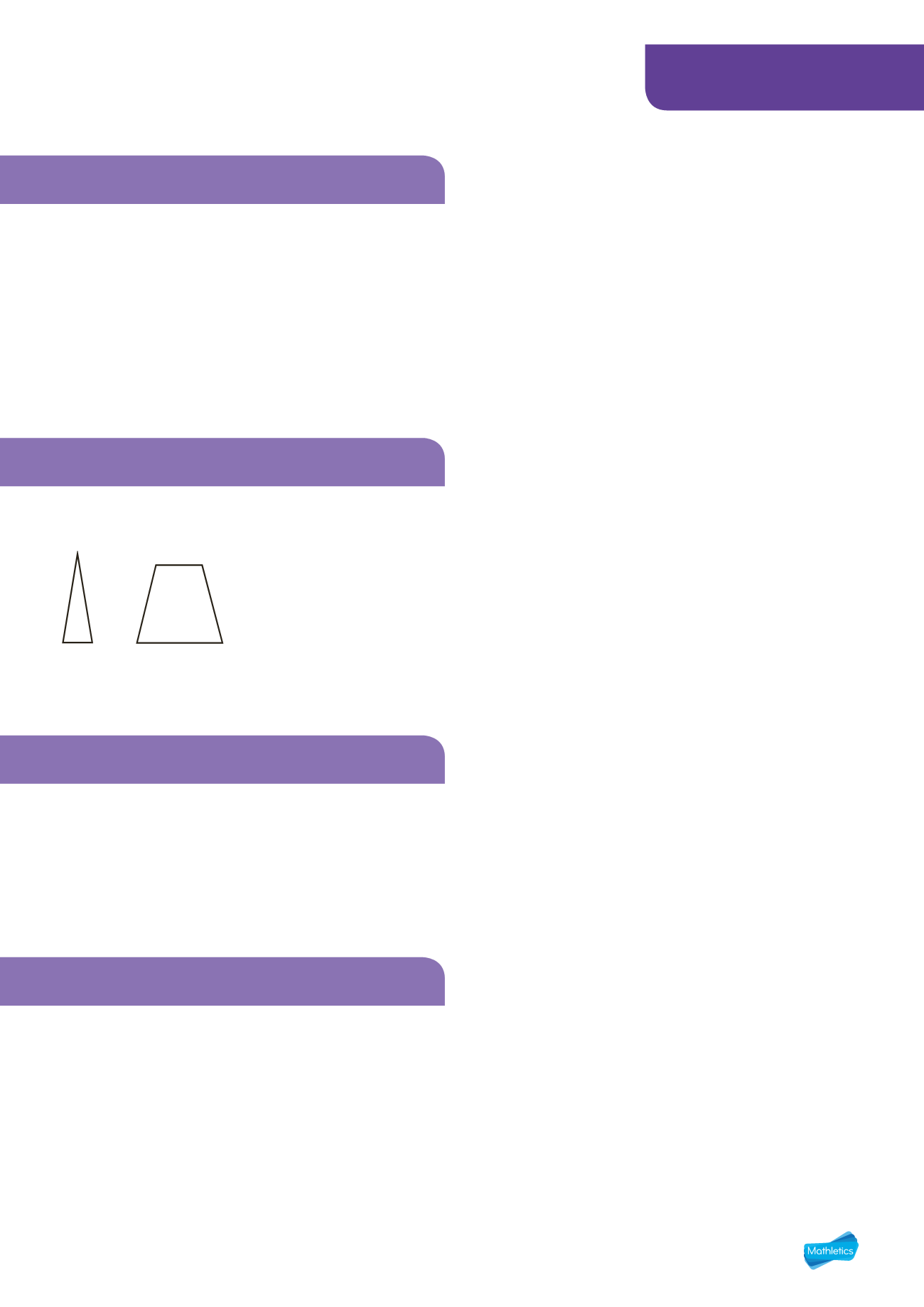
[Point to the shapes below.] Why might these two shapes belong together other than colour?
•
Which shapes have names you know? Does knowing the name of a shape help you figure a way to label
the circles in the graph? How?
Scaffolding the learning
•
Why couldn’t one circle include only yellow shapes and one circle include only red shapes?
•
Choose any shape you like. Find another shape that is like it in some way other than colour or size.
What makes them alike? How would you label the circle if you put them both in it?
•
What do you notice about the angles of the shapes that might help you decide which shapes
belong together?
Extending the learning
Students might choose two of these geometric attributes to sort shapes together and then create shapes
that fit all three parts of the two sorting circles .
Attribute choices:
There are exactly two equal angles.
There are exactly two equal sides.
There are no square corners.
There are more than five sides.
What’s the point of this task?
Students have a chance to use two attributes of their own choosing to sort a set of shapes. Many options
for attributes are available using the provided shapes, including having at least one equal angle, having
four sides and having at least two equal sides, as well as colour and size.
Students will need to realise that certain choices will not lead to shapes that would be listed in the
intersection of the circles; for example, they can’t choose one circle for yellow shapes and one for red or
one circle for shapes with no equal sides and one for shapes with at least some equal sides.
The use of the Venn diagram (the sorting circles) is not the only way to show a sort using two attributes,
but it is a useful graphic organizer for students to meet.
Geometry