


 26 / 32

26
Although the state of Western Australia was
settled in the late 1820s, nothing much
happened until gold was discovered, first at
Coolgardie in 1892 then in 1893 at
Kalgoorlie.
In the dry inland, the horse could be a
liability, so the bicycle became the popular
mode of transport, the new “safety bicycle”
being a much more practical cross-country
machine than the earlier “ordinary” or
penny-farthing.
This is the point in history at which Graeme
Cocks takes up the story of the “Red Dust
Racers” in this weighty tome (around 3½ kilograms in weight) that has taken him twenty
years to research. The cyclists and later motorcyclists and motorists were keen to show off
the speed of their machines and they soon found what seemed to be the ideal location, a few
miles up the road at a clay pan known as Lake Perkolilli.
The dry lake stretched for one and a quarter miles (2.1 kilometres) long by about a mile (1.6
kilometres) wide and provided a dead flat surface that was perfect for high speed running.
To quote Graeme’s introduction: “The rock hard surface was a revelation. They could hurtle
across the landscape with a freedom that had not experienced before. There were no limits.
The rider or driver could be totally at one with the machine. There were no crossings, no
police, no horses or camels to get in the way, no brick walls or picket fences to run into, no
tram [trolley] tracks to get caught in. It was just the cacophony of the machine, the smooth
surface of the clay pan and the wind rushing past.”
Organised racing began at the lake in 1914 and Graeme covers the development of
motoring and motor racing in Western Australia that led to the Lake Perkolilli races. World
War I interrupted racing and some of the top racers didn’t survive the war, but racing
returned to the lake in the 1920s and continued into the 1930s.
At a mile and a quarter, the lake isn’t long enough for really high speed runs, but it is
certainly big enough to set up a circular track and that’s what happened. Circular tracks of
up to two miles circumference were used at various times and a “Grand Prix” circuit with
hairpin bends was also marked out.
Apart from a solitary Bugatti, the leading cars were almost
all American chassis, and the car to beat from 1927 until
the early 1930s was Silverwings, a remarkable racer based
on a 1926 Chrysler 70. This car is well known to VSCCWA
members and it dominated racing at Perkolilli, driven by
Arthur Colliver, until Ossie Cranston created his Ford V8
special from a 1933 Ford. The Ford’s grill changed each year
to match the current model, and by 1935 it acquired long
tapered tail with a characteristic fin on top. Other quick
cars at Perkolilli included an Auburn straight eight and a
number of Overlands, a popular model on the goldfields.
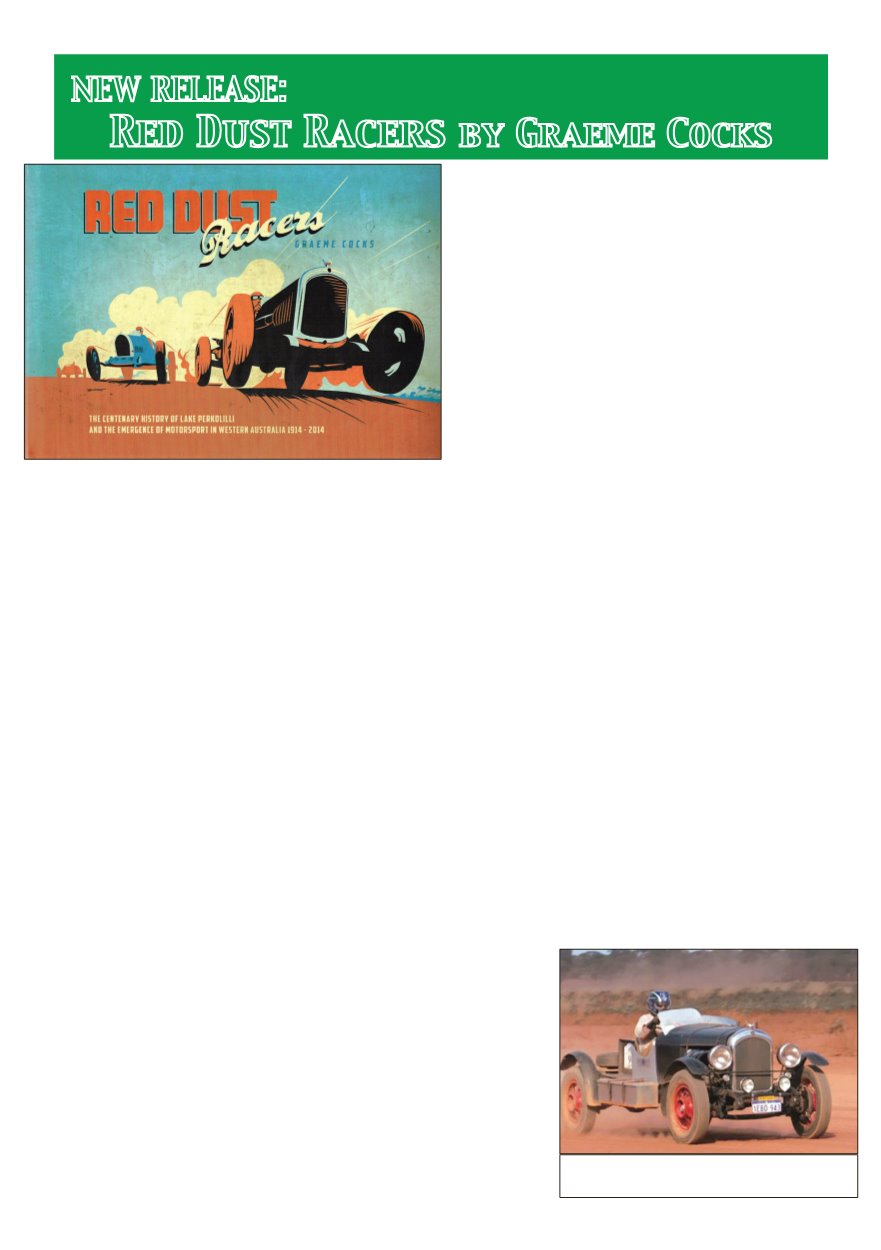
NEW RELEASE:
Red Dust Racers
by Graeme Cocks
The Silverwings replica on the
lake in 2014