


 22 / 32

22
From the Library
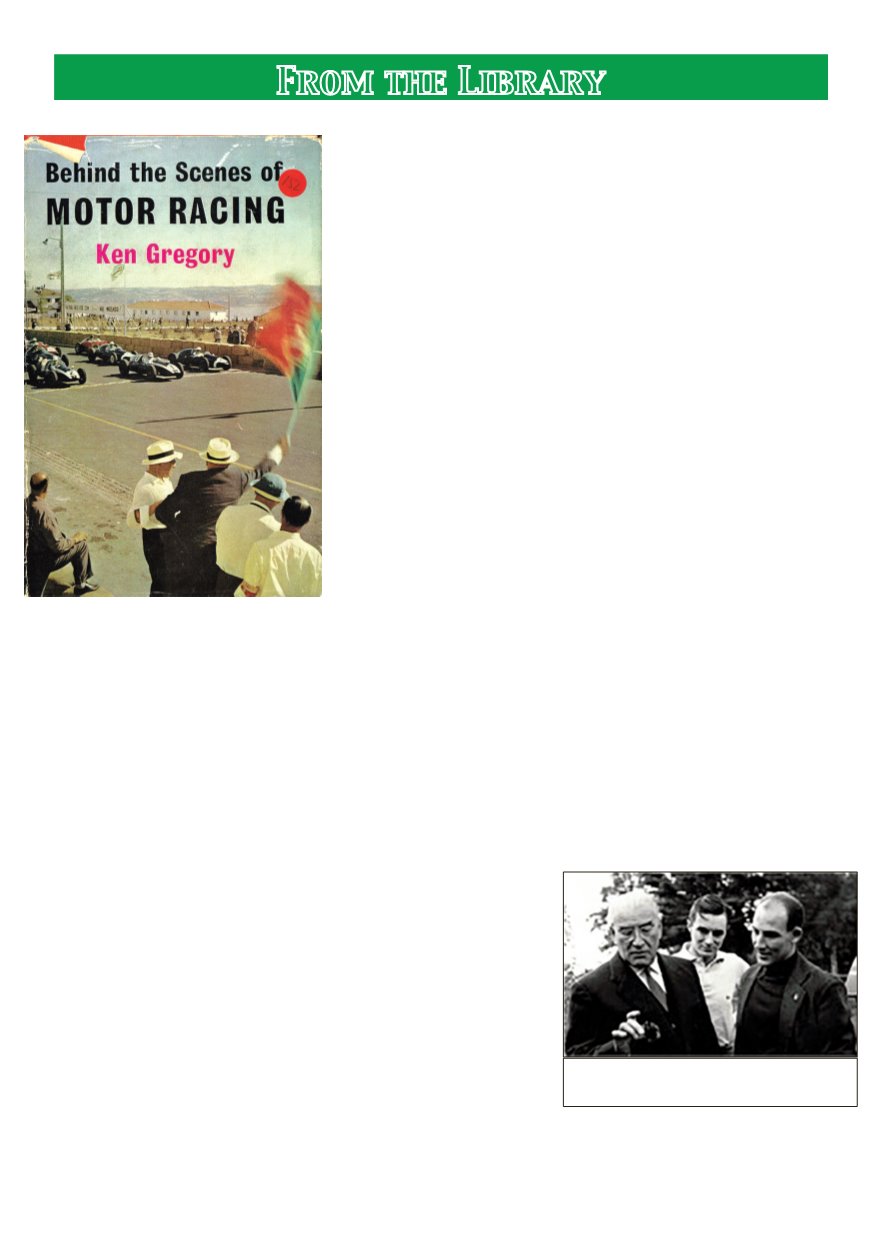
BEHIND THE SCENES OF MOTOR RACING by KEN GREGORY
Ken Gregory, born July 26 1926, died December 1 2013,
the author of this month’s reviewed book was known as
“Britain’s most famous racing manager” for his defining
role in the professional careers of Sir Stirling Moss and
Peter Collins; throughout the 1950s and 1960s he
developed the image of the racing driver as a brand, and, as
a Formula One team owner, helped introduce modern-day
commercial sponsorship into the sport.
Gregory first met Moss in 1949 via his involvement with
the Half-Litre Car Club (subsequently British Racing and
Sports Car Club), one of the major organising bodies of the
emergent 500cc Formula Three single-seater racing scene.
They bonded over a mutual interest in motorsport and
women; it also helped that Gregory secured the respect of
Stirling’s father, Alfred Moss, himself a former racing
driver.
The following year Gregory helped to organise the
inaugural car races at Brands Hatch, previously the
preserve of motorcycles, becoming the circuit’s director and
winning its Junior Championship in a Cooper Mark
IV-JAP. The 20-year-old Moss had been among the first to
inspect the circuit, and in November that year both men joined Jack Niell in an F3 Kieft
CK51-Norton at Montlhery, returning home with 13 international speed records. By 1951
Moss had made Gregory’s flat his London base, and the pair were travelling to races together
throughout Britain and on the Continent. Restlessly ambitious and facing an increasingly
busy schedule, Moss pressed Gregory to continue his organisational role on a more formal
basis.
Gregory’s acceptance marked the beginning of a new era in the history of the sport. Moss
was the first ever professional racing driver, in that his only income was from racing. He
explained. “That made me the first professional racing driver manager.” A co-founder and
director of Stirling Moss Ltd, established in 1954, Gregory was at the head of the publicity
machine that turned Stirling Moss into a household name.
He provided the press with quotes on Moss’s behalf and
vetted endorsements for maximum impact, most
memorably in the case of Craven A cigarettes, sales of
which rose dramatically in response to a series of
advertisements featuring the young driver. As Moss’s career
took him abroad for longer stretches Gregory increasingly
consulted Alfred Moss on key business decisions, investing
a considerable sum of Stirling’s own money – without his
prior knowledge – into the purchase of a Maserati 250F for
the 1954 GP season.
Within a year the move had paid off, Moss’s standing being such that Gregory was able to
secure him a crucial and highly lucrative contract with Mercedes-Benz as team-mate to Juan
Manuel Fangio. On July 17 1955 Moss drove the Mercedes-Benz W196 at the British Grand
Alfred Moss, Ken Gregory and
Stirling Moss