


 20 / 32

20
Brooklands debut in 1934.
Bill designed the car as a two-seater, “In case it was not fast enough, then I could use it to go
to and from work on the road.” The smoothly-rounded, aluminium body was left in
unfinished, polished alloy due to lack of money for paint! Weighing 545kg, it managed the
quarter mile in 15.5 seconds initially and later 14.2 seconds, and topped 193km/h.
Jennings developed the pushrod Riley from its initial 41 kW at Dixon's maximum 5000 rpm
to as much as 98kW at 6000 rpm by 1957,
with the greatest power increment coming
when Bill designed and fitted a new exhaust
system late in '56 to find an additional 22kW,
500 more revs and an extra 12km/h on
Killarney's main straight.
The Jennings Special's tubular chassis frame
used prop shafts as main chassis members,
an Austin A40 rear axle with A90 crown
wheel and pinion and lightweight Flat 1100
brakes. Front suspension comprised Morris
Minor torsion bars and Austin A90 brakes,
while telescopic shock absorbers were used
all round.
Bill's analysis of contemporary 'cart-sprung' specials led him to adopt a supple suspension
and ride and he attributed the Riley's reliability largely to the replacement of the four British
coarse- thread main bearing bolts with just two per rod, using Packard's American fine,
rolled-thread bolts. Ensuring that the engine breathed properly through carefully calculated
cam profiling and valve lift and effective exhaust extraction were among Bill's theoretical
skills, while steering geometry was another Jennings speciality.
Debuting in 1952, the Jennings-Riley package went on to take an unprecedented three
National Championships in 1954, 1956 and 1957 with third place in 1953 and second in
1955. Like Frank Brodie's MG Special, one of its main rivals, the Jennings-Riley was ultra
reliable and always meticulously prepared.
Competition was really tough with
several other top specials and
competitive drivers, who were also all
trying to outfox the handicappers. led
by the knowledgeable and highly
competent Frank Hoal. Frank told
how he had been caught out by Bill's
"only modification: a new exhaust
pipe". The result was two seconds a
lap faster!
Throughout our discussion, Bill gave
all credit to his car; he seemed not to
consider himself as an outstanding
driver. As teenagers and avid followers
of racing, my brother and I had been
enthralled by his soundly beating the
New Zealand Cooper-Climaxes and
Lord Louth's D-Type Jaguar in the
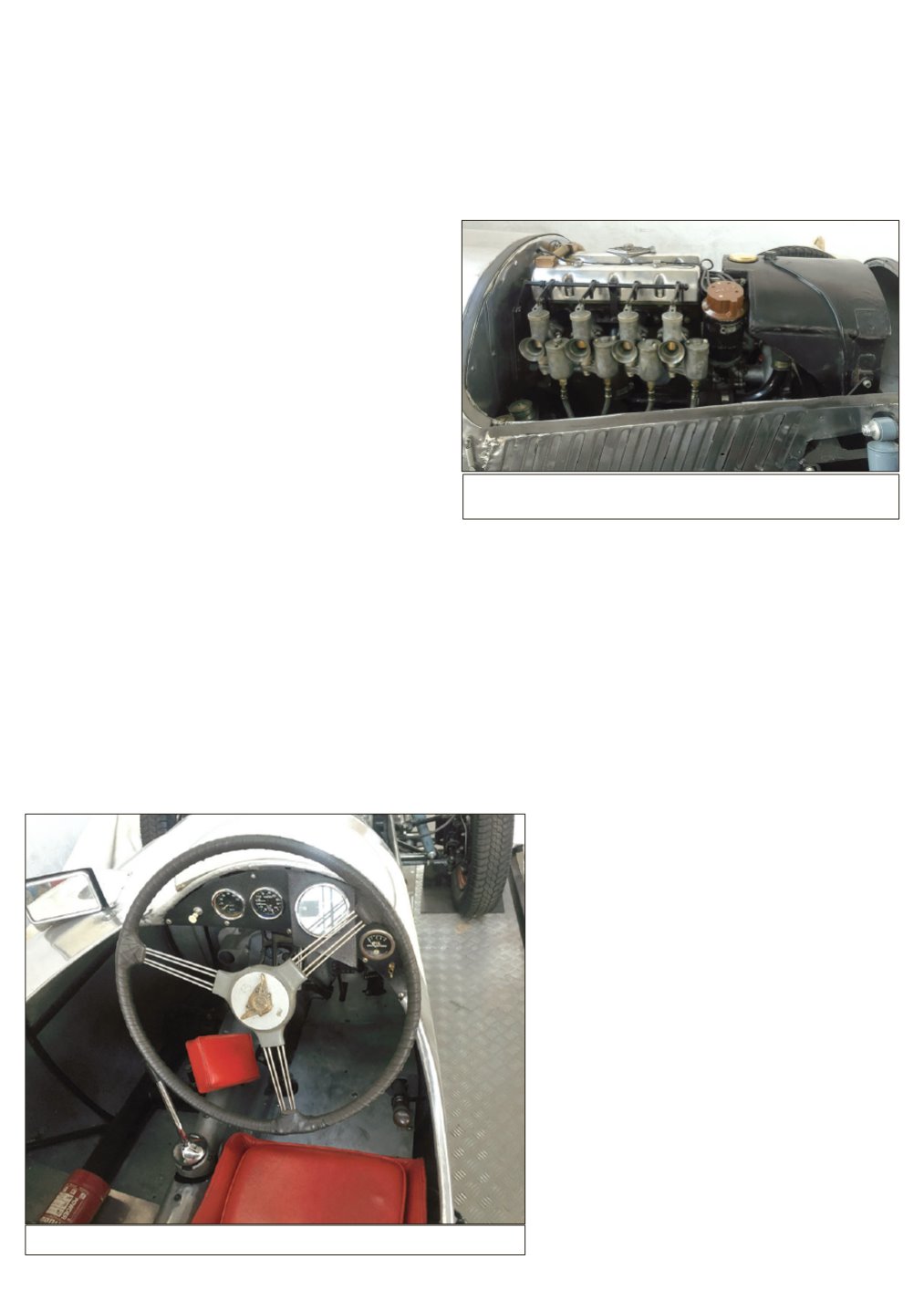
The Jennings Riley cockpit, a very tight two-seater
Four Amals and a Scintilla magneto showing the
Fredie Dixon influence