


 36 / 68

36
Australian Journal of Dementia Care
October/November 2016 Vol 5 No 5
the care of a person with young onset
dementia wish to be known as ‘supporters’
rather than ‘carers’. This term better reflects
the range of people in our study, who were
not always family members, and also
shows that many people regard themselves
as being in supportive partnerships as
opposed to dependent relationships. I see it
as a very positive term.
Translating into practice and policy
One of the strengths of the INSPIRED
study is that we used a mixedmethods
approach. This means that both
quantitative (eg severity scores on
dementia scales) and qualitative data (eg
people’s attitudes, care pathways) were
collected, and were used in an iterative
approach. Not only did we generate a lot of
data about each participant, but the data
we collected is very rich andmeaningful.
This can help to promote the translation of
research findings into policy and practice.
It is wonderful to see the National Young
Onset Dementia KeyWorker Program
working so well acrossAustralia and
helping so many people and I like to think
that The INSPIRED Study helped to play a
role in that.
We also recently presented data from our
study at the 2015 Senate inquiry into the
adequacy of residential care available for
relatively young people with severe
physical, mental or intellectual disabilities
inAustralia. Our quantitative prevalence
data gave the panel a feel for the size of this
group but the qualitative data helped us to
convey the lived experiences of our
participants. The panel members found
this very powerful and it helped them to
grasp the key issues and challenges for
young people with dementia going into
aged care facilities, either for respite or
more permanently.
Our study has led to recognition of the
diversity of support systems for people
with young onset dementia and their
unique needs. Some are living alone and
can be quite isolated, some are cared for by
older parents or by siblings, some have
young children who also need support,
andmany have partners who are still
working.
There is no ‘one size fits all’ model of
service provision or support. We know that
people need services that are flexible,
tailored to their needs and interests, and
allow them to be meaningfully engaged.
Although services for young people with
dementia are still relatively limited, we
have had the ability to advocate for a
consideration of this group within the
development of dementia service
frameworks.
INSPIRED data is also being used to help
guide health professionals in their
diagnosis andmanagement of this group.
One of our published papers has examined
care pathways for people with young onset
dementia, with a focus on the diagnostic
process. We found that there was often a
delay of more than two years from the
person and/or their supporter first
noticing symptoms before presenting for
their first consultation with a doctor; this
was more noticeable with our youngest
participants.
Nearly half of our participants were
initially given a non-dementia diagnosis;
predominantly depression or mild
cognitive impairment. The median time to
diagnosis for the group was three years
from the onset of symptoms.
Importantly, increased recognition is
needed of the importance of referring a
person for specialist cognitive assessment if
there is behavioural change or treatment-
resistant depression with an onset in the
40s or 50s. Clinicians also need to use the
term ‘mild cognitive impairment’ with
caution, as this is a research and not clinical
diagnosis and creates confusion for their
patients and supporters.
International importance
Internationally, there are relatively few
groups focusing on the experience of
dementia in young people. Australia, and
the investigators of the INSPIRED Study,
are at the forefront of young onset
dementia research.
We reported the first Australian
prevalence data for young onset dementia,
and this work is only one of a handful of
international studies examining the
epidemiology of dementia in young
people.
Comparison of our data with the other
main comprehensive studies conducted in
the UK and Japan has shown differences in
the types of dementia that are more
common in each country. This means that
different geographical regions might have
different risk factor profiles andmay
require individualised interventions
tailored to their country.
The International Psychogeriatric
Association (IPA) Young Onset Dementia
Shared Interest Forum, of which I’m a
member, recently met during the IPA
Congress in San Francisco. We are
currently planning an international Delphi
consensus study to establish consistent
terminology, principles of care, harmonise
assessments, and establish research
priorities. The findings of the INSPIRED
Study will help to inform this project.
What’s ahead?
It is an exciting time for the INSPIRED
Study. Our PhD student Monica Cations,
who is funded by anAlzheimer’sAustralia
Dementia Research Foundation
scholarship, has been focusing on
determining modifiable lifestyle and
environment risk factors for young onset
dementia.
Monica recently presented her findings
at The Alzheimer’s Association
International Conference in Toronto and
her pilot work has particularly indicated
the importance of early and mid-life
factors. In our planned larger study
(INSPIRED-II), for which we are about to
seek national funding, we are therefore
taking a lifecourse approach to
understanding dementia risk, including
factors such as childhood trauma and
stress. Importantly we are investigating
modifiable
factors that accelerate the young
onset of dementia, thus creating
opportunities to intervene to reduce a
person’s risk profile.
There is alsomuch to learn about the
impacts of concussions on later risk for
cognitive decline. We believe that there may
be an overlap between the behavioural and
cognitive signs observed in a relatively
small proportion of sportspeople exposed
tomultiple head knocks over the course of
their career and frontotemporal dementia,
particularly in associationwith
Parkinsonism. We will also consider the
impact of susceptibility genes such as
ApoE4, which canmodify a person’s
recovery from a head injury by promoting
neuroinflammation, for example.
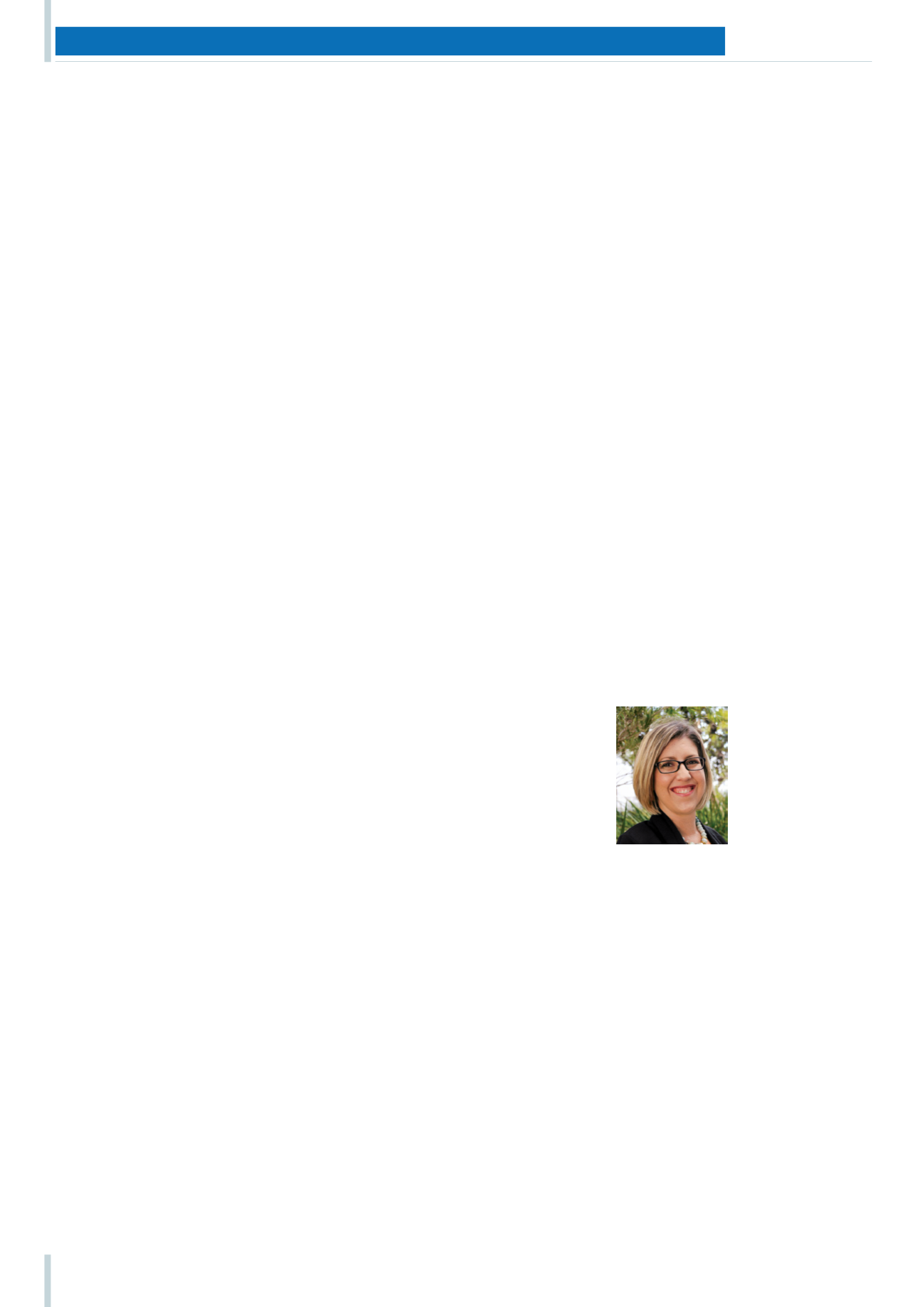
Dr Adrienne Withall is a
Senior Lecturer and
Senior Research Fellow in
Ageing and Mental Health
in the School of Public
Health and Community
Medicine at UNSW
Australia. She is a Chief
Investigator of the
INSPIRED Study of young
onset dementia. Contact Adrienne at
a.withall@unsw.edu.au.References
Cations M, Withall A, Low L-F, Draper B (2016)
What is the role of modifiable environmental and
lifestyle risk factors in young onset dementia?
European Journal of Epidemiology
31(2)107-124.
Draper B, Withall A (2016) Young onset dementia.
Internal Medicine Journal
46(7) 779-786.
Draper B, Cations M, White F, Trollor J, Loy C,
Brodaty H, Withall A (2016) Time to diagnosis in
young-onset dementia and its determinants: the
INSPIRED study.
International Journal of Geriatric
Psychiatry
. Available at:
http://www.ncbi.nlm.nih.gov/pubmed/26807846.Withall A, Draper B, Seeher K, Brodaty H (2014)
The prevalence and causes of young onset
dementia in Eastern Sydney, Australia.
International Psychogeriatrics
26(12) 1955-1965.
Withall A (2013) The challenge of service provision
in young onset dementia.
Journal of the American
Medical Directors Association
14(4) 230-232.
DCRC SPEC I AL I SSUE : THE B I G P I CTURE I N DEMENT I A RESEARCH