


 31 / 68

Vol 5 No 5 October/November 2016
Australian Journal of Dementia Care
31
dementia is ‘still a person’, and not
someone to fear, laugh at or ignore – be
they family or a stranger. More
specifically, students follow the story of
Ollie, a 10-year-old boy, Ruby his 12-
year-old sister, and their Pops, who they
have noticed start to act a little different
to usual.
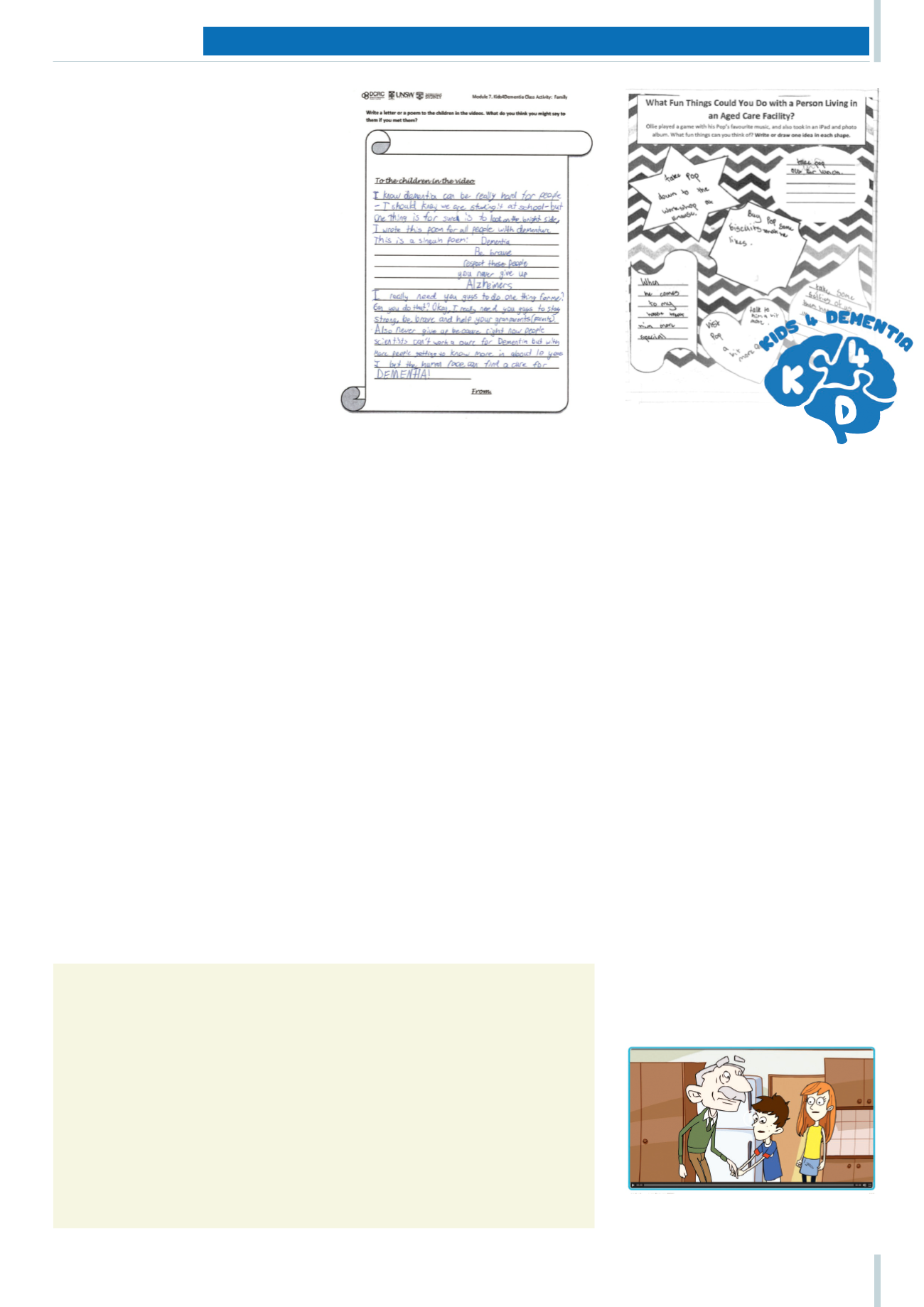
Seven short modules – including film
of people with dementia and their
relatives speaking candidly about the
condition – cover topics such as: ‘How
does it feel to have dementia?’, and
‘What can I do?’ Each module is
accompanied by an activity, such as an
interactive brain, role-play, or drawing.
Kids4Dementia has been designed with
teachers, for teachers. It demands no
preparation, minimal resources, and no
prior knowledge on the part of the teacher.
The program is flexible in that teachers can
pick and choose the order of the modules.
Moreover, the program purposefully
aligns with curriculum outcomes,
effectively providing busy teachers with a
‘pick up and go’ lesson plan for the NSW
Personal Development Health and
Personal Education (PDHPE) syllabus.
The program roll-out
The program has been piloted with three
Australian primary schools (195 students
aged 10 to 12 years old). Preliminary
results were presented at an international
conference earlier this year (Baker 2016)
and tested the hypothesis that students
who took part in the Kids4Dementia
program will have an improved
understanding of dementia compared to
children yet to participate in the program.
The goal for 2017 is to advance the roll-
out of Kids4Dementia across 30 primary
schools in NSW. We are currently
accepting expressions of interest from
schools keen to be involved in this
initiative (see below).
Nearing the end of a focus group with
students who had just completed the
Kids4Dementia program, one girl
participant looked at me intently and
said “Thank you”. I replied, “You’re
welcome, but for what exactly?”
“Thank you for this program because if
you didn’t do it, people would probably
just walk past someone with dementia,”
she said.
Our children are smart. They are our
future citizens who will grow up to be
health professionals, teachers and leaders
of tomorrow. Adementia aware and
supportive society where the rights,
needs and experiences of people living
with dementia in the community are
understood (National Health and
Medical Research Council, 2015) can
happen if we inform and review our
attitudes where they first begin to form.
Acknowledgments
We thank all the children, parents,
grandparents, teachers, Central Coast
Adventist School, St Peter’s Primary School and
St Agnes’ Primary School, for their contribution
to the project. We also thank the advisory
committee (Associate Professor Belinda
Goodenough, Associate Professor Lee-Fay
Low, Christine Bryden, Professor Yun-Hee
Jeon, Karen Hutchinson, and Laura Richards),
expert reviewers (Dr Teresa Atkinson, Dr Nicole
Kochan and Dr Karen Mather) and Alzheimer’s
Australia NSW for their support and contribution
to the project.
Kids4Dementia is funded by the Dementia
Collaborative Research Centre: Assessment
and Better Care as part of an Australian
Government Initiative.
References
AIHW (2012) Aged care packages in the community
2010-11: a statistical overview.
Aged care statistics
series no 37. Cat. No. AGE 69.
Canberra: Australian
Institute Of Health AndWelfare.
Alzheimer’s Disease International (2012)
World
Alzheimer report 2012: overcoming the stigma
of dementia
. London: Alzheimer’s Disease
International.
Alzheimer’s Society (2016). Available at:
www.alzheimers.org.uk/site/scripts/news_article.php?newsID=2530 (Accessed 2016).
Baker JR, Jeon YH, Goodenough B, Low LF,
Bryden C, Hutchinson K, Richards L (2016) The
Kids4Dementia Education Program and its
effectiveness in improving children’s attitudes
towards people with dementia. Budapest,
Hungary: Alzheimer’s Disease International.
National Health And Medical Research Council
(2015)
NHMRC national dementia research and
translation priority framework: research initiatives,
translation targets and indicators of success.
Dr Jess Baker is a Lecturer with the
Psychiatry Research and Teaching Unit, UNSW
Australia and research collaborator with the
Dementia Collaborative Research Centre:
Assessment and Better Care. She leads the
Kids4Dementia project. Contact her at:
jessica.baker@unsw.edu.auDCRC SPEC I AL I SSUE : THE B I G P I CTURE I N DEMENT I A RESEARCH
What does school participation in Kids4Dementia involve?
• The participation of at least one Year 5 or Year 6 class.
• The commitment of 115 minutes of class time (approximately four classes) to deliver
the education program over one school term.
• Time for students to complete 30 minutes of questionnaires before the program, and
20 minutes of questionnaires after the program.
• Availability of equipment to play videos to a class. Access to a printer to print activity sheets.
• The school must be in NSW and not be involved in any other dementia-related
curricular.
NSW schools that would like to be involved in this initiative from 2017 can submit
an expression of interest now to Dr Jess Baker at
jessica.baker@unsw.edu.au.
Students learn about dementia by
following the story of Pops, Ollie and Ruby