


 27 / 68

Vol 5 No 5 October/November 2016
Australian Journal of Dementia Care
27
glimpses of resources that traditionally
might have only been targeted to one
group.
What’s on the horizon?
The DementiaKT Hub will also support
the DCRCs’ commitment to build capacity
in KT in dementia. This means improving
the skills of researchers, service providers,
health professionals, and policymakers in
how to design and implement KT projects.
There is a toolbox area being developed
which will give access to a range of
resources useful for dementia-related KT
research and evaluation. In particular,
there will be a more interactive version of
the ‘Innovation to Implementation’
materials used in the Knowledge
Translation Workshops for the dementia
workforce presented by Belinda
Goodenough over the past three years.
The DementiaKT toolbox is being
developed in partnership with a team of
computer scientists fromWestern Sydney
University, and scheduled for completion
in December 2016.
It is hoped that The DementiaKT Hub
will help to accelerate the knowledge
journey for translating research into
practice, and to reduce that time lag from
17 years.
Visit The DementiaKT Hub at
www.dementiaKT.com.au.
References
Morris ZS, Wooding S, Grant J (2011) The
answer is 17 years, what is the question:
understanding time lags in translational research.
Journal of the Royal Society of Medicine
104(12)
510-20.
Acknowledgments
The DementiaKT Hub is funded by the DCRC
Knowledge Translation program, and, at the time
of writing, major partner NSW/ACT DTSC. It is a
collaborative team effort owing much to the
following people: Associate Professor Belinda
Goodenough, Ian McDonald, Tracy Higgins, Dr
Liesbeth Aerts, Adam Bentvelzen, Dr Katrin
Seeher, Dr Malini Devadas, Heather Hubble, and
the talent of Plural Agency.
Associate Professor Belinda Goodenough (left)
is Senior Visiting Fellow to UNSW Australia
(DCRC: ABC) and KT Program Manger for
Dementia Training Australia. At the time of writing
she was KT Program Manager for the DCRCs
and the NSW/ACT DTSC; Tracy Higgins provides
support to the DCRCs’ KT Program.
DCRC SPEC I AL I SSUE : THE B I G P I CTURE I N DEMENT I A RESEARCH
New resource helps hospitals
focus on the person
Hospitals can be stressful
and busy places, where
someone with dementia
may find communication
especially challenging.
Often a family carer is
needed to help explain
(and re-explain) issues to
hospital staff, and assist
them to understand the
usual daily routines, needs,
and preferences of the
person with dementia.
In consultation with
consumers and an expert
advisory group, a
Dementia Collaborative
Research Centre: Carers
and Consumers (DCRC:
CC) team, led by Professor
Christine Toye of Curtin
University, has developed
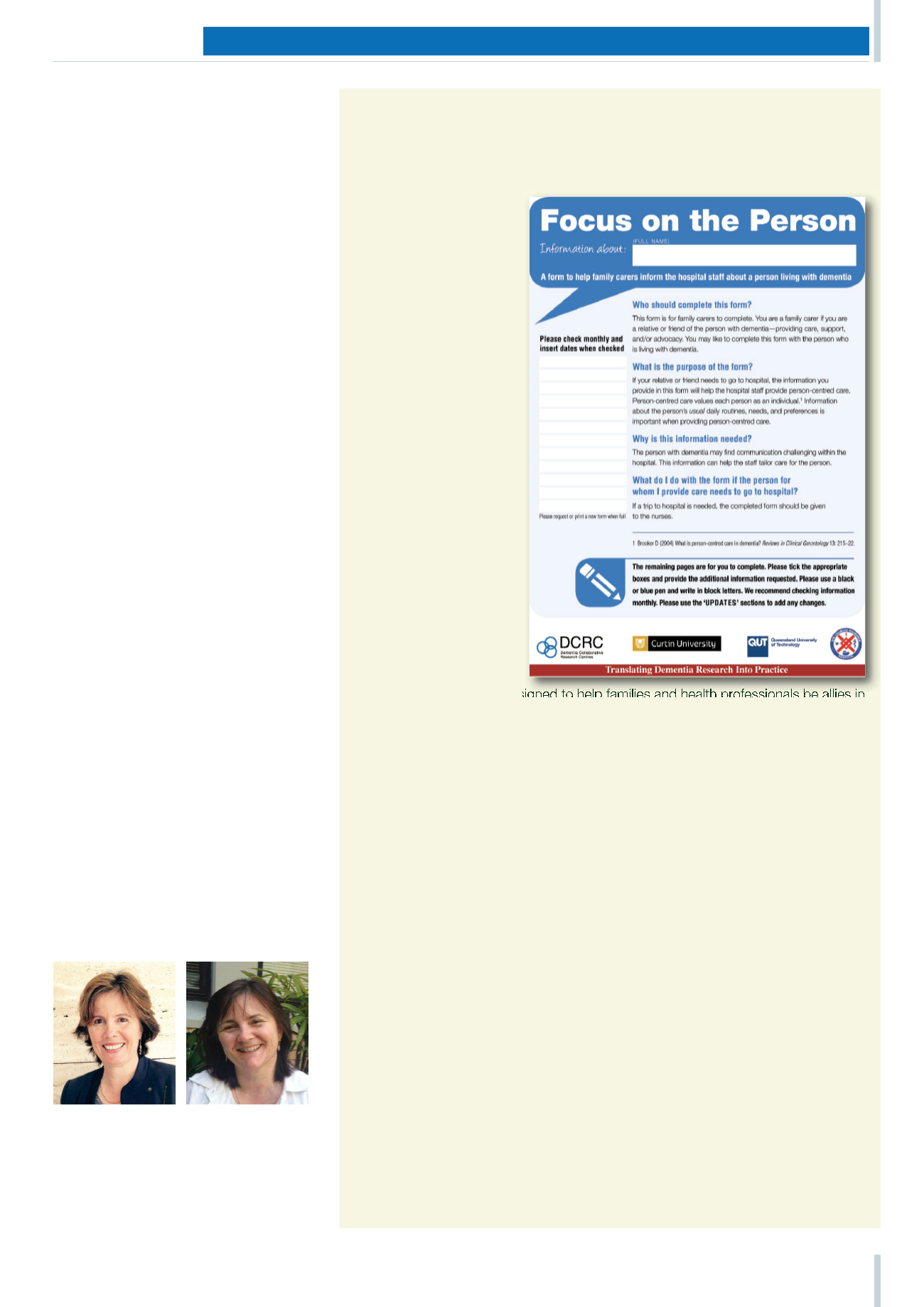
Focus On The Person – an
evidence-based tool to
help family carers give staff
useful personal information
summaries during a
hospital visit.
Focus On The Person is designed to help families and health professionals be allies in
providing person-centred care. It comprises short template forms, written in plain
English, to be completed by a family carer. They can be printed out (eg on a home
printer) or completed and saved in an online electronic version – making it easy to keep
the information updated.
The tool covers 16 topics. Some are everyday domains like ‘eating and drinking’ (eg
dislikes, cultural preferences) and ‘communication’ (eg ‘preferred conversation topics’).
Other domains address health issues such as ‘usual tablets and medicines’, personal
care (eg going to the toilet) and falls risk.
As an up-to-date record, this information can be quickly and easily provided by family
carers to hospital staff to help them provide personalised care to a person with
dementia.
Focus On The Person is part of a bundle of resources developed for home carers by
DCRC: CC. It is available for free from the new DementiaKT Hub website at
dementiakt.com.au/fotp.Acknowledgments
Focus On The Person was developed by: Professor Christine Toye and Dr Susan Slatyer, both
from the School of Nursing, Midwifery and Paramedicine, Curtin University and Centre for
Nursing Research at Sir Charles Gairdner Hospital; Mary Bronson, Andrew Hill and Dr Sean
Maher, Medical Division, Sir Charles Gairdner Hospital; Professor Keith Hill, School of
Physiotherapy and Exercise Science, Curtin University; Dr Pam Nichols and Professor Samar
Aoun, School of Nursing, Midwifery and Paramedicine, Curtin University; Dr Eleanor Quested,
School of Psychology and Speech Pathology, Curtin University; and Dr Elissa Burton, School of
Physiotherapy and Exercise Science, Curtin University.
Reference group members were recruited from Alzheimer’s Australia WA, Carers WA, Sir Charles
Gairdner Hospital, and the Department of Health of Western Australia.
Support for study recruitment was also received from Juniper Community, Alzheimer’s Australia
WA, Carers WA, and Sir Charles Gairdner Hospital. Funding was provided by the DCRC: CC.