


 30 / 68

30
Australian Journal of Dementia Care
October/November 2016 Vol 5 No 5
Creating a dementia-friendly
society, starting with kids
“I
f you married someone with
dementia, could you then get it?”,
“How can you have no memory,
yet still do stuff?”, “If you get dementia
does that mean you have to go to one of
those awful jail places, where you just sit
and watch TV?” This is a small sample of
the curiosity I have encountered while
developing Kids4Dementia, an
innovative dementia education program
for Year 5 and 6 schoolchildren.
The children I have met are keen and
receptive to learning more about a
condition that many did not know ‘was
even a thing’. This parallels a large
British poll, where 62% of eight- to 17-
year-olds reported that they would like
to help people with dementia but felt
held back by a lack of understanding of
the condition (Alzheimer’s Society, 2016).
Changing attitudes
Dementia is one of the biggest health
issues facing Australia and the globe
today. By 2050, over 900,000 Australians
will be living with the condition (AIHW,
2012). Children rarely feature in
dementia research, but they need to and
should do. The stigma experienced by
people with dementia is real, common,
and often life-changing (Alzheimer’s
Disease International, 2012).
Kids4Dementia is focused on tackling
this stigma by changing attitudes at a
generational level – creating positive
attitudes amongst today’s children.
It is evidence-based and was
developed, in part, from the results of
focus groups with 49 children in the
community and people with dementia
and their relatives. The contemporary,
classroom-based program presents an
accessible population strategy approach
for all children with or without an
experience of dementia.
Through an engaging animated story,
real-life videos and fun activities,
students learn that a person with
DCRC SPEC I AL I SSUE : THE B I G P I CTURE I N DEMENT I A RESEARCH
the latest Australian and international
guidelines. Links to different national
and international consumer
organisations assist GPs in guiding
patients and their families to other
helpful resources.
With the updated GPCOG we continue
to promote timely detection of dementia
and improve the information exchange
between GPs and specialists. While the
GPCOG is primarily focused on
supporting GPs and other primary care
health professionals, the ultimate goal is
of course better assessment and timely
care for patients.
You can find more information about
GPCOG at
www.gpcog.com.auor contact
the team via
gpcog@unsw.edu.au.References
Brodaty H, Pond D, Kemp N, Luscombe G,
Harding L, Berman K, Huppert F (2002) The
GPCOG: a new screening test for dementia
designed for general practice.
Journal of the
American Geriatrics Society
50 530-534.
Brodaty H, Low LF, Gibson L, Burns K (2006)
What is the best dementia screening instrument
for general practitioners to use?
American
Journal of Geriatric Psychiatry
14(5) 391-400.
Seeher K, Brodaty H (2016) The General
Practitioner Assessment of Cognition (GPCOG).
In: Larner AJ (Ed)
Cognitive screening
instruments. A practical approach
. London:
Springer. In press.
Dr Liesbeth Aerts is a Research Associate
with the Dementia Collaborative Research
Centre: Assessment and Better Care (DCRC:
ABC), School of Psychiatry, UNSW Australia; Dr
Katrin Seeher is a Visiting Fellow with the
DCRC: ABC and a consultant with the World
Health Organisation; Professor Henry Brodaty,
who developed the GPCOG with Professors
Felicity Huppert, Dimity Pond and others, is
DCRC: ABC Director, Co-Director of the Centre
for Health Brain Ageing (CHeBA), Scientia
Professor of Ageing and Mental Health, UNSW
Australia, Consultant Psychogeriatrician Aged
Care Psychiatry and head of the Memory
Disorders Clinic, Prince of Wales Hospital,
Sydney. To follow up on this article, contact
Liesbeth at:
l.aerts@unsw.edu.au.
• GP education program supports timely
diagnosis: see p44
• The role of GPs and practice nurses in
dementia prevention: see p45
Jess Baker
presents an update on the Kids4Dementia project, an
innovative classroom-based program designed to educate the next
generation about dementia
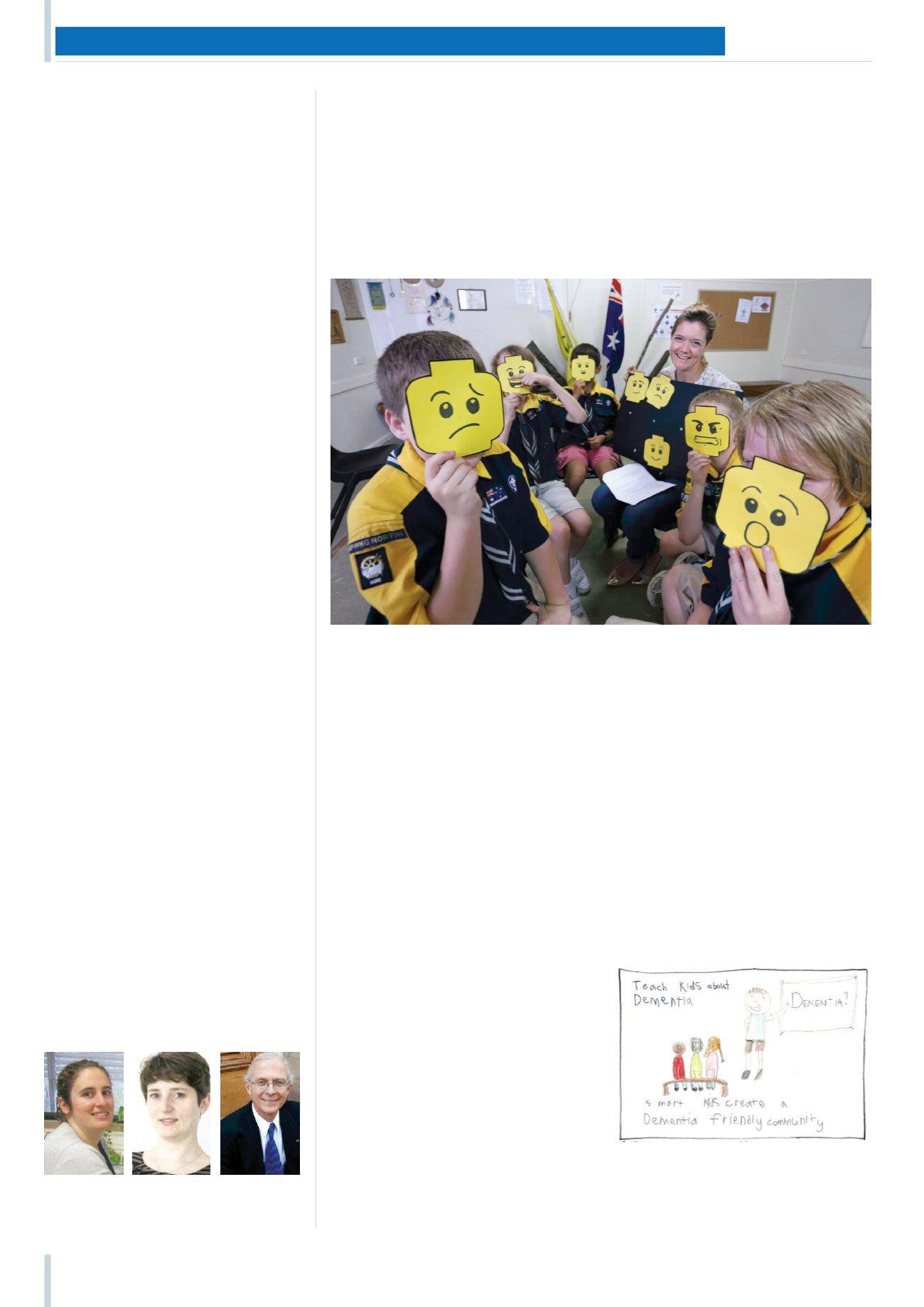
Dr Jess Baker with some of the primary school students involved in the Kids4Dementia
pilot study
Each module in the Kids4Dementia
program is accompanied by a class
activity, such as drawing (above) and
writing a letter or poem (next page)
Dr Liesbeth Aerts, Dr Katrin Seeher and
Professor Henry Brodaty