


 29 / 68

Vol 5 No 5 October/November 2016
Australian Journal of Dementia Care
29
G
PCOG was originally developed in
2002 as a tool for GPs, primary care
physicians and family doctors to
help them assess patients and detect
cognitive impairment.
Obtaining a dementia diagnosis can be
a difficult and lengthy process, involving
different specialists and many tests.
Nevertheless, early detection is crucial to
help with timely management of
symptoms, including the planning of
assistance. It is also important for general
health management, as having memory
problems or dementia could mean that
the diagnosis or treatment of concurrent
illnesses may require more attention.
Recent clinical studies indicate that both
currently available symptomatic drugs
for dementia and those still under
development could have a more positive
impact when started early in the disease
process.
GPs are the best-positioned
professionals to address early concerns
or to notice changes in patients, but they
face several hurdles. Commonly used
instruments to test memory and
cognition (such as the Mini-Mental State
Examination) are not always accessible
or practical to use in primary care
settings, because of their complexity and
the extensive time requirements. They
may involve lengthy training or high
licensing fees.
To bridge this gap and provide GPs
with a reliable yet quick and accessible
screening instrument, Professor Henry
Brodaty (co-author here) and colleagues
developed the GPCOG (Brodaty
et al
2002). It combines the most useful items
from commonly accepted comprehensive
tests for cognition, dementia and
independence.
The result is a four-item patient
examination to assess time orientation,
visuospatial functioning, planning,
information processing and memory. If
the results of this test are equivocal, GPs
can continue with a six-item interview
with a knowledgeable informant to see
whether there has been a decline in the
patient’s memory or general abilities.
Both parts of the test are very short and
can also be conducted in parallel. In less
than five minutes, a GP can gather
information on different aspects of
cognition and whether there has been a
recent decline.
Free resource
GPs can perform the GPCOG as a
traditional paper-and-pencil test or as an
interactive online application, both
available free of charge for clinical and
research use. Instructions on the use of
GPCOG, interpretation of the results and
an informative training video are
available on the GPCOG website
(www.gpcog.com.au) and via the
Dementia Collaborative Research
Centres’ (DCRCs’) new DementiaKT
Hub website
(www.dementiaKT.com.au).
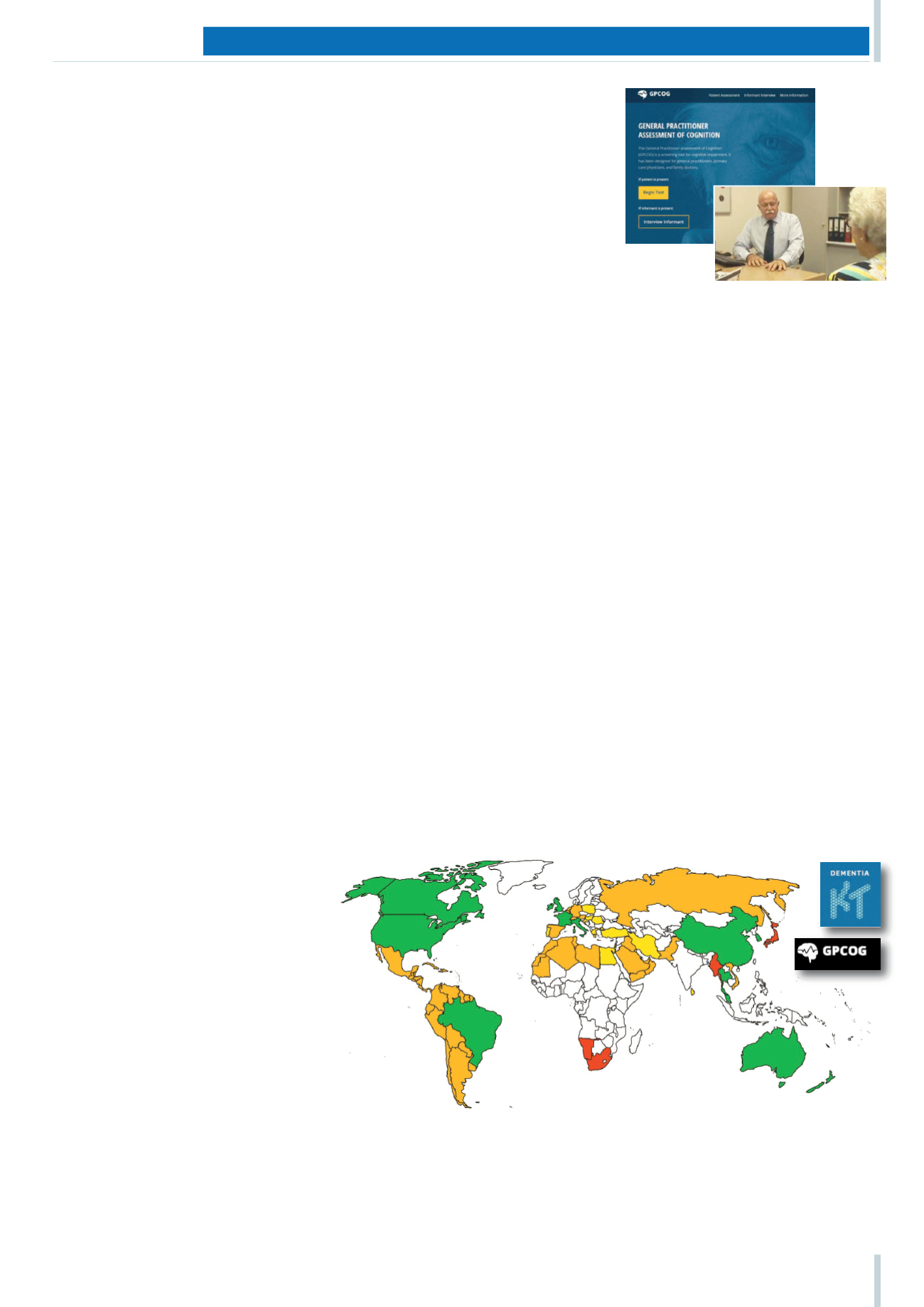
Over the past decade, the GPCOG has
been translated and validated in many
languages and has been used by
clinicians and researchers on all
continents (see map). The test remains
valid, independent of patient gender or
cultural and linguistic background.
Both the paper-and-pencil test and the
online tool are available at the GPCOG
website in English, Chinese, French,
German, Greek, Italian, Korean, Polish,
Romanian, Russian and Spanish; but the
tool has also been translated into Arabic,
Portuguese, Dutch, Farsi, Hebrew,
Hungarian, Maltese, Sinhalese, Turkish,
Thai, Urdu, Vietnamese and Welsh which
will be added to the website in time.
Updating GPCOG
In 2016, the GPCOG website
(www.gpcog.com.au) had a makeover,
with funding provided by the DCRCs’
Knowledge Translation Program. The
website and test are now easier to
navigate, especially when using smart
phones or tablets. Importantly for GPs,
the website holds a wealth of information
on how to proceed if a patient’s test score
indicates there is cognitive impairment.
We have also updated the overview of
recommended investigations based on
DCRC SPEC I AL I SSUE : THE B I G P I CTURE I N DEMENT I A RESEARCH
GPCOG: a fast, reliable tool to
help GPs diagnose dementia
In the 15 years since its development in Australia, the General
Practitioner Assessment of Cognition (GPCOG) has proven to be an
invaluable tool for first-line clinicians.
Liesbeth Aerts
,
Katrin
Seeher
and
Henry Brodaty
explain how the test, and recently
updated online tool, can be useful in promoting better assessment
and timely care for people with dementia
The global reach of the General Practitioner Assessment of Cognition: the GPCOG was
originally developed and validated in Australia. Since then, it has been translated (orange) or
translated and validated (green) for use in the local language of many countries around the
world. Currently, the team is working on additional validations (yellow) and translations (red)
via collaborations with local researchers and clinicians
A GP can gather information on a patient's
cognition in less than five minutes using
the GPCOG