


 28 / 68

28
Australian Journal of Dementia Care
October/November 2016 Vol 5 No 5
D
etermining the presence of dementia
in a person and assessing their
cognition, function and behaviours
can be complex. The many available
measures and large amount of research can
make it difficult to choose the best
instrument to assess a particular individual
in a particular setting for a particular
purpose. Measures that are popular with
clinicians may not necessarily have the best
evidence-base or be applicable in all
clinical scenarios.
The Dementia Outcomes Measurement
Suite (DOMS), launched in 2007 and
recently updated, aims to clarify best
practice in screening, assessing and
monitoring people with dementia across
different domains. If clinicians become
familiar with and agree upon a selected
number of recommendedmeasures or
instruments, they will be able to ‘speak the
same language’ when assessing dementia
(Sansoni
et al
2007) and communication
will become more efficient.
The DOMS project was one of the first
major pieces of work commenced by the
Dementia Collaborative Research Centres
(DCRCs). TheAustralian Department of
Health andAgeing engagedAssociate
Professor Jan Sansoni, Principal Research
Fellow at the University of Wollongong, as
project lead, along with a teamof
researchers, including the authors, and an
advisory committee ofAustralian
clinicians, to determine ‘best practice’ in
screening, assessing andmonitoring people
in different domains of dementia, including
cognition, staging, function, delirium,
behaviour and quality of life. Many scales
andmeasures were identified. The review
process initially reduced these to a shortlist
which included only those whichwere
sufficiently validated for use with dementia
populations and clinical settings.
Each short-listedmeasure was then
assigned a numerical rating according to
detailed criteria including reliability and
validity, sensitivity to dementia, cost, and
ease of use. By choosing the scales with the
highest ratings in each domain the group
derived a set of recommendedmeasures.
For example, the Global Deterioration
Scale (GDS), Clinical Dementia Rating
scale (CDR) and the Dementia Severity
Rating Scale (DSRS) were the measures
which ranked best as tools to stage the
severity of a diagnosed dementia.
The DOMS update
The original DOMS website was
developed in 2010 to distil the findings of
the review andmake it easier to access the
recommendedmeasures. This website has
been very successful, with a monthly
average of 1400 unique visitors and 4400
downloads. Aside fromminor updates,
however, a comprehensive update of
current best practices and the website itself
was long overdue.
The update was recently completed by
the DCRC: Assessment and Better Care
(DCRC: ABC) DOMS team, with help from
an expert steering committee. There’s now
an increased focus on clinical practice with
wider coverage of different:
• types of dementia, including fronto-
temporal dementia
• severities of impairment, including mild
cognitive impairment
• clinical settings, including primary care
versus specialist clinics
• assessment modalities, including
performance-basedmeasures of function
(eg ‘cognitive impairment interferes with
independence in everyday activities’).
The rating scheme was updated to reflect
these changes and included greater
emphasis on clinically-relevant
psychometrics. The scope has also been
expanded to an international audience.
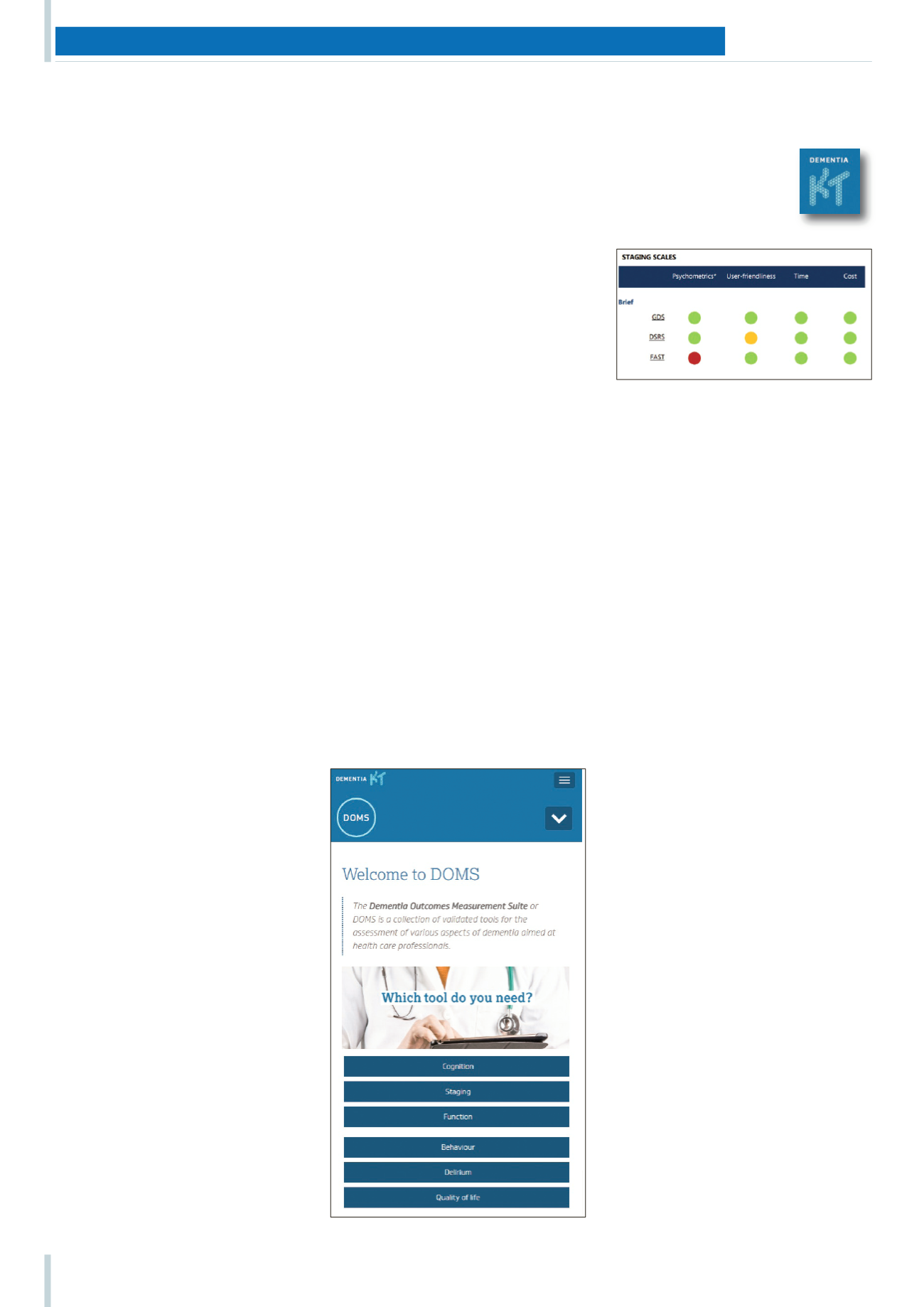
The updated website
(dementiakt.com.au/doms) was launched in July 2016 with
a more modern and user-friendly interface
suitable for computers, smartphones and
tablets (see below left). The newwebsite
provides PDFs of the recommended
measures, along with user manuals and
web links to helpful resources.
Visually appealing and user-friendly
resources on the website make it easy to
compare different scales and assess their
‘best use’ via a simple and intuitive ‘traffic
light system’ (see above).
By keeping the content and the look of
the online DOMS platform contemporary,
it continues to encourage best practices in
dementia care andmanagement. We
believe that ‘speaking the same language’
is the first step to more efficient
communication between clinicians and
will ultimately lead to better patient care.
For more information or to give feedback on
the updated website, visit dementiakt.
com.au/domsor email
DOMS@unsw.edu.au.
References
Sansoni J, Marosszeky N, Jeon Y-H, Chenoweth
L, Hawthorne G, King M, Budge M, Zapart S,
Sansoni E, Senior K, Kenny P, Low L (2007)
Final
report: Dementia Outcomes Measurement Suite
project
. Centre for Health Service Development,
University of Wollongong.
Acknowledgments
The DOMS team comprises: Adam Bentvelzen,
Research Assistant, DCRC: ABC, UNSW,
Australia; Dr Liesbeth Aerts, Research Associate,
DCRC: ABC; Dr Katrin Seeher, Visiting Fellow,
DCRC: ABC; Associate Professor Belinda
Goodenough, Knowledge Translation Program
Manager, DCRCs and NSW/ACT DTSC; and
Professor Henry Brodaty, DCRC: ABC Centre
Director and CHeBA Co-Director.
We thank the DOMS expert steering committee,
especially Jacqueline Wesson, Dr Lyndal Newton,
Daniella Kanareck, Anne-Nicole Casey, Julie
Strukovski, Dr Simone Reppermund, Kim Burns
and Dr Sharon Levy.
DCRC SPEC I AL I SSUE : THE B I G P I CTURE I N DEMENT I A RESEARCH
The Dementia Outcomes Measurement Suite (DOMS) is a free, evidence-based web
platform designed to assist clinicians improve the assessment of dementia.
Adam
Bentvelzen
,
Liesbeth Aerts
,
Katrin Seeher
,
Belinda Goodenough
and
Henry Brodaty
introduce an important update to this resource and its new user-friendly website
DOMS lets clinicians ‘speak the same language’