


 26 / 68

S
eventeen years. This is the time
lag calculated by a UK-based
team as the average wait for a
research discovery to impact upon
health-related care and treatments
(Morris
et al
2011).
The reasons for this time delay for
knowledge translation can be complex.
Some relate to the ways and speeds at
which organisations work. So an
important topic of study in the field of
knowledge translation (KT) is how to
help dementia care teams implement,
manage, and sustain change.
Other key factors in dementia
research KT seem simpler: awareness
and access. Knowledge can only start
the journey to being both used and useful
if it first can be found. Yet it can be
challenging to knowwhere to find
dementia-related resources that are
backed up by the latest science. For
example, results of a recent survey in a
project led by a Dementia Collaborative
Research Centre: Carers and Consumers
(DCRC: CC) team showed that the
Australian residential aged care
workforce reported difficulties accessing
the latest research-based knowledge.
Australia’s Dementia Collaborative
Research Centres (DCRCs) were
established with a vision for promoting
the rapid uptake of their research findings
into practice and policy. This KT mission
includes developing contemporary and
easy ways to help people find and use the
outputs of DCRC research. This year, the
DCRCs are pleased to launch an extension
of their web-based resources: a microsite
called The DementiaKT Hub
(www.dementiaKT.com.au).
Who is The DementiaKT Hub for?
The DementiaKT Hub is a freely
accessible internet-based site for everyone
who has an interest in dementia,
including health professionals, carers,
policy makers, researchers, people living
with dementia, and the general public. It
is styled as a one-stop destination for
finding a range of resources that are
informed by DCRC-related research,
consultancy, and partner-based activities.
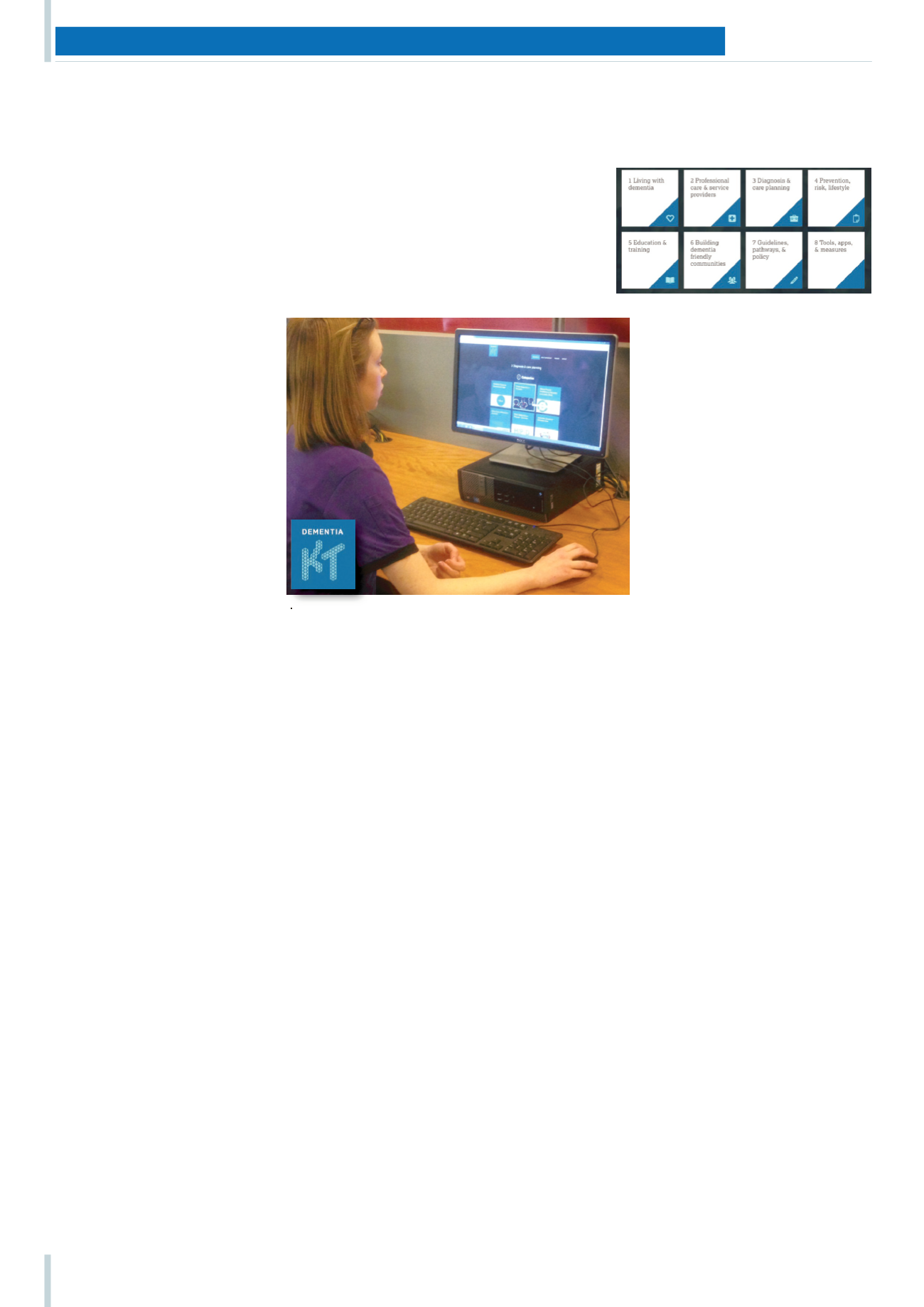
The hub acts as a gateway to access
resources under eight content categories
in dementia, including: dementia
prevention; living with dementia;
education for health professionals; and
collections of tools (see photo top right).
Each resource entry gives key information
on how to get the resource, why it is
useful, and where to find more
information about it. An example is the
Focus On The Person tool for home carers
(see box p27).
The DementiaKT Hub is also the
new home for the Dementia Outcomes
Measurement Suite (DOMS) – an
Australian Government-funded initiative
to helpAustralian health professionals
understand and use the same tools to
measure dementia-related domains
(see p28).
Why is The DementiaKT Hub needed?
Dementia-related knowledge translation
must be a high priority if the value of
Australia’s research investment is to be
fully realised (see p32 for details of new
projects funded by the DCRCs). The
DCRCs are now part of the newNHMRC
National Institute for Dementia Research
(NNIDR). The DementiaKT Hub will
complement the NNIDR’s strategic
directions for translational outcomes (eg
at a policy level) by providing a gateway
to access ‘grassroots’ resources
relevant to care, practice, and
consumer issues.
The DementiaKT Hub project leader
is Associate Professor Belinda
Goodenough, who also manages the
KT Program for Dementia Training
Australia (fromOctober 2016) and was
the NSW/ACT Dementia Training
Study Centres’ KT Programmanager
at the time of writing. Belinda began
with the premise that some of the best
KT in dementia starts with the
punchline, not the problem. Part of the
traditional view of how research
should translate into practice has been
overly dependent on research experts
trying to convince practitioners that a
problem exists, and giving them the
solution. Yet people appreciate being
shown a resource and then taking a more
hands-on exploratory approach to
discover for themselves how it fits with
their needs and context.
The traditional ‘problem to solution’
pipeline approach also risks creating
knowledge silos – such as websites that
cater only for a specific dementia
stakeholder, or suggesting that certain
resources are only useful for one type of
health professional.
Overall, we have learnt a few things
fromwebsites like TripAdvisor: people
like to browse, and they follow glimpses
of the destination. Agreat way to build
awareness is to support people to get
curious about places or products they
never knew existed and take the time to
figure out for themselves if it seems
relevant or interesting.
For example, a person who is
potentially naïve about dementia may be
looking for information on how better to
cope as a carer at home, and could also
browse resources aimed at dementia
prevention, or upskilling the professional
workforce. Sometimes we know that our
dementia care workforce, including GPs,
become aware of dementia-related
resources because consumers have found
them first. In this way, The DementiaKT
Hub helps a wide and diverse community
to ‘knowwhat you don’t know’ and get
26
Australian Journal of Dementia Care
October/November 2016 Vol 5 No 5
The DementiaKT Hub: translating
research into practice
DCRC SPEC I AL I SSUE : THE B I G P I CTURE I N DEMENT I A RESEARCH
Belinda Goodenough
and
Tracy Higgins
introduce
The DementiaKT Hub – a new one-stop online destination for the
latest research-based dementia resources involving DCRC expertise
Nursing student Bree explores resources
on The Dementia KT Hub