


 15 / 64

Research
Volume 12 No 3
I
June 2016
15
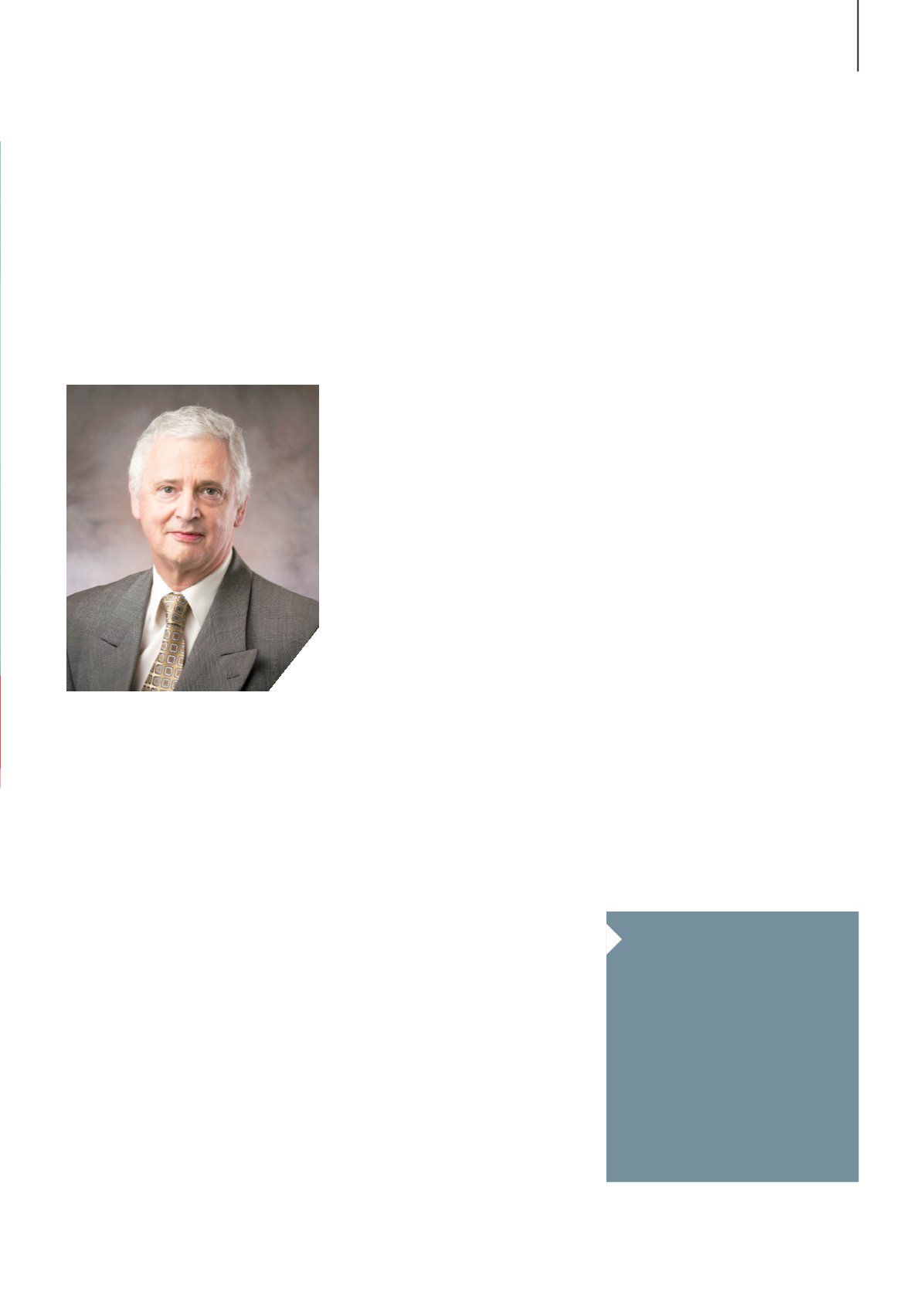
Prof Jim Denham OAM
Prof Denham was awarded a
Medal of the Order of Australia
in the 2016 Australia Day
Honours for service to medicine,
and to medical research.
Prof Jim Denham’s main research field is
clinical oncology, in particular the design
and conduct of multicentre clinical
trials involving radiotherapy, treatment
delivery and radiation toxicity.
Prof Denham’s research career began
in London with a thesis addressing
the natural history of the Follicular
Non-Hodgkin’s Lymphomas. For this
he received his MD diploma in 1984
from the University of London and was
equipped with the necessary scientific
temperament and skills to pursue a
lifelong clinical research career.
After moving to the Royal Adelaide
Hospital, he continued his interest in
clinical research with pilot studies of
chemo-radiation in oesophageal cancer.
He went on to receive his RANZCR
Fellowship in 1986 and continued his
research interests at the Mater Hospital
(Newcastle) in 1987 as its Director of
Radiation Oncology. For these efforts
Prof Denham was awarded his Conjoint
Professorship title by the University of
Newcastle in 1992.
Jim Denham played an important role in
establishing Australia and New Zealand’s
(ANZ) multicentre trials group, now
known as the Trans Tasman Radiation
Oncology Group (TROG). He became
its first President from 1994 to 2000 and
oversaw its initial growth phase. Over
its first 25 years, TROG had conducted
21 Phase 2 trials and 26 randomised
controlled Phase 3 trials (nine involving
international collaborations).
Prof Denham and his longstanding
colleagues played a major role in the
design and direction of ANZ’s two
largest cancer trials. These were for men
with locally advanced prostate cancer.
The TROG 96.01 trial enrolled 818
subjects between 1996 and 2000 and
reported its findings in 23 publications.
The TROG 03.04 (RADAR) trial enrolled
1,071 subjects between 2003 and 2007
and to date has 25 publications. Both
trials demonstrated that statistically
significant improvements in cancer
related outcomes could be achieved
without clinically important increases in
treatment-related morbidity.
Prof Denham’s publications include
over 200 articles. His lifetime research
funding amounts to $10.3M from
national competitive sources (including
15 NHMRC project grants), $7.7M from
industry and $1.3M from institutional
sources. His research activities were
recognised locally in 2006 with the
Hunter Medical Research Institute
Sparke-Helmore Award for Research
Excellence, and in Europe in 2007 with
honorary membership of ESTRO. In
2013, the University of New England
awarded him the title of Honorary
Professor.
In 2005, NSW Cancer Registry data
indicated that the Hunter had NSW’s
highest prostate cancer mortality rate.
Together with community groups,
Prof Denham worked to improve
awareness and over 18 months this
campaign succeeded in lifting the
Hunter’s detection rate from the lowest
in NSW to the highest! In 2013 he
was recognised for these and other
community based efforts with a NSW
Government Community Service Award.
A Career in Research
– Prof Jim Denham OAM
Tip for Trainees
Trainees with an interest in research
should remember that medicine is
still in its infancy and that we know
much less than we actually know.
Research topics are therefore easy
to find.
Prof Denham’s most important tip
is to consider the sample size issue
very carefully when designing a new
research project. If there are not
going to be enough events then
another project must be selected.