



 47 / 64

Clinical Radiology
Volume 12 No 2
I
March 2016
47
ANZSPR 2015 Annual
Scientific Meeting
Over 50 delegates gathered in Adelaide
last October at the iconic Adelaide
Oval for the annual Australian and New
Zealand Society of Paediatric Radiology
(ANZSPR) meeting. The meeting had
a focus on paediatric neurological
imaging and other general facets of
paediatric radiology.
Our invited speakers—Prof Manohar
Schroff (Toronto) and Dr Owen Arthurs
(UK)—along with our talented local
faculty, gave excellent and informative
lectures. Many thanks to the delegates
and sponsors who made the ANZSPR
meeting in Adelaide a fabulous event.
Expansion of Services at the Royal
Children’s Hospital, Melbourne
The Medical Imaging Department at
The Royal Children’s Hospital is set to
expand their services with the newly
acquired PET MR, (Siemens Biograph
mMR), and SPECT CT, (Siemens
Intevo), currently being installed in the
newly refurbished Nuclear Medicine
department.
The PET-MR was funded by the Royal
Children’s Hospital Good Friday Appeal
and RCH is the first children’s hospital in
the southern hemisphere to acquire one.
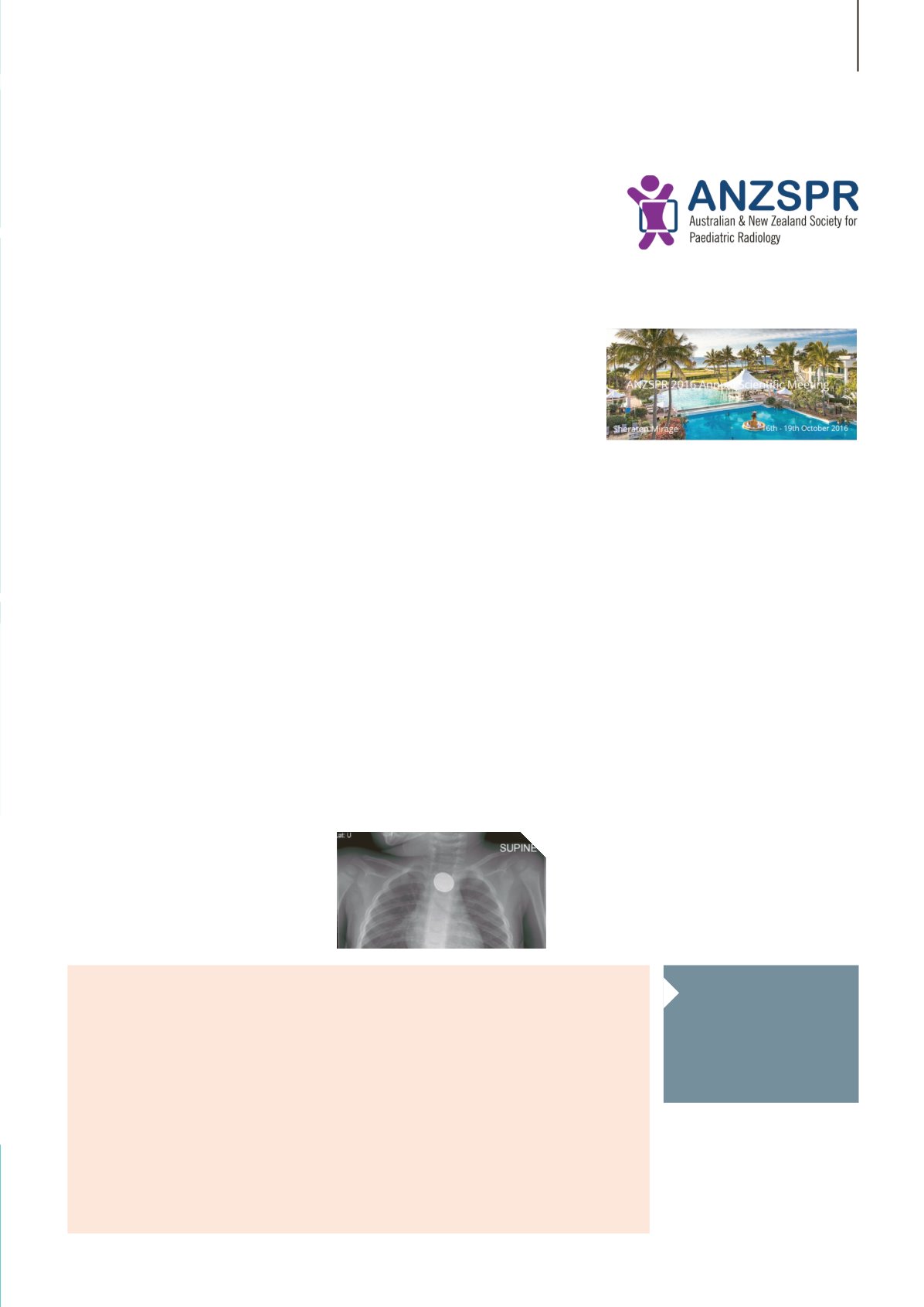
X-rays of Button Batteries
In June 2013, the first Australian child
died after ingesting a 2cm active
disc battery. Despite symptoms, the
ingestion and oesophageal lodgement
of the battery went unrecognised.
She collapsed two weeks post battery
ingestion following a large oesophageal
bleed. The disc battery was discovered
on a post intubation chest film.
Injury occurs when an active disc
battery (>1.2V) is placed in an internal
orifice (ingested/inserted) or any moist
environment (e.g. under a plaster
cast) and remains in one position for a
prolonged period. Tissue destruction
occurs within two hours and can
continue for hours/days even after
battery removal. Lithium batteries
>/=2cm in diameter are more likely to
lodge in the oesophagus and cause
serious injury.
Many disc batteries on X-ray have a
radiolucent ring around the perimeter;
however, this may not always be present.
Any staff member who sees a (possible)
disc battery on X-ray should report this
immediately to the senior treating clinician.
Upcoming Paediatric Imaging
Conference
16 – 19 October 2016
Sheraton Mirage Gold Coast
Register Now:
www.anzspr16.comJoin us for a three day program
featuring local and international
speakers, focusing on topics including
musculoskeletal, gastrointestinal and
genitourinary imaging. The program
and content is suitable for radiologists,
radiology registrar and fellows,
radiographers and specialists with an
interest in imaging.
Along with the academic program,
delegates will be able to enjoy a social
program comprising of a welcome
reception at Glass Dining and Lounge
Bar and the conference dinner to
be held at Fellini Restaurant, both
conveniently located at the Marina
Mirage Shopping Centre just a five
minute walk from the resort.
We look forward to seeing you on the
Gold Coast.
Dr Jenny Bracken
ANZSPR Secretary
ANZSPR News
Image courtesy of Nationwide
Children’s Hospital
Information about
ANZSPR can be found
on the College website
at
www.ranzcr.edu.au/organisation/special-
interest-groups/anzspr
ANZSPR Committee
The current ANZSPR committee will serve
from January 2016 until December 2018:
President: Prof Michael Ditchfield
(Monash Children’s Hospital, Monash
Health and Monash University,
Melbourne)
Secretary: Dr Jenny Bracken
(Royal Children’s Hospital, Melbourne)
Executive: Prof Lee Coleman
(Royal Children’s Hospital, Melbourne)
Dr Muddassir Rashid
(Gold Coast University Hospital, Gold
Coast; Lady Cilento Children’s Hospital,
Brisbane)
Dr Padma Rao
(Royal Children’s Hospital, Melbourne)
Dr Helen Bird
(Starship Children’s Hospital, Auckland)
Dr Jean Murdoch
(Wellington Hospital, Wellington)
Dr Peter Shipman
(Perth Radiological Clinic, Perth)