


 143 / 216

139
Copyright © 3P Learning – These resources have been created in partnership with Dr. Marian Small.
For more information visit
www.mathletics.comMake the Shape
Questions to facilitate the learning
•
How do you know your shape can’t be a triangle?
•
Could it be a 4-sided shape? What kind? Why?
•
Does the shape have to have an even number of sides? Why or why not?
•
What would be an easy strategy for creating even more shapes?
Scaffolding the learning
•
What do parallel lines look like?
•
When you see a shape with a small angle, what do you notice about it?
•
Suppose we started the shape like this:
What could we do next?
What’s the point of this task?
The focus of this task is on observing and creating
parallelism. But because students are also required to
have small angles in their shapes, they can’t just use the
standard rectangle, hexagon, octagon, etc. They need
to think about how to combine all of the requirements.
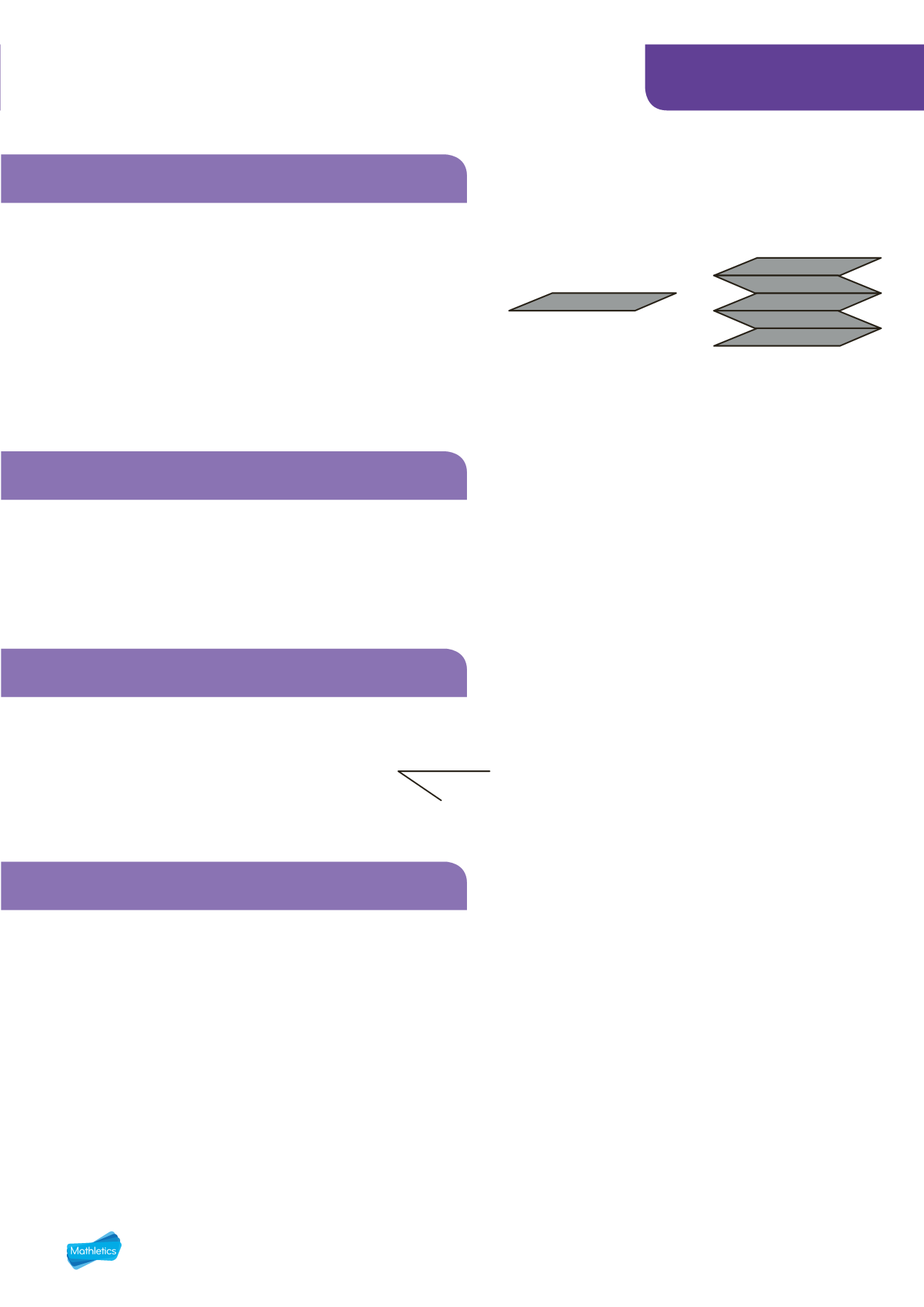
A simple solution is a parallelogram like the one at
the left. But because they have to create a number of
shapes, they might end up creating some like the one
on the right.
Extending the learning
Students might choose to create shapes that meet the requirements with particular numbers of sides,
e.g. 12 sides, 15 sides, etc.
Geometry