


 169 / 216

165
Copyright © 3P Learning – These resources have been created in partnership with Dr. Marian Small.
For more information visit
www.mathletics.comQuestions to facilitate the learning
•
How were your blocks arranged?
•
What meaning of multiplication does your model depend on?
•
Could you have looked at the numbers and predicted you would need 32 blocks to show the
multiplication model? How?
Scaffolding the learning
•
How might you arrange base ten blocks to show 2 x 12? Could you arrange them in a rectangle?
•
How many blocks did you need for 2 x 12? Why that number?
Extending the learning
Students might, instead, determine two numbers where the model for the product requires the use of 45
base ten blocks.
What’s the point of this task?
This task requires students to relate multiplication to area, an important connection, as well as to calculate
products. In this case, providing the total number of blocks instead of giving a specific product, makes
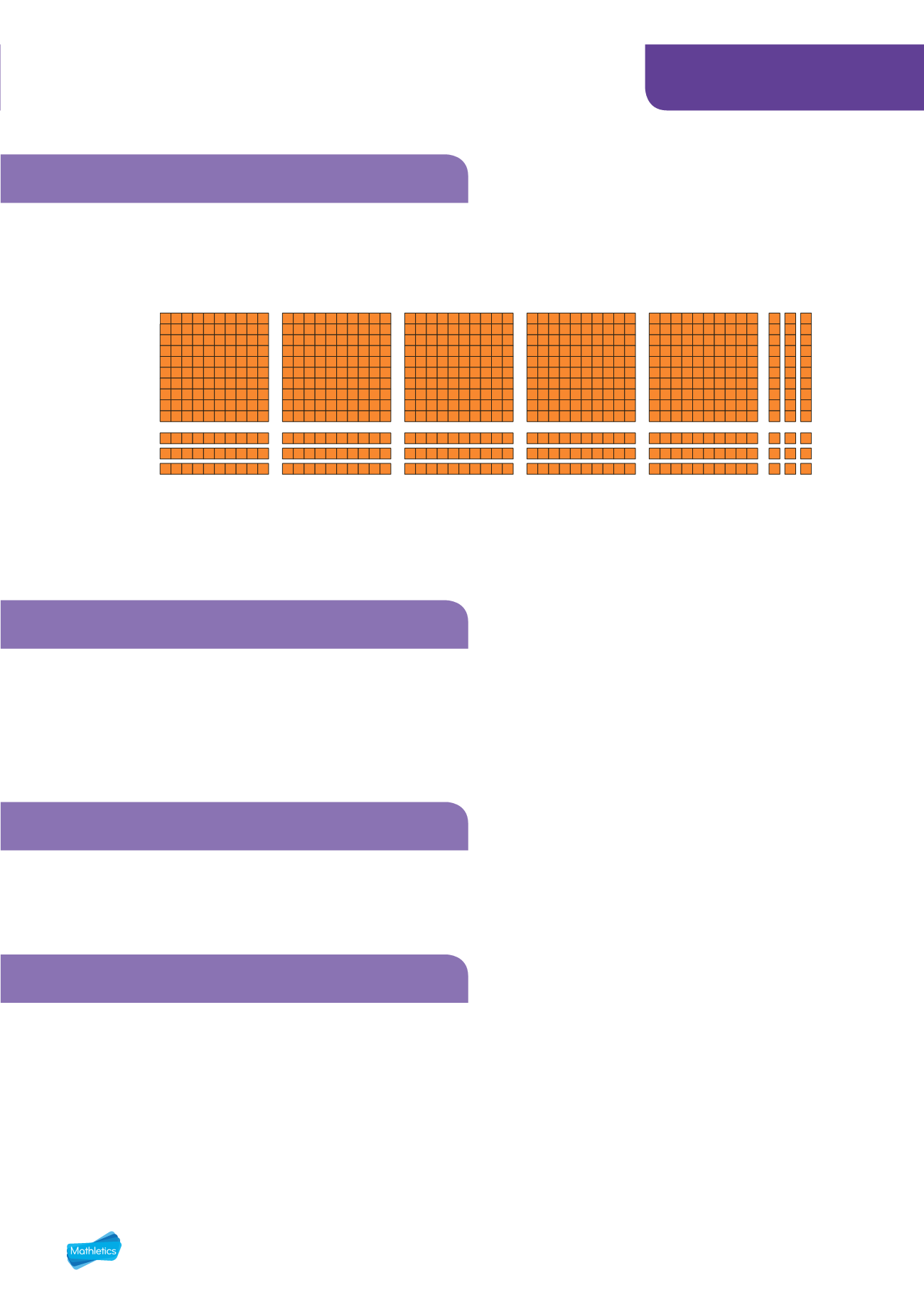
many results possible. For example, a student might choose 53 x 13 using a model like this:
Multiplying Two by Two
Other choices might have been 26 x 22 or 97 x 11 or 71 x 31.
Notice that the number of blocks in a row multiplied by the number of blocks in a column equals 32.
Number