


 20 / 32

20
a 48-215 Holden mated to the Fiat backing plates.
The original brake lines were welded hydraulic
lines from the Vengeance, but they were replaced
with modern parts to meet CAMS safety standards.
For similar reasons the wheels have been updated
to Mini based 10-inch rims on Fiat centres because
the original wheels and tyres are not considered
safe. Those original wheels came off an Iso Diva
motor scooter. They were 3½ inches wide 10-inch
rims with
(probably)
motor
scooter tyres on them. Considering that the car can reach
100 mph, I can understand CAMS' point of view.
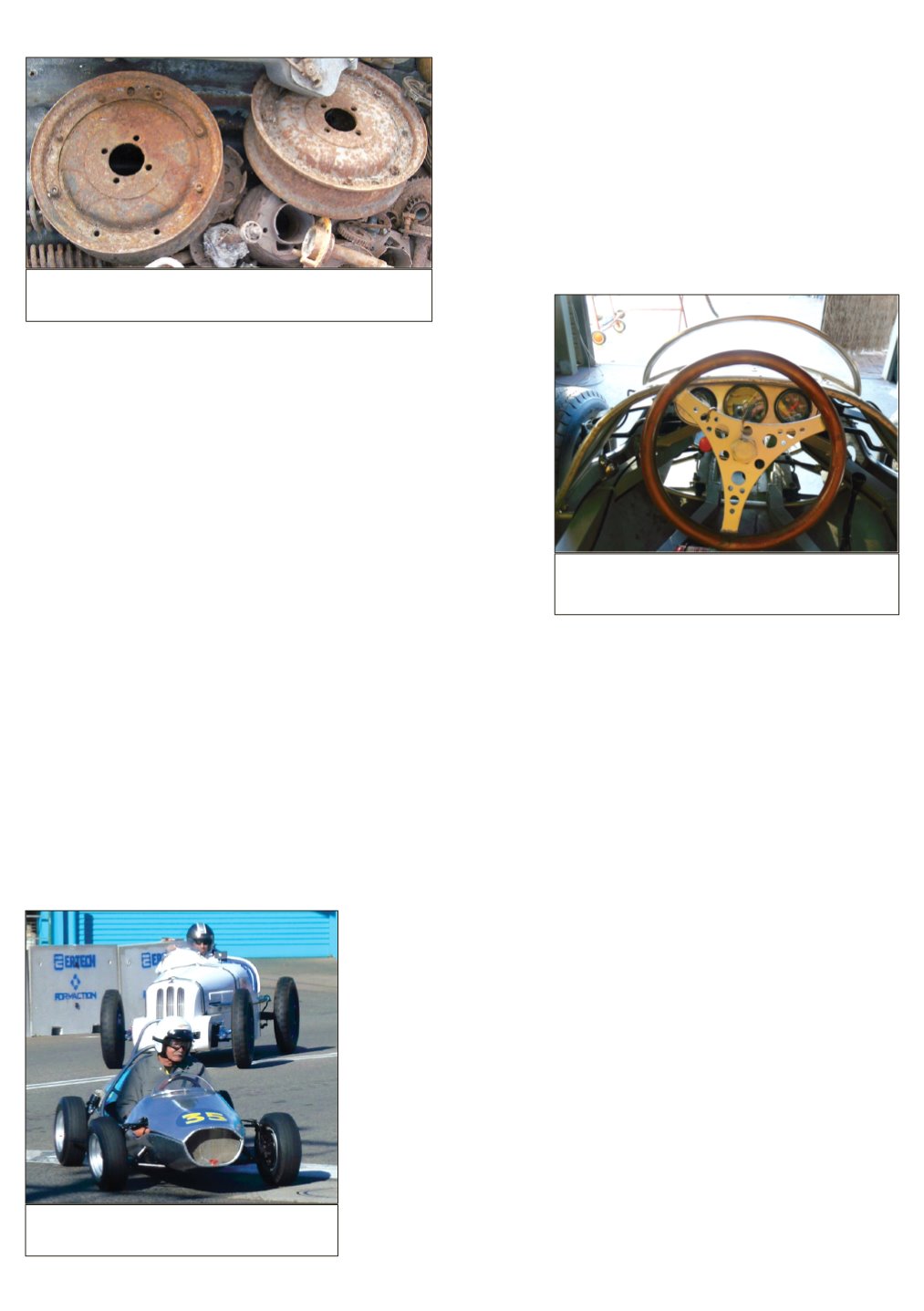
Other interesting items on the car include a steering
wheel built up from a rolled copper tube and the driver's
seat cut down from the pilot's seat from a Vultee
Vengeance. The rear axle is a specially built unit for
speedway use. The original fuel and oil tanks were
hydraulic fluid tanks taken fromwithin the Vengeance
wing. The current tanks are carefully made aluminium
replicas of the originals.
History
The car was first raced in 1952 or 1953 on the Kalgoorlie-Boulder Airport circuit. This was a
part sealed, part dirt track that ran around the service roads left after Nissen huts that served as
offices for a munitions factory were removed. It was an unofficial circuit and there are no
surviving records, hence the uncertainty about when the car first raced. Car builder Colin
Lonsdale remembers that there were around 20 cars racing in Kalgoorlie at the time.
Kalgoorlie-Boulder had a very large motor racing fraternity, many of whom never raced outside
the Kalgoorlie area. Distance was the killer, which seems odd when one considers the popularity
of racing at Lake Perkolilli in prewar years that saw competitors and spectators travelling from as
far as Perth and towns in the south west of the state. However, Lonsdale did compete in the
towns listed above and attended all State Championship meetings, although it is not clear
whether they were speedway or road racing titles. The best recorded result for the car seems to be
second overall in the 1962 speedway state titles.
The car as it stands is restored to its state in the early 1960s.
Larry estimates that it is 95% correct. A number of gauges
have been added to monitor engine condition, but other than
that the mechanical parts are as they were in the early 1960s.
Later in the 60s the car was fitted with a BSA Gold Star engine
to meet the under 500 cc requirement to run as a TQ. At that
time the driver was Merv Keast and the car was running in
speedway in the Goldfields.
Several different drivers have piloted the car over the years,
but it was always owned by Colin Lonsdale. Larry and Kerry
Coyle are only the second owners.
The car has raced both bitumen and speedway. Originally
built to race on the tarmac, it is fitted with brakes, and always
The neat steering wheel constructed
from rolled copper tube
One of the boxes of "spare parts" from which
Larry recovered useful bits for the rebuild
The Lonsdale Special leads the
White Mouse at Albany