


 18 / 32

18
The Lonsdale Special
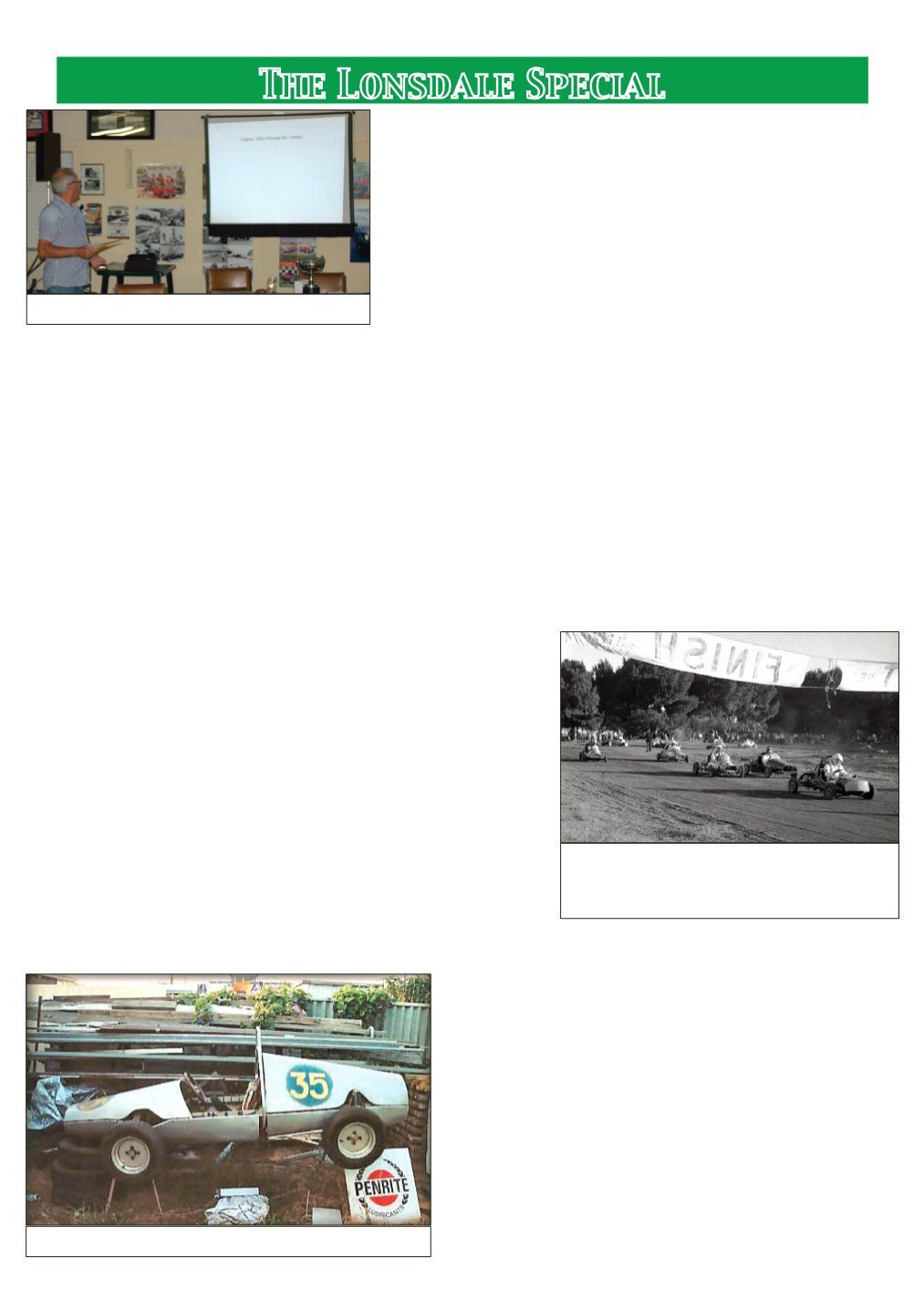
At our February general meeting, Larry Coyle displayed
his Lonsdale Special TQ and gave a PowerPoint
presentation of the history of the car.
He started out by explaining the origins of TQ racing in
Western Australia. TQ racing became popular after World
War II, but similar cars had been raced and hillclimbed in
Australia and overseas since at least the mid-1930s.
The postwar racers were the equivalent of the British 500
cc racers that became the basis for the international
Formula 3. They were truly a poor man's race car, using air-cooled engines extracted from
motorcycles. Most were rear engined, because of the ease of running chain drive from the
motorcycle gearbox to the rear axle, but front engined vehicles were also built in smaller
numbers.
It is reported that up to 200 cars were competing in its peak inWA in the early 1960s, many at
both bitumen and speedway events. Speedway cars differ from bitumen in areas such as brakes
and wheel alignment. Engine size was restricted in speedway cars, while road racing cars could
run whatever size engine fitted the class structure.
Air-cooled car events are still held regularly in the eastern states and New Zealand. Amagazine
called
Loose Fillings
has been covering the air-cooled racing scene since 1999.
For bitumen there were two divisions, ½-litre using 500cc JAP, Norton and BSA singles with a
few Triumph twins, and 1.0 litre using 1000cc [or 1100 cc,
Ed] JAP or Vincent V-twins and the like. Not many records
survive - which suggests localised competition and
probably unsanctioned racing.
In 1956 the Perth TQ Club was formed. Its first meeting
was "Around the Houses" in Mandurah. This club quickly
turned to speedway, but is still in existence today.
Lonsdale Special Number 35
The Lonsdale Special was obviously a "spare time" build as
it was started in 1946 but not completed until 1952 or 1953.
Two cars were built simultaneously, but only this one
survives.
It was raced in the Kalgoorlie-Boulder area on both dirt and bitumen tracks, at Albany at the
Strawberry Hill and aerodrome circuits, around the houses at Narrogin, Kellerberrin,
Burracoppin and Mount Barker, at Kambalda
Speedway and in speed trials at Lake Perkolilli. It
finished its racing career after blowing up in Mount
Barker in the early 1970s.
The car was largely built frommaterials recovered
from the wing of a scrapped Vultee Vengeance dive
bomber. The Vengeance aircraft were based at
Pearce during the war and were auctioned off for
scrap at Boulder after the war. The landing gear
hydraulics were recycled into bulldozers created
from army surplus General Grant tanks, but most
The Lonsdale as found, before restoration.
Clontarf Speedway, built by the WA
Speedcar Club in 1953, was run by
the Perth TQ Club from 1958-1963
Larry in mid-presentation