


 13 / 32

13
It was Different in the 1950s
Formula One was very different in the 1950s. The rules were much simpler for one thing!
Today the rules specify everything but the colour of the drivers' underwear, and I'm not 100%
sure about that. Engines are only part of a hybrid "power unit" and the
rules lay down the number of cylinders, the configuration and even the
spacing between the cylinder bores!
Signores Colombo, Jano, Lampredi and the
rest would have been horrified. In 1954 the
new Formula One specified engines of up to
2500 cc if unsupercharged or up to 750 cc supercharged. How the
designer achieved that and what the car looked like were up to him.
The cars that rolled on to the Grand Prix grids in
1954 were enormously varied. Engines had any
even number from four to eight cylinders.
Chassis were built up from steel tube but only the
Mercedes-Benz (M-B) had a full space frame. All
cars were front engined and rear drive except the entirely unsuccessful
DB Monomille, which was front wheel drive with the engine mounted
ahead of the front wheels! DB was one of only two marques that took advantage of the 750 cc
supercharged option. The other was the Italian Giaur, which raced only once.
Rear suspension on all but one of the competitive cars was some variation
on the De Dion rear axle. M-B had a low pivot swing axle system. All the
leading cars had wishbone front suspension and wire wheels and drum
brakes were almost universal. Connaught had "corners by Dunlop", alloy
wheels and disc brakes from that company.
Connaught and M-B shared two unusual features. Both
had fuel injected engines and both presented fully streamlined cars with
enclosed wheels. Connaught was the only team with its own wind tunnel,
so it is not surprising that the British car had the more effective shape. The
German car suffered from what the late L.J.K Setright called "aerodynamic oversteer" that was
countered by designing a huge amount of understeer into the suspension. That worked alright
at Reims and Monza but made the car a real pig to drive around Silverstone.
Connaught's problem was more practical. To access the oily bits, the whole
top half of the body shell lifted off as one piece, and it wasn't easy to find
somewhere in a crowded pit area to put the thing down! Not only that, but
being very light, it tended to blow away. Both teams reverted to conventional
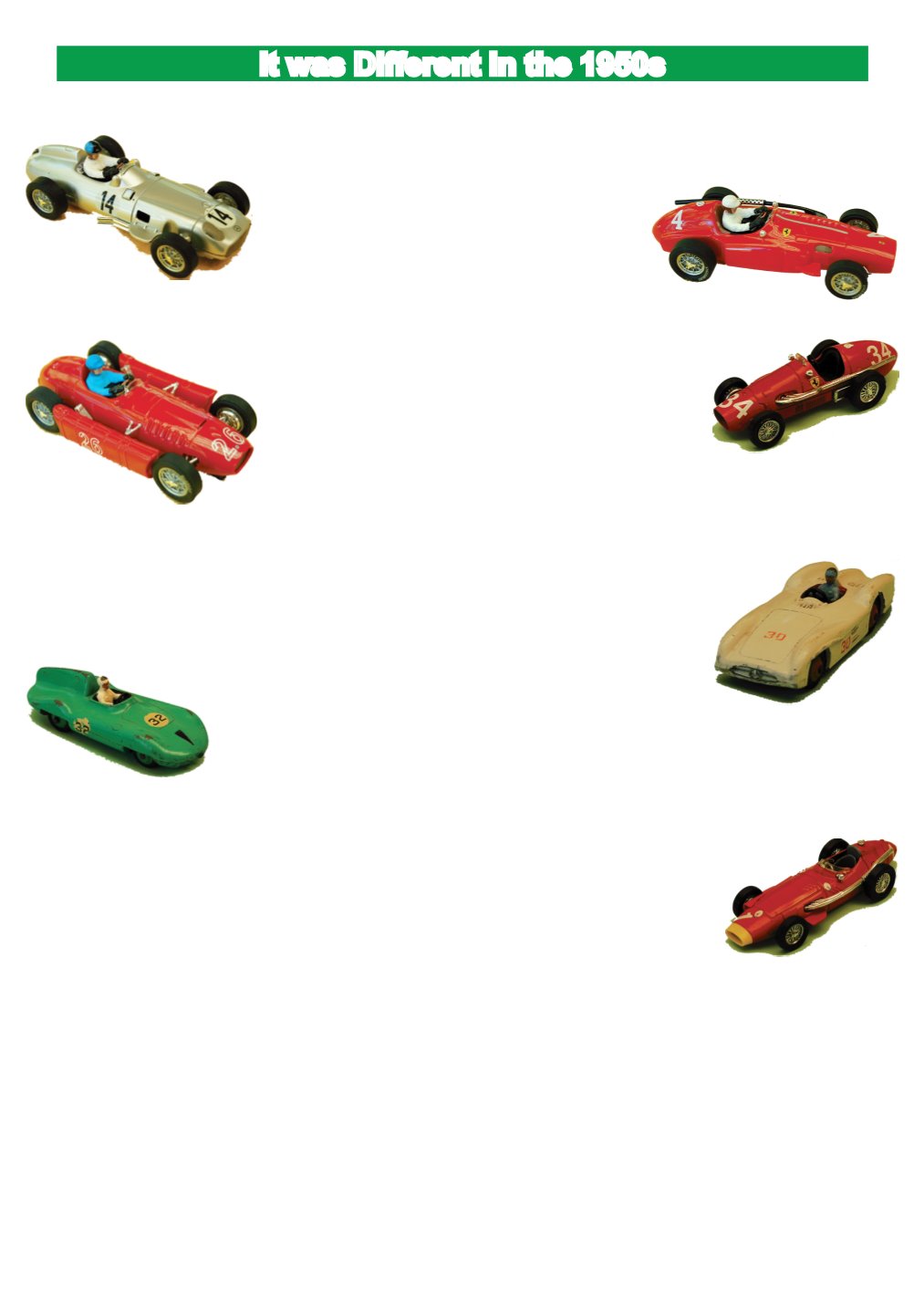
open wheeled models (see top left).
Back to those engines - Ferrari had two different four-cylinder engines, the Tipo 625
developed from the 1952-3 two-litre Tipo 500 and the Tipo 553 Squalo but mixed and
matched components from both engines in both chassis over the year. Connaught used an Alta
four developed from a 1930s design, which was fast but fragile. Uniquely, the Connaught drove
through an ENV pre-selector gearbox, the last marque to use such a transmission in F1.
Maserati and Gordini had six cylinders. Both M-B and Lancia had eight cylinders. The M-B
had a straight eight laid over 30 degrees from the horizontal with desmodromic valves and
drive taken from the centre of the crankshaft. The Lancia's V8 was part of the chassis, forming
the only connection between the rear of the frame and the front suspension. Both M-B and
Lancia ran the driveshaft down the side of the cockpit to a rear transaxle, but the Lancia also
mounted the clutch at the rear, as in its road cars.
Mercedes-
Benz W196
M-B W196
Lancia D50
Ferrari Squalo
Connaught
Maserati 250F
Ferrari
Tipo 625