

 26 / 32

26
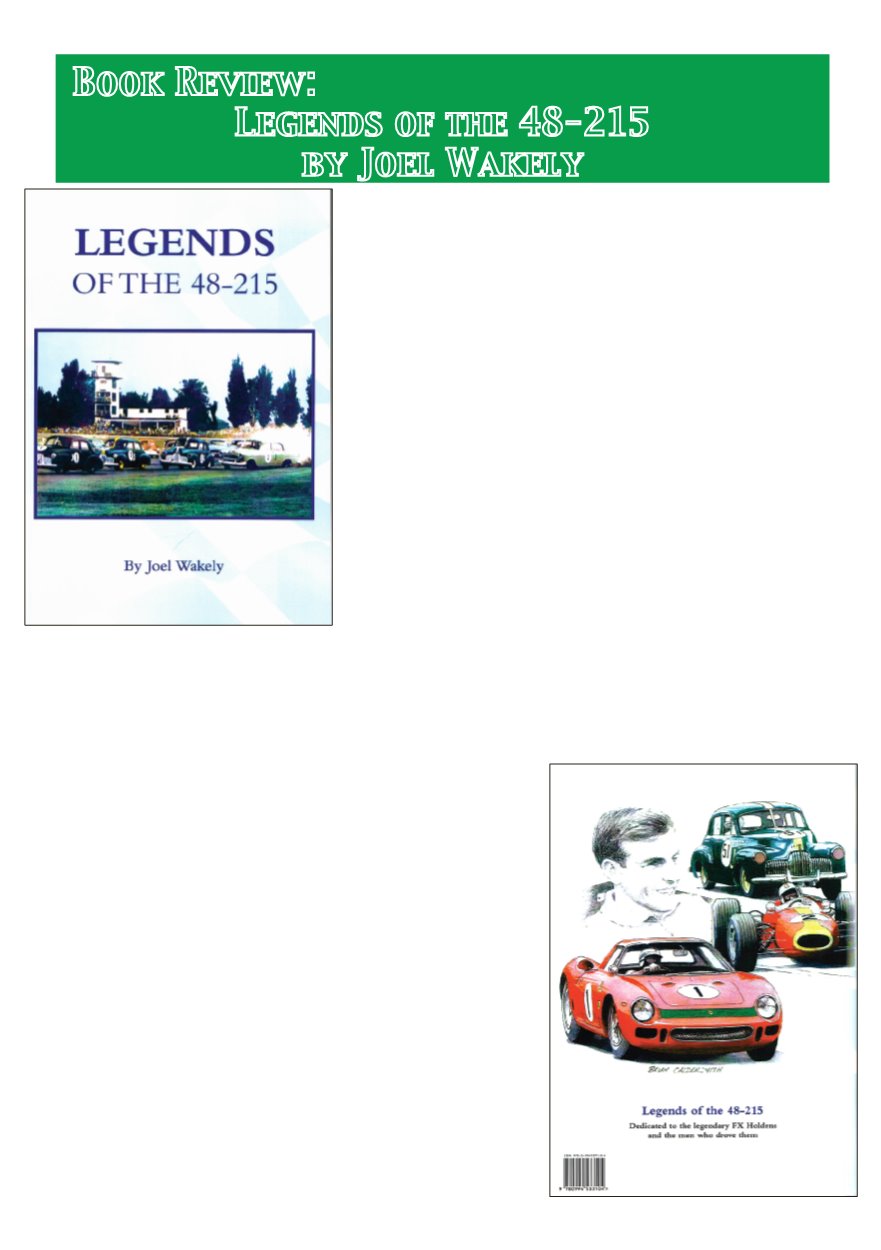
This book is a celebration of the "humpy" Holden in its
purest form, the 48-215.
Writer Joel Wakely was proprietor of the BP Boomerang
Service Station that gave Spencer Martin his first
competitive drive. That was in the Boomerang entered
48-215, which was about the quickest of its kind in 1962
and 1963.
While the Boomerang car and the recently built replica of
it are fully described in the book, there are ten featured
cars including the surviving Holden prototypes, early
production models and even an immaculately restored FJ.
The Brock Holden that he raced at Goodwood and the
Tony Gaze, Lex Davison, Stan Jones 1953 Monte Carlo
Rally car are also described.
Some of the technical information included in the
development story of the Boomerang car provides a useful
warning for those intending the run a humpy in Group
N(a). It also explains why the Brock car had a Vauxhall
crankshaft.
Brief racing histories of Holden racing drivers from the 1950s and early Appendix J days
include the obvious names like the Geoghegans, Tom, Leo and Ian, and others not so well
remembered as Holden drivers such as Bo Seton, Brian Muir. Lou Kingsley and Jack Myers
are probably remembered by only the older members of the VSCC.
The excesses of the Formula Libre cars with roofs of the 1950s were reined in by CAMS
withAppendix J from 1960, and Wakely describes what
was needed to build an Appendix J Holden.
There are a couple of annoying (to me) lapses. Cars are
described as being in "concourse" condition, when the
correct term is
concours,
a French word meaning
competition. I blame the ubiquitous spell-checkers, which
insist on adding the "e" on the end. Oddly, the other error
works the other way. The Lotus Elans in Chapter 12 have
gained an acute accent over the "E", which might be
correct in French but was never there in the Lotus
catalogue. Pedants will also note that the Mustangs
described as 1964 models in Chapter 12 are actually late
1960s models.
All in all this book is a fascinating history of a real
"golden age" of Australian touring car racing, told by
someone who was at the cutting edge of contemporary
touring car technology.
Bob Campbell
Book Review:
Legends of the 48-215
by Joel Wakely