


 3 / 68


Vol 5 No 5 October/November 2016
Australian Journal of Dementia Care
3
Comment
by Dr Jane Thompson
2
News
4
Research News
65
Resources/Events
67
Project updates & viewpoints
The story of dementia: Faith Gibson and Pam Schweitzer
8
John Killick continues his series exploring the history of dementia through the stories of individuals
Allies in care: optimising life with dementia
10
JacquelineWesson, Jamie Hallen,Atosha Clancy and Glen Pang explain the positive contribution allied health professionals can make
to the lives of people with dementia, their carers and families, and introduce two new guides for health professionals and consumers
Features
Viewing art brings ‘in the moment’ pleasure
13
A recent evaluation of the Art and Dementia program at the Art Gallery of NSW shows that viewing art brings ‘in the moment’
pleasure for people with dementia, as well as opportunities for storytelling, reminiscence and conversation
Sustaining the success of person-centred dementia care
16
Not-for-profit aged care provider Eldercare completed the implementation of its Dementia Excellence Program at 12 residential
facilities across the greater Adelaide and Yorke Peninsula regions earlier this year
BPSD: alternative understanding of a well-accepted term
20
Christine Bryden gives a brief overview of BPSD and, from the perspective of a person living with dementia, proposes an experiential
understanding of the acronym to prompt improved responses by caregivers to these non-verbal communications
Inside
this issue...
Regulars
16
For all who work with people with dementia
Vol 5 No 5 October/November 2016
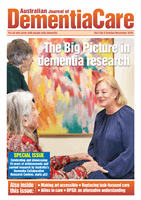
Cover:
Participants in the Art Gallery of New
SouthWales Art Access Program, with Mary
Webb’s
Joie de vivre
1958, purchased 2011, ©
Estate of Mary Webb.
Photo: Felicity Jenkins, AGNSW
The Big Picture Journey of Firsts in Dementia Research
24
The DementiaKT Hub: translating research into practice
26
Belinda Goodenough and Tracy Higgins introduce The DementiaKT Hub – a new one-stop
online destination for the latest research-based dementia resources involving DCRC expertise
DOMS lets clinicians ‘speak the same language’
28
The Dementia Outcomes Measurement Suite (DOMS) is a free, evidence-based web platform
designed to assist clinicians improve the assessment of dementia
GPCOG: a fast, reliable tool to help GPs diagnose dementia
29
In the 15 years since its development in Australia, the General Practitioner Assessment of
Cognition (GPCOG) has proven to be an invaluable tool for first-line clinicians
Creating a dementia-friendly society, starting with kids
30
Jess Baker presents an update on the Kids4Dementia project, an innovative classroom-based
program designed to educate the next generation about dementia
The case for a National Dementia Registry in Australia
33
The need for a clinical registry to collect data on dementia in Australia was raised publicly in
2013. Karolina Krysinska, Perminder Sachdev and Henry Brodaty explain the benefits
Inspiring action: Australian team at forefront
of young onset dementia research
35
Australia’s INSPIRED Study is leading young onset dementia research internationally, with the
aim of improving services and support for this previously under-researched group
Cognitive rehabilitation for people with dementia:
what is it and does it work?
37
Alex Bahar-Fuchs,Aleksandra Kudlicka and Linda Clare describe how cognitive rehabilitation
can be used as part of an enablement approach to support people with dementia
Trial HALTs unnecessary use of antipsychotics
40
Preliminary results from the HALT Project show that the majority of people with dementia in aged
care homes who are prescribed antipsychotic medications to control BPSD do not need them
CST guide designed for Australia
42
Daniella Kanareck, Natalie Narunsky and Brian Draper have developed an Australian guide to
complement the Cognitive Stimulation Therapy (CST) manuals used in UK care settings
GP education supports timely diagnosis
44
Dementia is not yet curable, but the benefits of early diagnosis include access to specialised
health care, appropriate interventions and local support services
Dementia prevention priorities in General Practice
45
GPs and Practice Nurses looked at the evidence for dementia prevention and opportunities for
getting the message to their patients
Four warning signs of nursing care issues
46
Kasia Bail explains how four common, but potentially preventable, complications experienced
by older patients with dementia in hospital can be useful indicators of quality of care
Strategies for changing staff care practices
48
Successfully changing staff practice in aged care homes to improve outcomes for residents is
not easy, but a recent study has identified strategies that can be used
Checking the evidence for Appreciative Inquiry
49
Even the smallest changes in dementia care delivery can be challenging to implement.
Appreciative Inquiry is one practice-change approach that’s gaining popularity in Australia
Connections in care count
52
Anne-Nicole Casey and Janet Mitchell are using social network analysis (SNA) in their research to
investigate the relationship networks of people with dementia living in long-term residential care
Measuring the importance of getting out and about
54
A Sydney study is using a new ‘lifespace’ app to explore community mobility and challenges for
people with dementia.The results will be used to develop new interventions
Taking steps to reduce risky aspects of wandering
57
Margaret MacAndrew, Elizabeth Beattie, Elaine Fielding and Catherine Wyles present the views of
care staff on the effectiveness and feasibility of a new walking program for people with dementia
Tools to build care workers’ evaluation skills
59
Dementia SPEAKE is a series of free online resources to help dementia care workers develop
the skills to formally evaluate their programs and services. Megan Heffernan,Tiffany Jessop
and Ruby Tsang explain
BPSD: getting good practices into everyday practice
60
Kim Burns, Ranmalie Jayasinha, Belinda Goodenough and Henry Brodaty report on experiences
of dementia care staff in putting into practice knowledge of evidence-based interventions
DCRC Special Issue features: The Big Picture in Dementia Research