


 8 / 68

8
Australian Journal of Dementia Care
October/November 2016 Vol 5 No 5
The story of dementia: Faith
Gibson and Pam Schweitzer
F
or many, memory loss is
what first comes to mind
on thinking about
dementia. And again, what
comes to mind for most people
when they think of memory is
names, dates, people, places.
But there is far more to
memory than this – there is
memory for emotion, habit
and action. If we open our
minds to the depth and
complexity of memory, we can
begin to explore its
possibilities for enhancing the
quality of life both for people
with the condition and for
those close to them. This
initiative is called
reminiscence. The movement
has succeeded in establishing
life history and medical
history as complementary
approaches and of equal
importance.
Faith Gibson
A key person during the past
three decades of the
reminiscence movement has
been Faith Gibson. Her quiet-
spoken but authoritative
presence has dominated
gatherings and discussions on
the subject. Born in Australia,
but resident for all of that
period in Northern Ireland,
she became Professor of Social
Work at the University of
Ulster. Her books on the
subject –
Reminiscence and recall
and its largely rewritten and
renamed fourth edition,
Reminiscence and life story work,
and
The past in the present
are
notable for their combination
of intellectual rigour and user-
friendliness, with their charts,
check lists, practice examples
and application exercises.
In the first part of
The past in
the present
Faith examines
memory, its dynamic and
reconstructive nature, and the
advantages of encouraging
reminiscence in a social
context. Faith has always
viewed reminiscence as
valuable in itself, but also as a
fruitful path into other creative
artistic interventions.
She goes on to make a
fundamental claim for it in
terms of preservation of the
personality (of particular
relevance, of course, to those
with dementia):
“Regardless of age and
circumstances, if one does not feel
valued by others, it is difficult to
value oneself. People can be
reminded of their unique identity
and value by recalling details of
their past achievements and the
esteem in which they were once
held. Whether people’s lives have
been long or short, recalling their
personal life stories reminds them
and others around them of each
person’s singular identity and
value as an individual. It helps
them to continue valuing
themselves, to retain control at a
stage in life when events,
opinions, circumstances, and
other people may be eroding their
independence and paying them
less respect. By reminding
themselves of who they used to be,
they may retain a stronger sense
of self in the present”
(Gibson
2004 p31).
Chapter three constitutes
Faith’s most original
contribution to the literature.
Here she outlines the special
gift of reminiscence to staff
development:
“
Encouraging care staff to
review their own lives can bring a
heightened sense of their own
uniqueness and, by implication,
the uniqueness of the people
whose lives they share in the
course of their daily work. In a
simple consciousness-raising
training exercise, for example,
staff could be asked to name or list
three to five characteristics that
make them different from other
people. This provides rich
material for discussions about
sameness, difference, and our
need to be seen as unique
individuals yet members of a
group”
(Gibson 2004 p55).
She goes on to say:
“Through engaging in life
history work, staff members
glimpse the older person as he or
she used to be. With new eyes,
they see the long, intricate, often
heroic journeys travelled by each
individual. This new view
radically shifts perceptions and
changes relationships. Through
this fresh understanding, care can
be transformed. If staff members
become intrigued by these
intensely unique histories, then
not only do their conversations
become more meaningful but also
their sympathy and empathy for
the person
–
regardless of current
frailty, mood and behaviour
–
is
greatly enlarged”
(Gibson 2004
p56).
Pam Schweitzer
Pam Schweitzer had a career
in theatre education, and
gradually became fascinated
by reminiscence and oral
history. In 1983 she founded
the Exchange Theatre Trust in
London and remained its
Artistic Director until 2005.
She opened the first
Reminiscence Centre there in
1987, and this enthusiasm
expanded into the founding of
the European Reminiscence
Network in 1993, with
partners in 16 countries. As
coordinator, an almost
superhuman task for someone
even with her dynamism, Pam
in the succeeding years has
organised conferences,
seminars, festivals and
training courses. In a number
of these projects she has been
assisted by Faith Gibson.
Pam’s book
Reminiscence
theatre
(Schweitzer 2006) has a
wider remit than dementia.
Her book written with Errolyn
Bruce,
Remembering yesterday,
caring today
(2006), however,
concentrates on reminiscence
with people with the
condition.
Remembering Yesterday,
Caring Today
This is one of the most
important large-scale projects
so far attempted with people
with dementia, far-reaching
both geographically and by
ambition. The project involves
John Killick
continues his series of articles for
AJDC
, exploring
the history of dementia through the stories of individuals
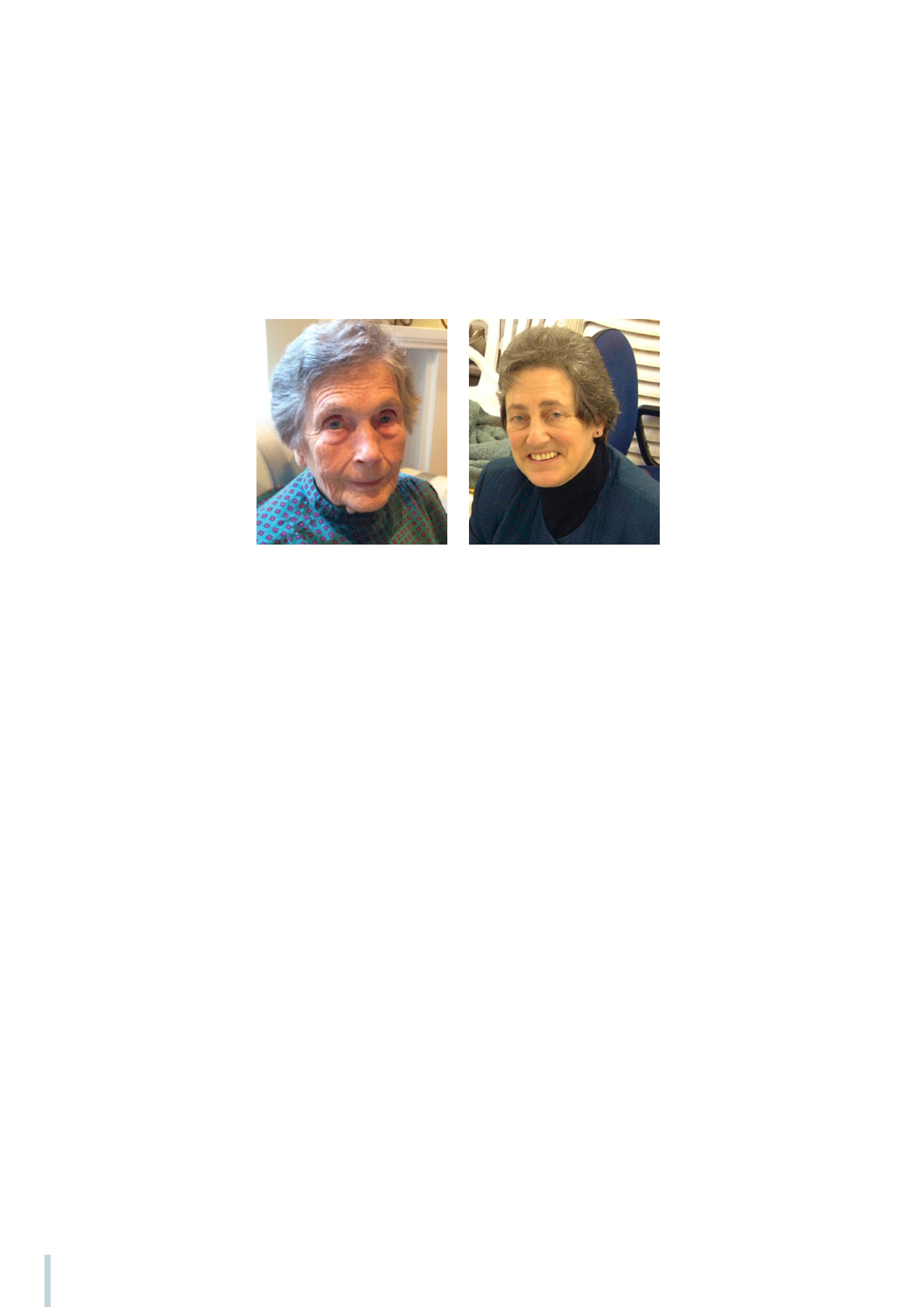
Faith Gibson (left) and Pam Schweitzer