


 11 / 68

Vol 5 No 5 October/November 2016
Australian Journal of Dementia Care
11
There’s a list of national
contacts for organisations that
can direct people to allied
health professionals in their
area, such as MyAged Care
and professional associations
such as the Australian
PhysiotherapyAssociation.
Allied health professionals can
also be accessed through a
person’s primary health
network, local health service/
hospital, GP or geriatrician.
A four-minute film promotes
the guides and is available on
both the ACI andAlzheimer’s
Australia websites.
Integrated approach
There has been tremendous
growth in knowledge over the
past decade about dementia
and how it affects the person
and those close to them.
Australia’s new
Clinical practice
guidelines and principles of care for
people with dementia
states that
“people with dementia should
not be excluded from any
health care services because of
their diagnosis, whatever their
age” (Guideline Adaptation
Committee 2016).
This recommendation reflects
the contribution allied health
professionals can make,
especially in areas not
previously considered part of
dementia health care, such as
rehabilitation, behaviour
management and palliative
care. There is also increasing
recognition of the value of an
inter-professional healthcare
team approach: where a group
of health professionals
collaborate to frame a common
understanding and develop an
integrated approach to
dementia health care.
The following examples from
the guides demonstrate just
some of the ways allied health
professionals may partner with
people with dementia.
Shaun’s story
Shaun had always worked
hard. When he developed
dementia and had to retire
earlier than planned, he needed
to make some big adjustments.
But adjust he has. He started
tending a vegetable patch at
home, and now volunteers at
two community gardens,
earning a TAFE certificate along
the way.
He also regularly attends a
coffee club organised by a
dementia advisor. Between 10
and 25 people, some with
dementia, some carers, meet at
the same café once a fortnight
to talk and relax. Adementia
advisor is always present to
provide support and
information. Shaun found the
coffee club so enjoyable he’s
now going to others in
neighbouring areas: “I enjoy
them. I like to feel I can support
and encourage people,” he
says. “This is a good way of
helping others out.”
Social worker and dementia
advisor, Sue, explains that the
aims of the café are to promote
social inclusion and peer
support, and to offer ongoing
information and support in a
relaxed way: “They are a great
way for people to feel
connected with each other”.
“I think two of the most
valuable aspects of this model
are the peer support, and the
fact that it is appropriate for
people with dementia from the
very early stages and
throughout the progression of
the disease,” Sue says.
“Peer support is very
powerful. I can spend a lot of
time informing people about
services, but being able to talk
to others that receive services is
far more effective in helping
people to accept them. Recently
one of our participants was
admitted to hospital and
needed to move into residential
care; his wife didn’t drive so a
couple of other carers from the
group took her around to look
at facilities and supported her
throughout this very difficult
time.”
“I find being involved in the
cafes very personally and
professionally rewarding.”
Daniel’s story
Acouple of years after being
diagnosed withAlzheimer’s
disease, Daniel joined a pilot
study on cognitive stimulation
therapy (CST) at a metropolitan
teaching hospital. He joined a
group with eight others who
were also living with dementia.
Social workers, nurses and an
occupational therapist were
involved in running the weekly
groups, with two staff each
week sharing the role.
Although he questioned the
reason for attendance each
week, Daniel never missed a
session. He made friends with
another man and they caught
A call to action
Dementia means living with change. The
impact of dementia on the person and
those close to them changes as the
condition changes.
Joan Jackman (pictured) cared for her
husband Michael, who had a younger
onset dementia. Joan’s experience in
supporting Michael through the changes in
his cognitive, perceptual and language
abilities as the condition progressed, together with her
professional experience as an occupational therapist, has
inspired her and other consumer representatives from
Alzheimer’s Australia to issue a ‘call to action’ for allied health
professionals.
“We want all allied health professionals to understand the
complex but varied needs of people living with dementia and the
vital role they play in supporting people with dementia to live the
life they deserve,” Joan said. “Allied health professionals are
enablers – working with the person with dementia and their
carer, they help people adjust to their individual changing
abilities and capacities.”
“Our experience was that there was not as much support for the
disabilities that come with dementia as for other types of
disability, such as stroke and brain injury for example, an area I
worked in for many years. I knew the difference that allied health
professionals could make and it was incredibly frustrating to feel
like we couldn’t access that help,” Joan said.
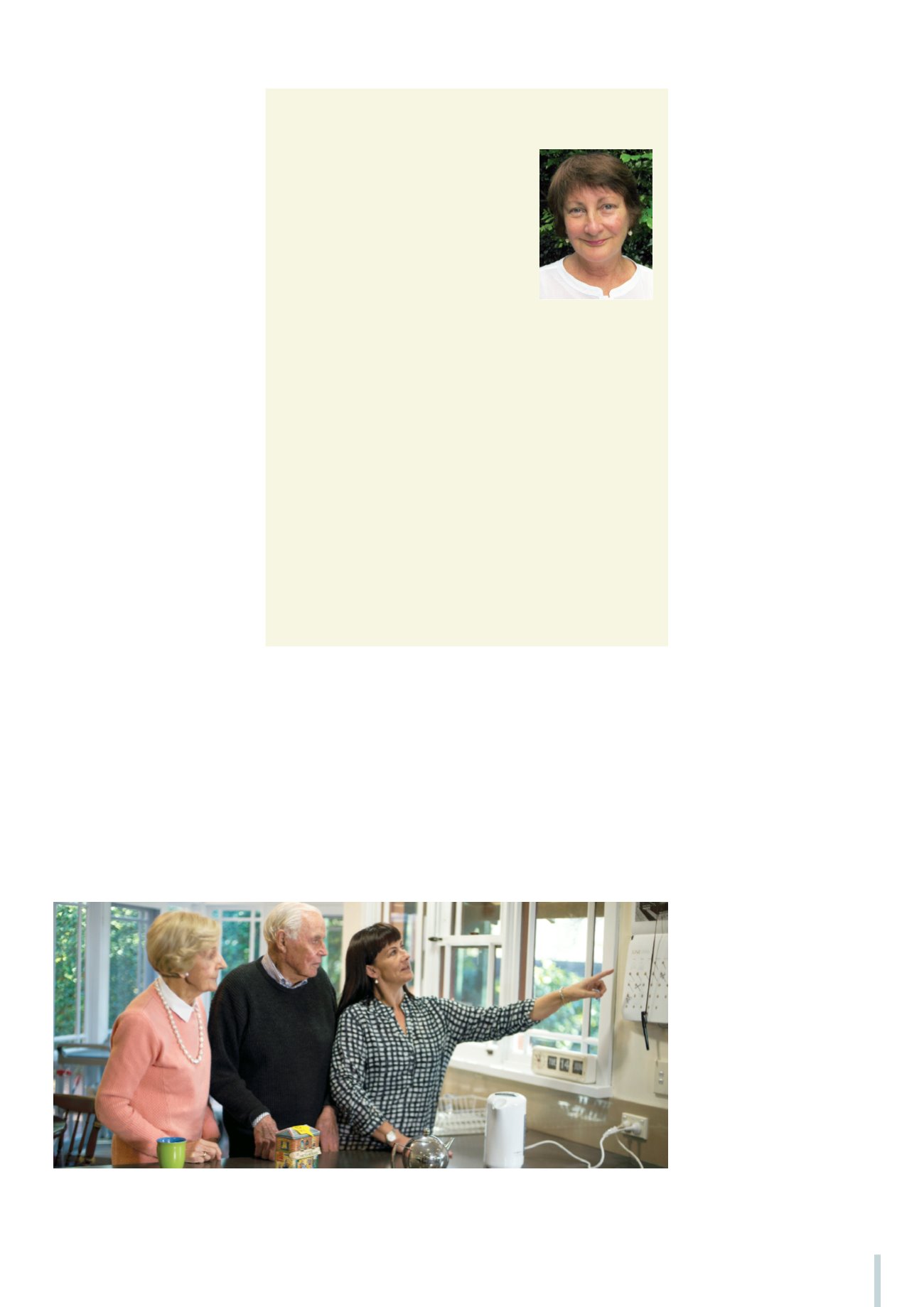
Allied health professionals can make a positive difference to the lives of people living with dementia and
their carers, with strategies for minimising the impact of memory loss, keeping physically and mentally
active and staying socially connected.
Photos: ACI