


 16 / 68

16
Australian Journal of Dementia Care
October/November 2016 Vol 5 No 5
culture in Australia:
A Statistical Overview
2010.
Basting AD (2009)
Forget memory: creating
better lives for people with dementia
. Baltimore:
Johns Hopkins University Press.
Bruner JS, Jolly A, Sylva K (1976)
Play: its role in
development and evolution
. New York: Basic
Books.
Cohen GD (1988)
The brain in human aging
.
New York: Springer Publishing Company.
Cohen-Mansfield J, Marx MS, Freedman L,
Murad H, Thein K, Dakheel-Ali M (2012) What
affects pleasure in persons with advanced stage
dementia?
Journal of Psychiatric Research
46(3) 402-406.
Cutler D (2009)
Ageing artfully: older people and
professional participatory arts in the UK
. United
Kingdom: The Baring Foundation.
Epp T (2003). Person-centred dementia care: a
vision to be refined.
The Canadian Azheimers
Disease Review
April, 14-18.
Flatt JD, Oakley MA, Gogan J, Varner T, Lingler
JH (2014) Subjective experiences of an art
museum engagement activity for persons with
early-stage Alzheimer’s disease and their family
caregivers.
American Journal of Alzheimer’s
Disease And Other Dementias
30(4) 380-390.
Guzman-Velez E, Feinstein JS, Tranel D (2014)
Feelings without memory in Alzheimer disease.
Cognitive and Behavioural Neurology
27(3) 117-
129.
Hydén L-C (2014) Cutting Brussels sprouts:
collaboration involving persons
with dementia.
Journal of Ageing Studies
29
115-123.
Kenning G (2015) ‘Fiddling with threads’: craft-
based textile activities and positive well-being.
Textiles: Journal of Cloth and Culture
13(1) 50-
65.
Killick J (2013)
Dementia positive
. Edinburgh:
Luath Press Ltd.
Maslow AH (1970)
Motivation and personality
(2d ed). New York: Harper & Row.
Mittelman M, Epstein C (2006)
New York
University evaluation of Meet Me at MoMA
87-
105. New York: New York University.
Renehan E, Dow B, Lin X, Blackberry I, Haapala
I, Gaffy E, Hendy S (2012)
Healthy ageing
literature review
. Completed by NARI and COTA
for the Victorian Department of Health.
Rogoff B (1990)
Apprenticeships in thinking.
New York: Oxford University Press.
Sabat SR (2006) Implicit memory and people
with Alzheimer’s disease: implications for
caregiving.
American Journal of Alzheimer’s
Disease And Other Dementias
21(1) 11-14.
Thomson L, Chatterjee H ( 2013)
UCL Museum
Wellbeing Measures Toolkit.
Paper presented at
the AHRC, London.
Vygotsky L (1978)
Mind in society: the
development of higher psychological
processes
. Cambridge, MA: Harvard University
Press.
Zeisel J (2009)
I’m still here: a breakthrough
approach to understanding someone living with
Alzheimer’s
. New York: Avery.
Dr Gail Kenning is a researcher in the Faculty
of Arts and Social Sciences, University of
Technology Sydney and Honorary Reader in
Design for Ageing and Dementia with CARIAD
(Centre for Applied Research in Inclusive Art and
Design), Cardiff Metropolitan University, Wales,
UK. Contact Gail at:
gail@gailkenning.comW
e conceived our Dementia
Excellence Program in 2010 and,
six years later, believe we’ve
learned the formula for improving the
well-being and quality of life for our
residents. On average, 56% of residents at
our facilities have a medical diagnosis of
dementia and that number has reached
as high as 88% at one site (Boerth 2016).
To meet the need for high-quality
dementia services, we transformed our
culture by replacing ‘task-focused’ care
with a genuine ‘person-centred’
approach.
Promoting resident choice
Person-centred support has been defined
as “treatment and care provided by
health services that places the person at
the centre of their own care and considers
the needs of the older person’s carers”
(Victorian Department of Human
Services 2003). The Australian College of
Nursing believes ‘person-centredness’ is
an ideology that underpins the delivery
of nursing and health care generally
(ACN 2014). To us, it’s care that enables
real resident choice. We identified five
areas where residents can be empowered
to make their own decisions:
• Individual hygiene preferences (when
and how a resident wants to bathe or
shower).
• Mealtimes (when, how and what a
resident likes to eat).
• Sleep and wake patterns (when and
how a resident prefers to rise and settle).
•Meaningful engagement (which activities
a resident wants to participate in).
• Preferences (how a resident likes to
live, what they enjoy and what gives
them purpose).
Our dementia care is now less
structured. We’ve made simple changes
to facilitate real choices. Mealtimes have
become shared experiences where
residents and carers eat together. Items of
interest, half-completed tasks which
invite engagement and books are
accessible for residents to connect with at
any time. There is laughter, music,
singing and dancing. Spontaneity is
celebrated and a level of untidiness
accepted as a sign of life being lived.
This article explains how we
successfully introduced the Dementia
Excellence Program and identifies the
obstacles and challenges we have
overcome to ensure the long-term
sustainability of the program beyond
implementation.
Sustaining the success
Not-for-profit aged care provider Eldercare completed the
implementation of its Dementia Excellence Program at 12 residential
facilities across the greater Adelaide and Yorke Peninsula regions
earlier this year.
Sarah Jamieson
,
Karen Parish
and
Sue Krake
explain how the organisation successfully overcame challenges to
prove that a truly ‘person-centred’ approach to dementia care
enhances resident well-being
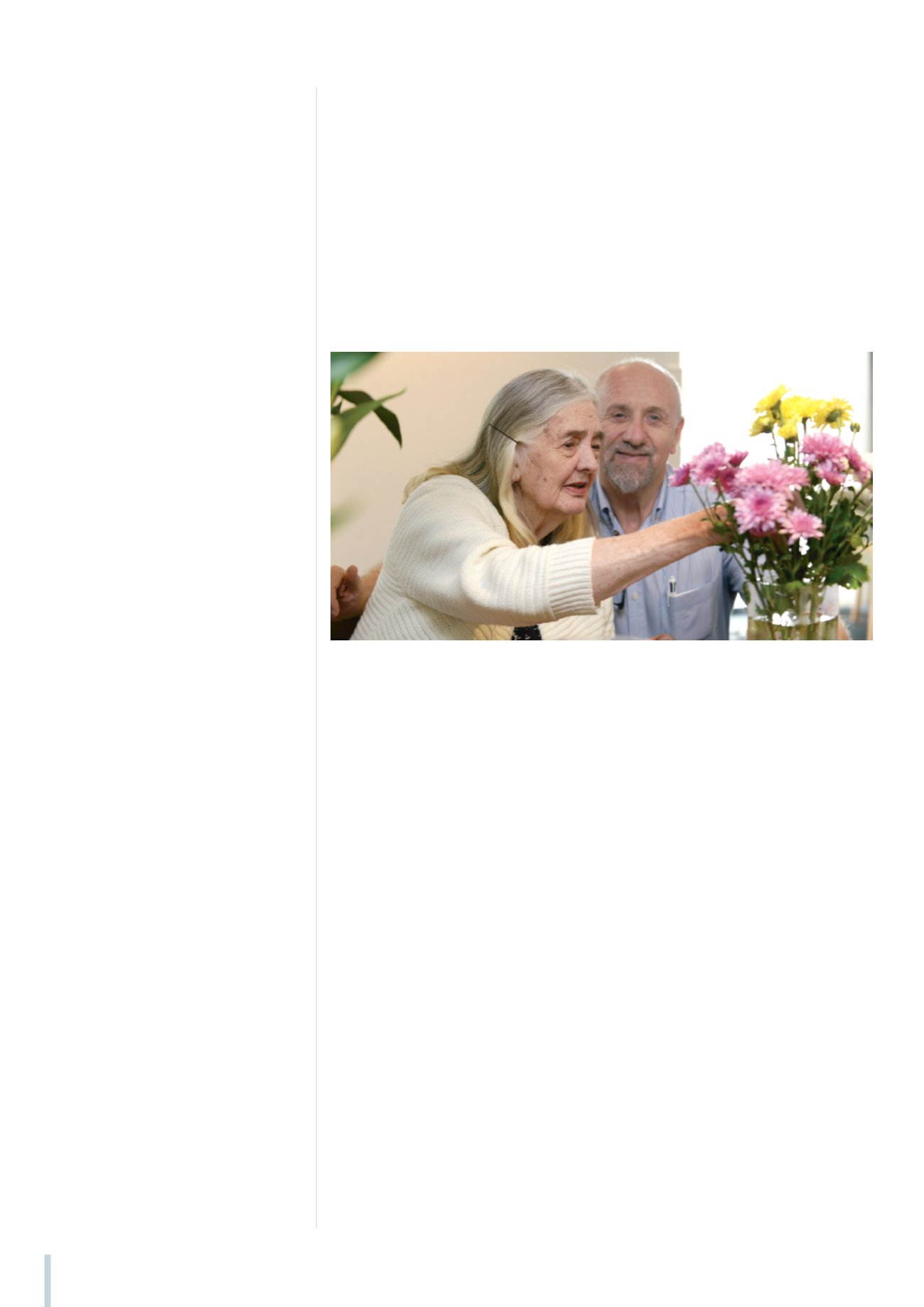
Eldercare’s staff now do things ‘with’ residents and not ‘for’ them.
All photos courtesy Eldercare