


 19 / 68

Vol 5 No 5 October/November 2016
Australian Journal of Dementia Care
19
added little value when compared to
mapping the ‘Top Five’ residents who
exhibit the most severe, or frequent,
distress and responsive behaviour. It was
decided that post-implementation
mapping could be modified to focus on a
group of 12 residents in each MSU. Each
group would constitute a mix of the ‘Top
Five’ residents; those who had been
previously mapped and those who were
new to the unit. These group assessment
results have now become the key
indicators of the program’s impact on
resident outcomes.
To help drive ongoing sustainability at
each site, responsibility for the program
has been incorporated into Eldercare’s
new clinical leadership structure.
Through a process of review and
response, the program has been modified
and has transitioned from being a stand-
alone project to becoming a pivotal
philosophy within Eldercare’s model of
care.
Learning important lessons
Passion and enthusiasm are important
ingredients for success but they do not
guarantee sustainability. Practical
considerations, and risks, including
human and financial resource
management, staff attrition and
employee workloads must be planned
for. Recurrent program review and
refinement are also vital and we continue
to conduct regular post-implementation
surveys of resident well-being and staff
attitudes.
The decision to embrace dementia
excellence concepts as ‘business as usual’
and incorporate them into our model of
care will secure the program’s long term
future. The results, and feedback, we
have from carers and family members
prove our Dementia Excellence Program
is a success. We’ve learned the key to
improving resident well-being and
quality of life lies in an overarching
‘person-centred’ approach where
individual choice is promoted through
small and simple changes.
Sarah Jamieson is the Dementia Excellence
ProgramManager at Eldercare; Sue Krake is the
Acting Operational Services Executive; and Karen
Parish is the former Operational Services Executive.
To follow up on this article contact Sarah Jamieson
at
sarah.jamieson@eldercare.net.au.
References
Australian College of Nursing (ACN) (2014)
Person-centred care. Position statement.
Available at:
https://www.acn.edu.au/sites/default/files/advocacy/submissions/PS_Person-
centered_Care_C2.pdf (Accessed 09/09/2016).
Boerth S (2016)
Diagnosis report. Dementia.
Eldercare.
Healthwise Medication Services,
South Australia.
Boerth S (2016)
Report on antipsychotic use,
dementia only: Eldercare
. Healthwise
Medication Services, South Australia.
La Trobe University (2013)
The person centred
care assessment tool (P-CAT)
. Available at:
http://arrow.latrobe.edu.au:8080/vital/access/m
anager/Repository/latrobe:35130 (Accessed
04/09/2016).
Pool J (2012)
The pool activity level (PAL)
instrument for occupational profiling: a practical
guide resource for carers of people with
cognitive impairment.
London: Jessica Kingsley
Publishers.
University of Bradford School of Dementia
Studies (2016)
Dementia care mapping.
Available at:
http://www.bradford.ac.uk/health/dementia/dementia-care-mapping/
(Accessed 04/09/2016).
University of Bradford School of Dementia
Studies (2015)
An introduction to dementia care
mapping.
Available at:
http://www.bradford.ac.
uk/health/dementia/dementia-care-
mapping/file-downloads/Introduction-to-
Dementia-Care-Mapping.pdf?cta=Download
(Accessed 14/09/2016).
Victorian Department of Human Services (2003)
What is person-centred health care? A literature
review.
Available at:
https://www2.health. vic.gov.au/Api/downloadmedia/{957EF817-
D47F. (Accessed 09/09/2016).
A ‘break task’ approach to breakfast
Sue Krake
was Site Operations Manager at Eldercare Evanston Park where the
Dementia Excellence Program was first trialled and explains how their flexible Breakfast
Program has positively transformed the dining experience for residents and staff
The idea for the Breakfast Program
stemmed from our dementia training and a
desire to make the dining experience more
pleasurable for residents and staff. We
identified residents’ reluctance to eat if they
had no appetite or were still half asleep when
woken too early. We decided upon a more
flexible, ‘common sense’ approach by
replacing our 8am set breakfast with an
extended meal service between 7am – 9am.
Residents now have more flexibility in terms
of when and what they eat. Staff take a trolley
around the dining room showing a choice of
meal options. These visual cues are
particularly beneficial to residents who have
difficulty communicating verbally. Carers
receive training in food handling and cupboards are stocked with food so they can make
toast, porridge and cereal to order. We also work closely with our on-site hospitality
services contractor who rosters the same staff in the dining room for consistency.
The results have been fantastic. Residents are eating because they’re happy to be
awake and are ready for food – not because it’s ‘time’ to have breakfast. Reports of
difficult behaviour, including aggressiveness, are decreasing because residents are
sleeping longer. They are eating more and gaining weight.
The only risk we need to manage is overeating and we have measures in place to
monitor consumption with carers watching daily food intake as well as weighing
residents regularly. We’ve extended flexible dining to lunch and provide meals to staff
members who sit alongside residents and eat lunch together. We’re seeing wonderful
outcomes here too with some residents now attempting to feed themselves by
following staff members’ dining etiquette.
Good teamwork and an excellent site culture are the reasons for our success. The key is to
have ‘buy-in’ fromemployees. The carers embrace dementia excellence and person-centred
care concepts, which makes life better for residents. In reality, life is better for everyone when
residents’ needs come first. Having the right people in the right jobs is imperative. Carers are
wisely selected and have completed Dementia Excellence Program training.
It’s possible to deliver efficient and flexible care. Carers now feel they have permission to do
things that they thought were outside their scope of practice, or that they didn’t have time for,
like going for walks with residents if the resident doesn’t feel like doing an activity. Our carers
find it rewarding to have this ability, which identified how task orientated we were without
realising it. The tasks still get done. In fact, tasks appear to be completed far more easily if the
resident is ready, rather than rushing or hurrying thembecause carers areworking to the clock.
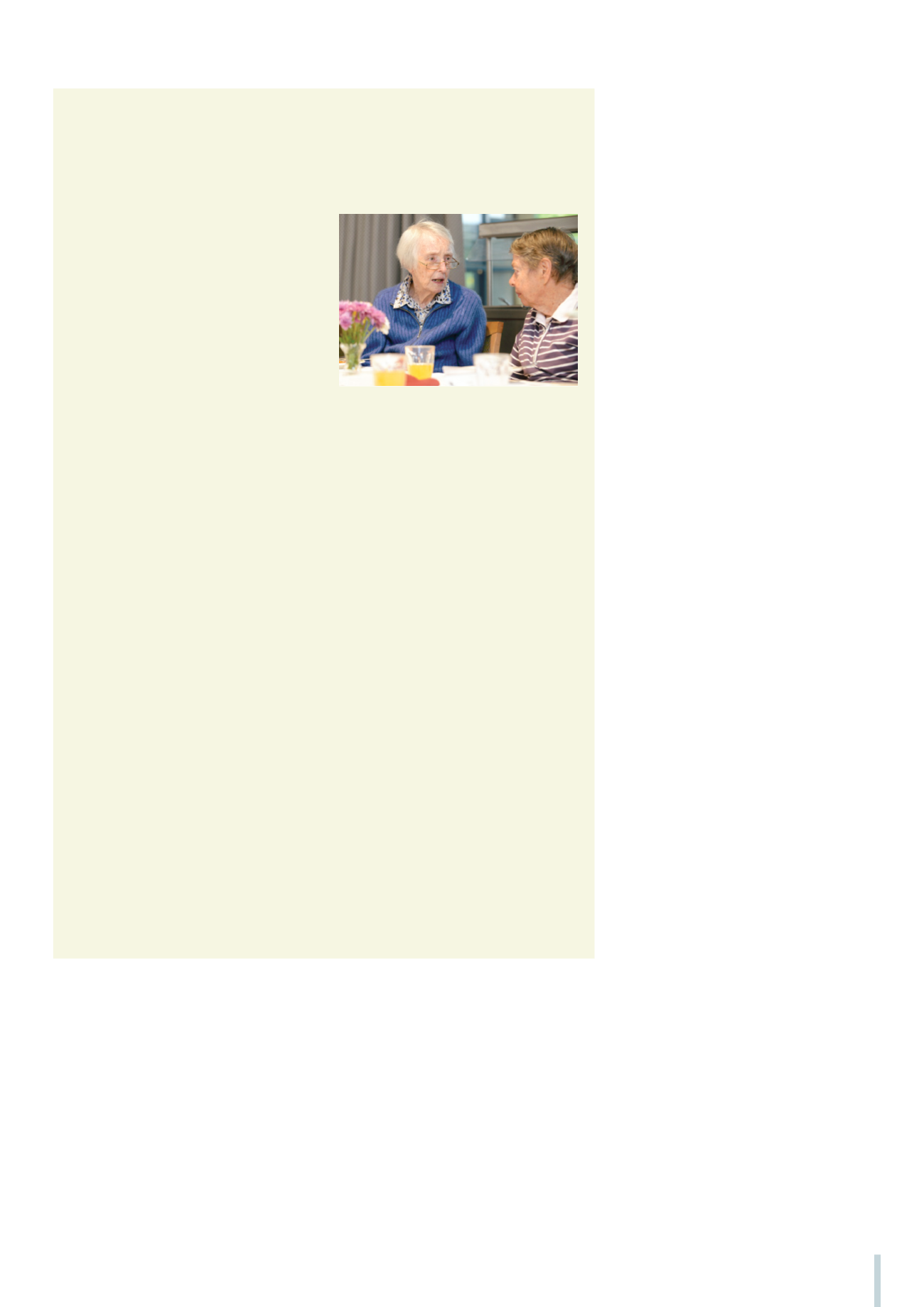
Mealtimes have become more enjoyable,
with residents eating because they’re
happy to be awake and are ready for
food – not because it’s ‘time’ to have
breakfast.
Photo courtesy Eldercare