


 14 / 68

14
Australian Journal of Dementia Care
October/November 2016 Vol 5 No 5
Participants may recall stories of the past,
talk about present experiences with the
guides and other participants, or quietly
enjoy looking at the artworks.
Danielle Gullotta explains: “We aim to
talk to the person first. Dementia is just a
condition they have. It is important that
people are given the opportunity to see
things they love…and to have
opportunities for new experiences”
(personal communication, July 4, 2015).
Focus on the ‘here and now’
When facilitating arts engagement for
people with differing cognitive and
physical abilities, and in introducing new
audiences to art and the gallery, special
requirements must be met. Simply getting
people living with dementia in the same
space as the artwork in order to experience
it first-hand takes organisation and
dedication on the part of many people.
The Art and Dementia program
primarily focuses on the ‘here and now’.
While some people with dementia may
not be able to recall the art they have
viewed or artists they have discussed, a
day or even in some cases only an hour
later, this does not diminish the potential
for the ‘in the moment’ pleasure of
experiencing artworks.
Steven Sabat, Professor of Psychology at
Georgetown University, suggests that
positive emotional experiences, like
viewing art, can have an ongoing impact
on people with dementia. He argues that a
“person may not be able to recollect
consciously some previous experience, but
his or her actions will reflect a memory of
that previous experience nonetheless”
(2006 p11). Therefore, positive emotional
experiences can contribute to people’s
overall well-being (Cohen
et al
2006;
Cohen-Mansfield
et al
2012).
Evaluating the Art Access Program
Researchers at the University of
Technology Sydney (including this author)
recently evaluated the Art Gallery of New
SouthWales Art Access Program to
examine its impact on people living with
dementia, their family members and
carers. The Arts Engagement For People
With Dementia study, which began in
October 2015 and was completed mid-
2016, was commissioned by the gallery. It
used a mixed methodology approach
involving qualitative and quantitative
research. Approval for the study was
granted through the Human Research
Ethics Committee of the University of
Technology Sydney (HREC 2015000330).
The primarily qualitative study followed
four groups as they viewed four paintings
under the expert guidance of program
facilitators. It engagedwith participants’
familymembers, care staff and facilitators
before and after the gallery visit. The study
used a range of research approaches
including observation, interviews and
surveys of those involved in arranging,
delivering, and experiencing the program
in the gallery space, and drew on best
practice evaluation of music, drama, and
the visual arts and social science methods
(Flatt
et al
2014; Killick 2013; Mittelman &
Epstein 2006; Thomson &Chatterjee 2013).
Accordingly, this evaluation used the
followingmethods with analysis based on
triangulation of data collected through:
• Ethnography incorporating both
personal and video observation.
• Interviews (formal and informal) with
carers and gallery staff involved in the
program. This provided a level of expert
review; and
• Pre- and post-visit survey
questionnaires.
This study did not seek to show the
long-term impact of engaging with
artwork, although there is need for further
research in this area, but instead focused
on evidence of ‘in the moment pleasure’.
In addition, the study examined:
• The extent to which the Art Access
Program provided pleasure and
enjoyment and positively contributed to
the well-being and quality of life of
people with dementia.
•What pleasure, joy, and mental and
emotional stimulation that contributed
to the quality of life of people living with
dementia could be observed ‘in the
moment’.
•What learnings can be gained from the
Art Access Program in relation to care,
well-being, and quality of life for people
with differing needs.
The participants
The groups of participants taking part in
the study were from a community centre
with a dementia care program, a
residential aged care facility, and a
government-funded program for people
with younger onset dementia, in Sydney.
The participants ranged from 46 years of
age to 92. Some were mobile and active,
showing only mild symptoms of
dementia, being able to engage in
prolonged relatively sophisticated
conversations about the artworks before
their memory issues became apparent.
Other participants were more severely
impaired by their dementia; three people
were aphasic, two were aphasic and had
little ability to communicate through facial
expression or gesture, and several
participants had comorbidities such as
Down syndrome and depression.
Observations and interviews
Researchers observed participants as they
travelled to the gallery, moved through the
gallery space, and viewed the artworks.
They noted participant responses
consistent with the behaviours of people
enjoying the experience. This included
smiling, laughter, animated chatter,
pointing and looking at the artwork, and
engagement with program facilitators,
their peers, or care staff.
Researchers also looked for reactions
that suggested participants were not
enjoying the experience. These included
behaviours such as fidgeting, negative
comments, crying out, sleeping, yawning,
shouting, or walking around.
All participants, care staff, and program
facilitators were audio and video recorded
to allow for further analysis to be
conducted by researchers after the gallery
visit. Unstructured interviews were
carried out with care staff, family
members, gallery staff, and program
facilitators and they were all also asked to
complete survey questionnaires. These
included questions about their overall
quality of life and their experience in the
gallery on the day of the visit.
A total of 35 people with dementia
attended the access program during the
four days of the evaluation and completed
questionnaires. Of those, 21 people were
observed closely. Ten program facilitators
were interviewed and completed
questionnaires about their experience of
delivering the program, and 11 care staff
accompanying the participants completed
questionnaires and spoke about their
experiences.
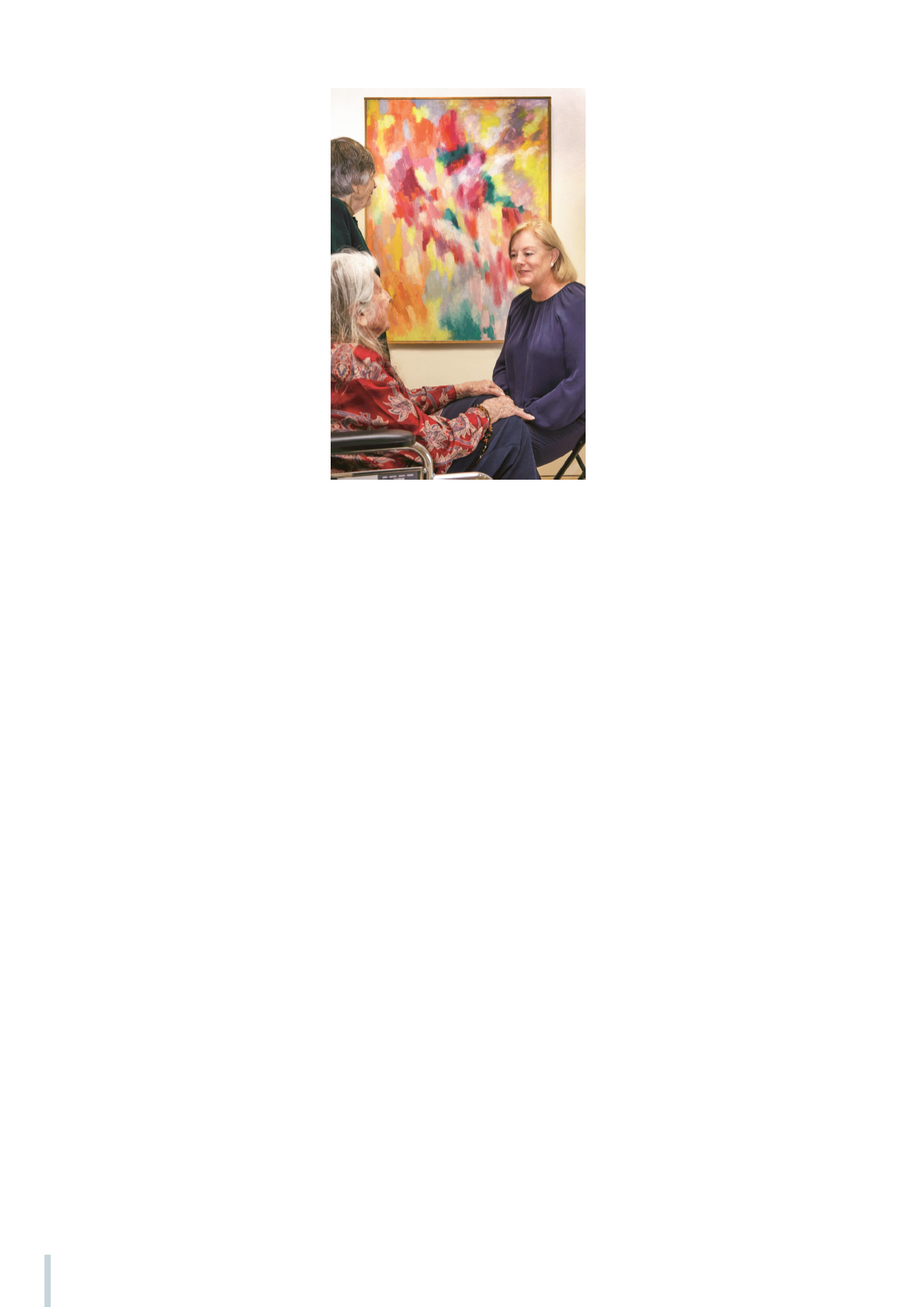
Enjoying
Joie de Vivre
at the gallery.
Photo: AGNSW