


 10 / 68

10
Australian Journal of Dementia Care
October/November 2016 Vol 5 No 5
Allies in care: optimising
life with dementia
T
here is increasing evidence
that the non-
pharmacological
approaches used by allied
health professionals are
effective for people with
dementia. These include
exercise, environmental
modifications, engaging people
with meaningful activities, and
therapies that address skills in
doing everyday activities
(Laver
et al
2016).
The allied health workforce
makes up approximately 25%
of Australia’s health workforce
(AIHW 2014) and comprises a
diverse range of professionals
with special expertise. It
includes, but is not limited to,
psychologists, pharmacists,
physiotherapists, exercise
physiologists, occupational
therapists, optometrists,
Chinese medicine practitioners,
podiatrists, osteopaths, and
Aboriginal and Torres Strait
Islander health practitioners.
Better partnerships
Allied health professionals are
well-positioned to make a
positive difference to the lives
of people living with dementia
and their carers; however there
is a general lack of
understanding about what they
offer.
The Allied Health sub-group
of the Aged Health Network at
the NSWAgency for Clinical
Innovation (ACI) has identified
a widespread lack of
knowledge amongst health
professionals about the role of
allied health in the care of
people with dementia. At the
same time, consumer
representatives from
Alzheimer’s Australia have
expressed concern that people
with dementia do not always
have access to allied health
services or have great difficulty
finding allied health
professionals to work with.
In response, the ACI and
Alzheimer’s Australia have
produced two new resources,
released during Dementia
Awareness Month in
September this year, to promote
better partnerships between
people living with dementia
and allied health professionals.
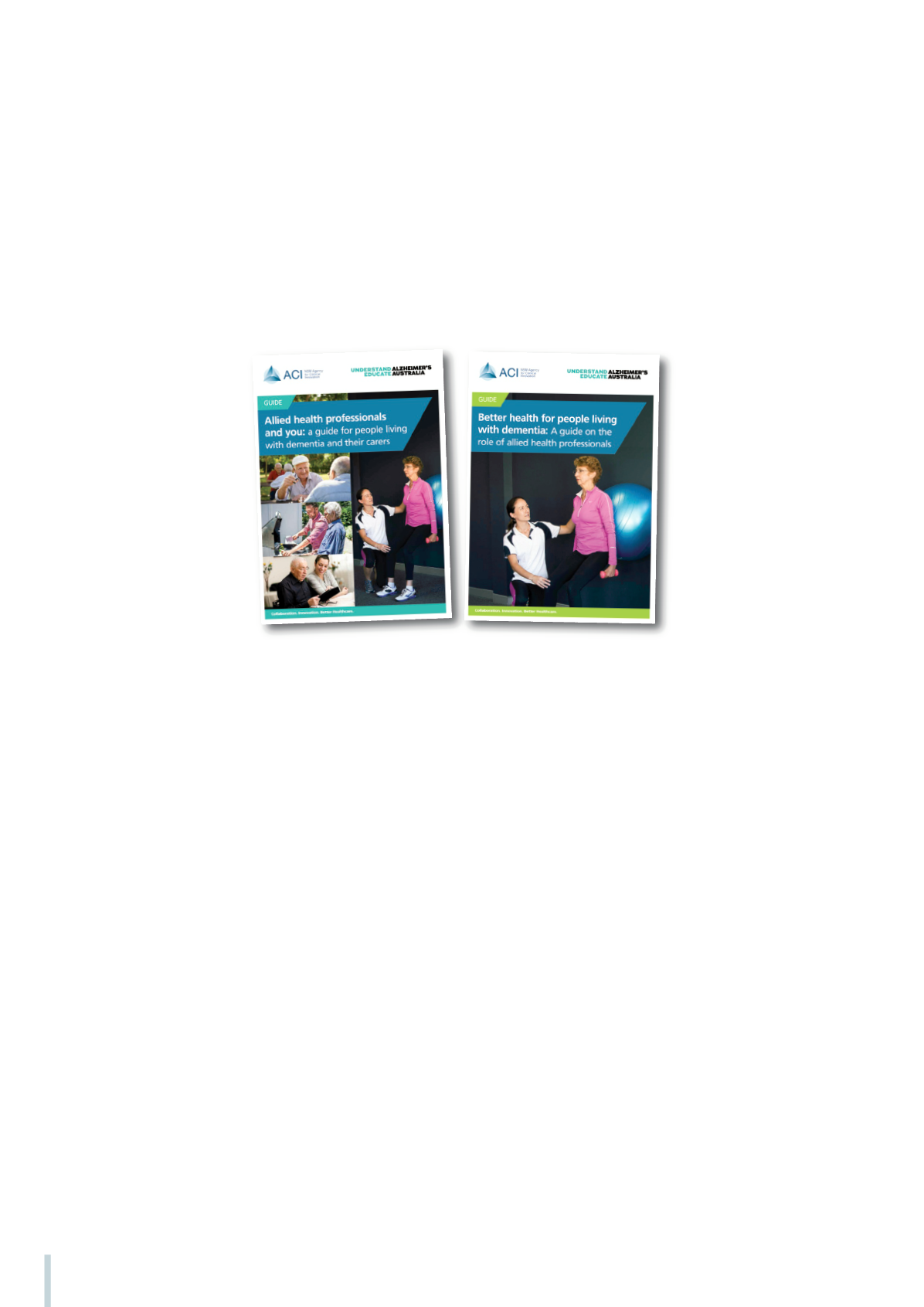
The guides (pictured above),
one for people with dementia
and carers, the other for health
professionals, highlight how
allied health professionals can
contribute to the everyday lives
of people living with dementia,
their carers and families.
The guides give examples of
the scope of practice for allied
health professionals working
with people with dementia
from early stages to issues that
may arise during later stages.
For example, strategies for
minimising the impact of
memory loss, keeping
physically and mentally active,
and staying socially connected
may be provided in the earlier
stages of dementia, while
discussing the transition to
residential care or need for
increased services may be
relevant to people in the later
stages. Other topics addressed
include eating well, speech and
communication, intimacy and
sexuality, the home
environment, palliative care
and end of life.
Everyone with dementia has
unique experiences and
circumstances, and allied health
professionals are skilled at
tailoring strategies and
interventions to meet
individual needs. The
consumer guide,
Allied health
professionals and you: a guide for
people living with dementia and
their carers,
explains the roles of
different allied health
professionals, how to find
them, and the interventions
they may provide. The aim is to
inform and encourage people
living with dementia and their
carers to partner with allied
health professionals.
The health professionals’
guide,
Better health for people
living with dementia: a guide on
the role of allied health
professionals,
provides
information and ideas for
doctors, nurses and allied
health professionals, whatever
their level of experience
working with people with
dementia, about a range of
evidence-based and best
practice health interventions
that support and assist people
living with dementia and their
carers. Good practice points
and case studies illustrate the
diversity of the field and the
expertise that may be offered.
The guide also acknowledges
there can be overlap between
allied professionals at times.
For example, an occupational
therapist (OT) and a
psychologist may both help
someone adjust to a diagnosis
of dementia: the OT by
identifying functional cognition
and helping adjust everyday
activities to enable the person to
continue doing those things;
and a psychologist by
providing emotional support
and teaching thinking habits to
help the person remain positive
or strategies to retain specific
cognitive skills.
Accessing services
Choosing a suitable allied
health service or services
depends on what the person
with dementia wants and needs
and what is offered in their
local area, as not all types of
allied health services are
available in all parts of
Australia.
Both guides include an
extensive list of resources,
including the types of services
available and how to access
allied health professionals.
Jacqueline Wesson
,
Jamie Hallen
,
Atosha Clancy
and
Glen Pang
explain the positive contribution
allied health professionals can make to the lives of people with dementia, their carers and families, and
introduce two new guides for health professionals and consumers