


 15 / 68

Vol 5 No 5 October/November 2016
Australian Journal of Dementia Care
15
Key findings
While there are methodological challenges
in evaluating the cognitive, affective, and
conative impact on people with dementia
of participating in art access programs, this
intensive period of study and analysis led
to three key findings:
• Art access programs provide
opportunities for
normalcy.
• The
context
of the visits to the gallery is
an important aspect of the art
experience.
• Social support or ‘
scaffolding’
can
enable people with dementia to
undertake new experiences and build on
existing capabilities.
Normalcy
In brief, normalcy results in each
individual being treated with dignity and
respect and accorded the rights and
privileges of all citizens regardless of
ability (Chenoweth
et al
2009; Killick 2013;
Kitwood 1997; Treadaway
et al
2014). This
does not mean that there is a ‘norm’ or
‘standard’ approach to be conformed to,
but recognises individuals as being
different, having different interests, needs
and capacities and wanting different
experiences. It recognises that although
dementia is a degenerative condition all
individuals have potentiality and
possibility.
Context
The importance of context is a key finding
of the study. Factors such as the length of
the journey to the gallery, the atmosphere
on the bus or other transportation used,
the seating of the chairs in front of the
artworks, noise levels in the gallery, etc can
cause discomfort, confusion, or even
rejection and withdrawal by participants.
Such factors can mean that individuals
may not arrive in the gallery space in a
condition to engage with the artwork.
Social scaffolding
Social scaffolding refers to the individual’s
support framework and how collaborative
and social experiences impact on people’s
ability to achieve (Bruner
et al
1976; Hydén
2014; Rogoff 1990; Vygotsky 1978). For
example, individuals can be supported in
achieving a greater understanding of
artworks through a relaxed environment,
interaction that models normalcy, and the
creation of an inclusive environment. Such
an environment welcomes and accepts all
responses to the artworks and proceeds
with an expectation that all attendees have
something to contribute – regardless of the
stage of their condition. Social scaffolding
is a key aspect of enabling individuals to
gain the most from their experience.
A positive experience
In evaluating the impact of the Art Gallery
of New SouthWales Art Access Program
for people with dementia, this study
looked broadly at the context in which the
programs took place. It considered the
physical, social and cultural influences on
people with dementia attending the
program; recognised the importance of
how the gallery as an organisation
responds to people with differing abilities;
sought to gain an understanding of who
was attending the program; examined
how attendees arrived in the space ready
to engage with the artworks and what
artworks were viewed.
The study found a range of stakeholders
were involved in providing a positive
experience for people with dementia.
These included care staff, gallery staff and
facilitators, and family members and
primary carers.
It highlighted the importance of
organisation, structure, and planning;
specialised training; and flexibility and
adaptability across all stakeholders. The
relationships between gallery staff,
professional care staff, family members
and carers and people with dementia were
important for the program’s success.
All attendees had a positive experience
of the gallery’s Art Access Program. The
reactions of people living with dementia
during the gallery visits were consistent
with those of other gallery-goers and
included smiling, laughing, pointing and
gesticulating at artworks, talking, asking
questions and commenting on artworks,
quietly contemplating the works, and the
occasional exaggerated exclamations
associated with liking or disliking the
work or the gaining of new insights.
Participants gained access to material
and experiences not often available in their
everyday lives, including opportunities for
social interaction and engagement with
their peers, care staff and facilitators, and
times of quiet reflection that did not focus
on their everyday circumstances, health, or
care needs.
The visit provided opportunities for
attendees to tell stories, reminisce, and
prompted moments of self re-
identification. Attendees showed their joy
by clapping, thanking facilitators, and in
commenting on howmuch they enjoyed
their experience.
For those who remembered the visit, it
provided opportunities for reflection and
conversation later with their peers, care
staff and family members. For those who
did not remember the events in the gallery
there was a lingering sense of having had a
good time; as one participant, ‘Jenny’,
commented: “I like…but I can’t
remember”. Implicit memory of the
experience and a sense of feeling good
was, it would seem, retained even after the
explicit memory of the event was gone.
More information
A copy of the evaluation report is now available to
download from the gallery’s website at
http://www.artgallery.nsw.gov.au/media-office/living-with-dementia/.
The Art Gallery of New South Wales’ Art and
Dementia Art Access Program is available
free for groups on any Thursday or Friday for
one hour between 10.30am and midday if
booked at least two weeks in advance.
Sessions for individuals and their carer
partners are offered on the third Thursday of
the month. Details at:
http://www.artgallery.nsw.gov.au/calendar/type/art-and-dementia/.
The gallery also offers a limited number of
outreach visits to eligible community
organisations who cannot access the
gallery, with tailored presentations exploring
selected artworks. For bookings and
inquiries phone (02) 9225 1740, email
pp@ag.nsw.gov.auor visit the website at
http://www.artgallery.nsw.gov.auReferences
Art Gallery of New South Wales (2015)
Annual
Report 2014-15.
Sydney: Art Gallery New South
Wales.
Australian Bureau of Statistics (ABS) (2005-6)
How many people go to museums? Arts and
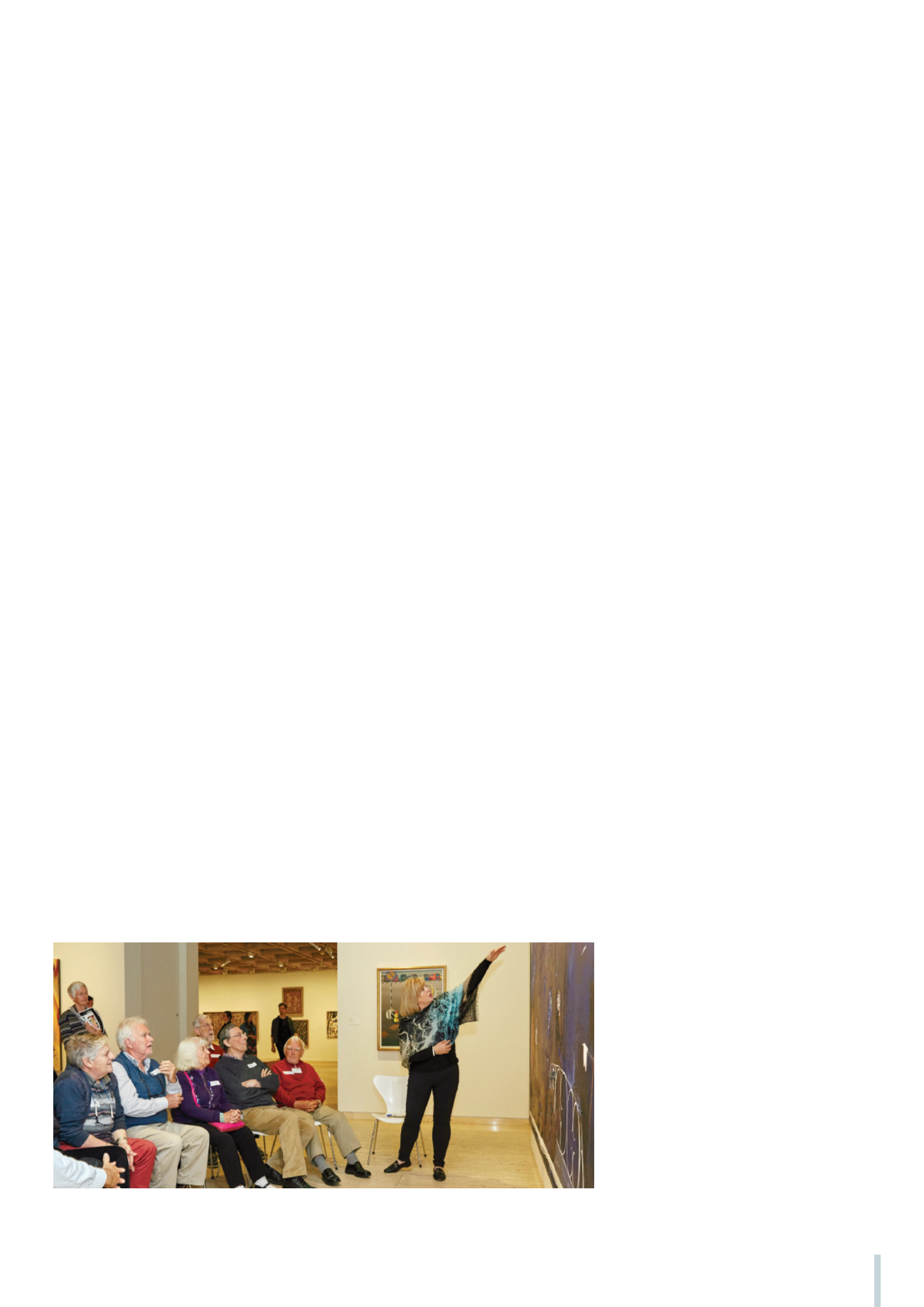
Art and Dementia Program participants with a facilitator at the gallery earlier this year.
Photo: Christopher Snee, AGNSW