



 184 / 216

180
Copyright © 3P Learning – These resources have been created in partnership with Dr. Marian Small.
For more information visit
www.mathletics.comRelated Patterns
Questions to facilitate the learning
•
Why is the 1 more added?
•
How do you know this will continue even for terms much later in the pattern?
•
How would you get the value of a term in pattern 1 if you knew the value in pattern 2 for the term in the
same position? [You would subtract 1 and take
3
10
.]
Scaffolding the learning
•
What does 3
1
3
times a number mean?
•
What would happen if you multiplied 3, 6 and 9 by 3
1
3
?
What’s the point of this task?
Linear patterns—number patterns with a constant increase or decrease—are fundamental in many aspects
of math. What is particularly interesting about them is that in each case, you can predict the term value in
one pattern using a simple relationship to the term value in the other. For example, a very simple example
is 2, 4, 6, 8, 10, … compared to 4, 8, 12, 16, 20, ... You can determine any term value in the second pattern
by doubling the corresponding term value in the first one; similarly, you can determine any term value in
the first pattern by halving the corresponding term in the second one.
The patterns used in this task are slightly more complex, but not too complex. Since the first pattern is a
simple 3-times table and the second pattern is the 10-times table with 1 added, the suggested rule makes
sense. What will be interesting is to see how a student might show it visually.
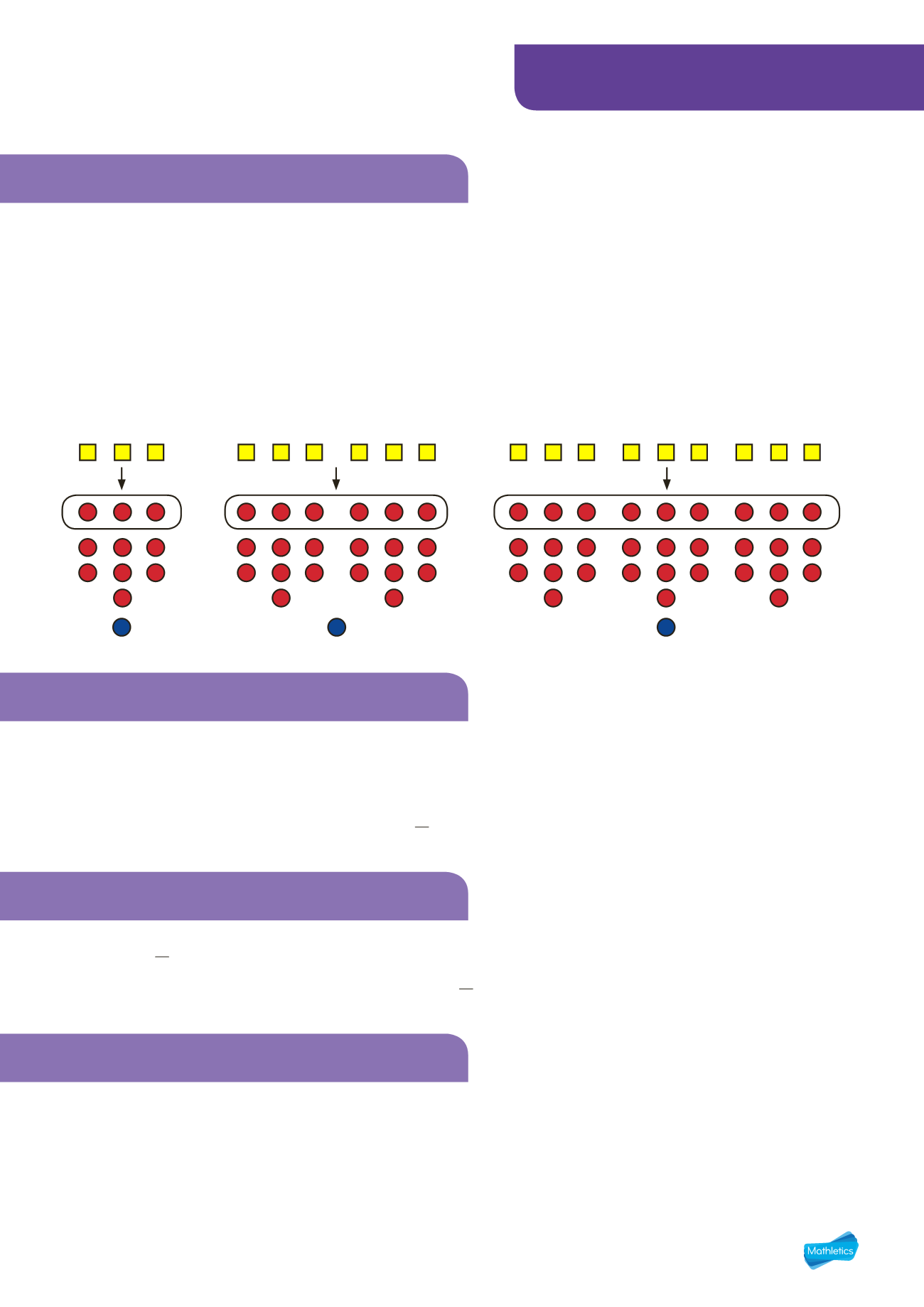
One possibility is to use a pictograph; another possibility is to use a pattern of figures like this one.
Extending the learning
Students might figure a rule to get from a term in the pattern 5, 9, 13, 17, 21, … to the term in the same
position in the pattern 5, 8, 11, 14, 17, …
Patterns and Algebra