


 39 / 40

R E S O U R C E S / E V E N T S
Vol 5 No 6 December 2016/January 2017
Australian Journal of Dementia Care
39
6-7 December, 2016 – NSW
Preparing for Choice and Control in Residential Aged Care
Presented by COTA and Criterion Conferences, in Sydney. Details:
http://www.criterionconferences.com/event/rac/23-24 February 2017 – SA
8th Annual National Dementia Conference
Presented by Informa, in Adelaide. Send topic and speaker submissions to
Lisa.Hedlund@informa.com.au. Special rate of $995 + GST (30% discount)
for
AJDC
readers, up to the conference date. Use promo code AJDC2017
when booking. Details:
http://www.informa.com.au/conferences/health-care-conference/national-dementia-conference
26-29 April 2017 – Japan
32nd International Conference of Alzheimer’s Disease International
In Kyoto. Online registration, abstract submission and details:
www.adi2017.org17-20 October 2017 – VIC
Alzheimer’s Australia National Conference 2017
In Melbourne. Details:
http://bit.ly/29wp4IQEvents
MindMate
is a free app developed by four
recent university graduates from Glasgow to
help people with dementia live more
independent lives, stay connected to their
social environment and give carers tools to
engage with and know the person’s life story
and preferences. MindMate features brain
training games, easy-to-use tools for
reminders, to-do lists and notes,
entertainment (including movies and TV shows
from the 1930s-1990s, music from the 1920s-
1980s, TED talks and relaxation music and
videos), advice on nutrition and exercise as
well as an area called My Life (My Pictures and
About Me). Tapping the My Pictures icon
allows the user to add and store photos of
relatives, favourite foods, friends, pets,
hobbies, childhood, worklife etc. ‘About Me’ is
used to store and access personal information
and record the person’s life story. Personal
preferences can be recorded in categories
such as: My Personal Possessions (items you
always like to have close to you); My Hygiene
(eg, do you prefer taking a shower or bath?);
Maintaining My Independence (what things do
you like to do for yourself?); Sleep and Rest
(what is your usual bedtime routine); Family
and Friends; Spiritual Care; Medication; and
Food and Drink.
It’s designed to support people with
dementia and their families through all stages
of the disease, with three versions – one for
individuals (MindMate), one for families
(MindMate Family), which has chat and video
features, and MindMate for Care Facilities. The
latter allows care staff to create a profile for
each resident on the same tablet.
It’s available for Apple and Android devices.
Details:
www.mindmate-app.com/.Dementia resources from around the
world,
launched earlier this year, is a collection
of curated websites about dementia –
including resources on diagnosis, treatment
options, strategies for daily living, dementia risk
factors, signs and symptoms, and support
groups – for people with dementia and carers.
At this stage most are US and Canadian
websites, with just a few from Australia. As
new online dementia and caregiver resources
are created and evaluated, they will be added
to the site. The project team are educators
from Canada’s Baycrest Health Sciences,
affiliated with the University of Toronto, with
funding from the Ontario Ministry of Health.
Visit the website at:
www.baycrest.org/educate/dementia-resources/
Supporting and accommodating people
with dementia at professional
conferences and other events
is a new
guide from advocacy support group
Dementia Alliance International (DAI), aimed at
conference organisers. The content is based
on informal feedback received from people
living with dementia and their care partners
who have attended Alzheimer’s Disease
International and other conferences and
events over the past four years. The guide
offers practical advice and recommendations,
as well as links to other resources, to help
organisers ensure people with dementia are
included on an equal basis to all other
conference speakers or delegates. There’s
recommendations on how to make venues
accessible for people with dementia, the use
of respectful language, avoiding labelling
people with dementia, creating a designated
meeting room, and guidelines for media. It’s
freely available at: www.dementiaalliance
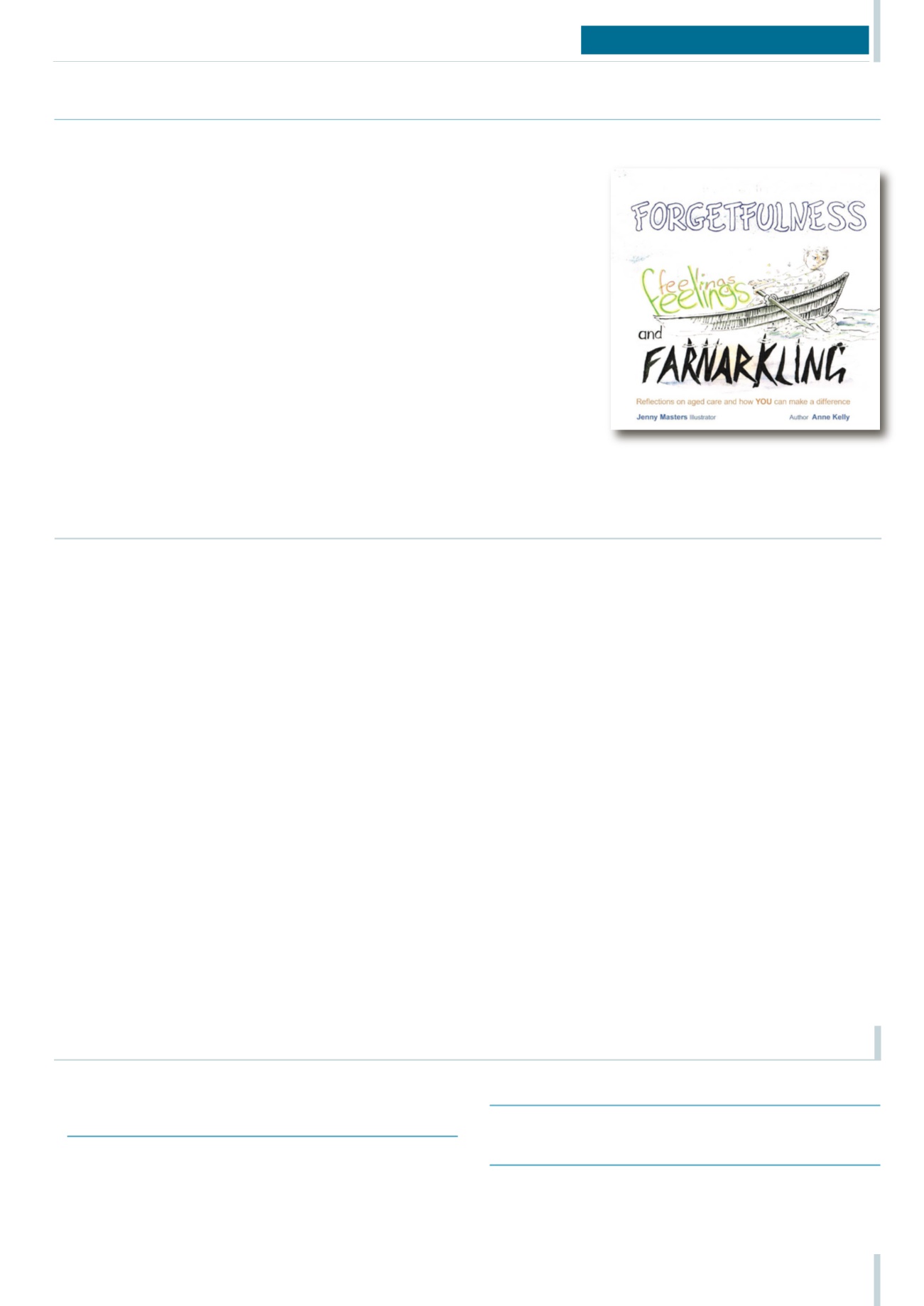
international.org/resources/publicationsForgetfulness, feelings and farnarkling: reflections on aged care and how you can make a difference
Illustrated by Jenny Masters, written by Anne Kelly, (2016), $25. Available from:
www.dementiashop.com.auWith occasional artistic license, this
collection represents real people’s stories
from almost 30 years of experience
working in aged and dementia care. Each
illustration, its accompanying story and
explanation gives life to the voices of
people with dementia. We trust that these
combined stories will provoke reflection
and action.
The book uses humour as a positive
way of looking at serious issues without
defensiveness. The aim is to encourage
reflection on care practices and how these
impact on the quality of life,
independence and choice for people
receiving care services. In our small way
we are trying to make a difference and
change those practices that rob older
people of their rights to spend their days
with dignity and purpose as
independently as possible – things such as
serving drinks in plastic mugs and not
enabling people to do for themselves
when they are able. Many examples of
practical actions are given to help
professional carers and families.
The idea for the project was born from a
discussion between artist Jenny Masters
and myself (dementia consultant Anne
Kelly) in mid-2012. We’d both been touched
in personal ways by dementia and had seen
examples of skilled, compassionate care
within dementia support services.
However, we were also aware of examples
of care deficits at individual or
organisational level and the question arose,
“what can we do to change this?” By
highlighting aspects of life from the points
of view of individuals with dementia, and
those close to them, we hope to encourage
discussion and to challenge existing care
systems and practice.
Anne Kelly, dementia consultant and
Managing Director of Montessori Ageing
Support Services