


 30 / 40

30
Australian Journal of Dementia Care
December 2016/January 2017 Vol 5 No 6
L
ike everyone else, people with
dementia are affected by the
buildings around them. Whether
they are living in their own home,
shopping in the mall, travelling by plane,
being treated in hospital, living in
residential care or in the final stage of
their life in a palliative care unit, the
quality of the built environment will
affect the quality of their life. They differ
from people who do not have dementia in
the extent to which the built environment
can prevent them from doing what they
would like to do. While those without
dementia can compensate for unhelpful
design, those with dementia can’t and the
built environment limits their
opportunities.
Happily, we are learning more and
more about good design in all of the areas
listed above. Aglance at the Dementia
Enabling Environment Project web site
(www.enablingenvironments.
com.au) developed by Alzheimer’s
Australia and the Dementia Training
Study Centres (DTSCs) provides access to
a wealth of information on improving the
home environment (and much more).
Growing knowledge base
The growing interest in dementia-
friendly communities has resulted in the
development of evaluation tools that are
helping us to understand the
characteristics of buildings and public
spaces that are enabling and disabling for
people with dementia (Burton
et al
2004;
Fleming
et al
(in press). The difficulties
encountered by people with dementia
and their carers travelling by plane are
being explored in a Dementia
Collaborative Research Centres’ project
(O’Reilly & Shepherd 2016). The
enormous human and financial cost
(AIHW 2013) of treating people with
dementia in hospitals is being addressed
by improving the physical environment
(Fleming & Bennett 2015; King’s Fund
2012a, 2012b). There is now a wealth of
knowledge on how to design residential
care facilities so that they reduce
confusion and agitation while supporting
activities of daily living and social
interaction (Fleming & Purandare 2010).
This has also been extended to provide
guidelines on the design of places that
assist people with dementia to die with
dignity and in peace (Fleming
et al
2015).
Asubstantial amount of the work that
contributed to this knowledge was carried
out in association with the Environmental
Design Education Service, known as
Designing for People with Dementia
(DPD), provided by the Dementia
Training Study Centres. This service has
been delivered to more than 300 aged and
health care organisations since it started in
2010 (Fleming
et al
2016).
It has led to real improvements in
understanding how the environment can
be used as a tool for enhancing the quality
of life and minimising the responsive
behaviours of people with dementia
(Phillipson
et al
2015). This has been
recognised in the recent granting of the
Older Person’s Mental Health Award to
the DPD program by the NSWMental
Health Association. Their video clip
(https://youtu.be/lx8SCT6A6ZQ)
illustrates the improvements than can be
brought about by a systematic approach
to assessing and modifying the
environment.
The establishment of Dementia
Training Australia (see article p26) has
enabled this service to continue and it
will be available to aged and health care
organisations wishing to improve their
current buildings or to plan new facilities.
However, the quality of the built
environment is only one factor in the
provision of services that enhance the
quality of life of people with dementia. It
accounts for approximately 14% of the
variance in quality of life of people with
dementia in residential aged care facilities
(Fleming
et al
2014). While this is actually
quite a significant amount of variation,
there’s clearly room for many more
interventions other than only improving
the environment.
Tailored Training Packages
This is where the new services being
offered by DTAdiffer from those that
were provided by the DTSCs. DTA is
offering Tailored Training Packages (TTP)
which combine training and consultancy
on a range of topics, including improving
the physical environment, into a suite of
activities tailored to meet the needs of
individual organisations.
This will enable the DPD service to be
combined with training on, for example,
minimising responsive behaviours,
Designing for People with
Dementia finds a new home
Professor Richard Fleming
, Executive Director Dementia Training Australia, outlines
the DTA training and consultancy services available to aged and health care organisations
wishing to improve their current buildings or plan new facilities for people with dementia
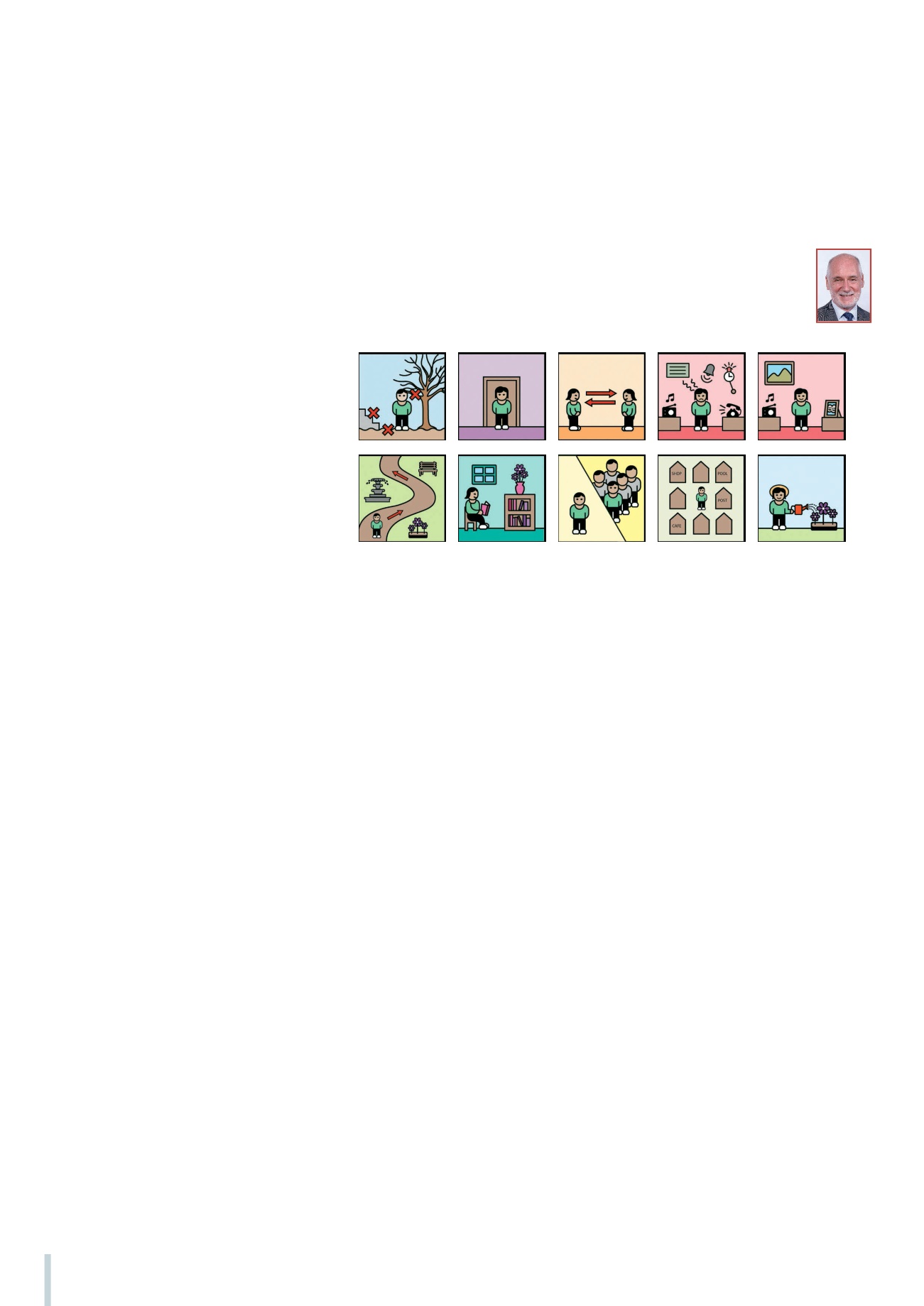
DTA’s Designing For People With Dementia service promotes these 10 principles as guidelines
for the design of physical environments for people with dementia in residential aged care (top,
from left): unobtrusively reduce risks; provide a human scale; allow people to see and be seen;
reduce unhelpful stimulation; enhance helpful stimulation; (above, from left) support
movement and engagement; create a familiar space; provide a variety of places to be alone or
with others in the unit, in the community; and design in response to a vision for a way of life