


 25 / 40

Vol 5 No 6 December 2016/January 2017
Australian Journal of Dementia Care
25
Landmarks along the way
In 2010 theAustralian Government
renewed the centres’ funding for a further
three years. During this second funding
period, relationships between the five
centres strengthened. They came together
to develop a strategic and cohesive method
of service delivery, coordinate production
of new resources and activities and take a
more focused and targeted approach to
training content. National priority areas
(NPA) were introduced, with each centre
responsible for deliveringAustralia-wide
training based on its areas of expertise, on
topics such as palliative care, person-
centred care, dementia in indigenous and
Culturally and Linguistically Diverse
populations. Each centre also led training
for specific target groups such as nurses,
General Practitioners and allied health
professionals. The DTSCs launched a
national website and continued to build
relationships with the DCRCs, with the
result that more DCRC research outputs
were included in training content.
Focusing on knowledge translation
The most important outcome of this
period, and what would eventually come
to define the DTSCs, was the acceptance
that the centres needed to do more than
raise awareness and gain agreement from
training participants if they were to effect
real change in the care of people with
dementia. KT had to become the
cornerstone of all DTSC activity. To this
end KT was included as an operational
NPAand a national programwas set up to
drive implementation and evaluation. One
of the results of this awareness of the
importance of KT was the launch of the
Australian Journal of Dementia Care
in June
2012 with support from the DTSCs.
Consequently, the translation of
knowledge into practice underpinned
DTSC training and led to the development
of the DTSC KT framework (Phillipson
et al
2014). There was now a shift in the centres’
activities. Training moved away from a
delivery-and-awareness-raising model
towards activities aimed at supporting
health professionals and healthcare
organisations to
adopt
the knowledge
gained fromDTSC training into their day-
to-day practice. These activities augmented
the DTSCs’ awareness-raising and seeking-
agreement activities and included
consultancy services such as the
Environmental Design Education Service
(see box below), a Fellowship program
which supported clinicians to effect
practice change in their workplace, train-
the-trainer programs to help clinicians
increase knowledge within their
workplace, and tailored training for
individual organisations.
In 2013 the DTSCs’ funding was
extended for another three years, through
to the end of September 2016. At the
beginning of this period the five centres
united to deliver an integrated national
training program, whilst still retaining
their individuality and local networks.
There was now a common organisational
and governance structure, including a
National Leadership Group and National
Coordinator.
By combining their expertise, the DTSCs
consolidated their role as a leader in KT-
orientated education (eg Goodenough
et al
Environmental design service wins mental health award
The Environmental Design Education Service
created by Professor Richard Fleming and Kirsty
Bennett has won the Older Persons’ Mental
Health Award at this year’s Mental Health Matters
Awards.
The 2016 Mental Health Matters Awards were
presented at NSW Parliament House by NSW
Minister for Mental Health Pru Goward on
September 29, at the launch of Mental Health
Month. The awards recognise the achievements of
individuals and organisations who have worked to
improve understanding, awareness, service
provision and the general mental health of NSW
communities over the previous year.
The Environmental Design Education Service,
known as ‘Designing for People with Dementia’,
was provided by the NSW/ACT Dementia Training
Study Centre until 30 September, and is now a
major activity of Dementia Training Australia (see
p30, ‘Designing for People with Dementia finds a
new home’).
The service uses a combination of handbooks,
workshops, consultancy and a smartphone app to
help aged and health care staff to plan
improvements to existing buildings so that they
help residents and patients with dementia by
reducing confusion and agitation, while improving
social interaction.
Professor Fleming and Ms Bennett have worked
closely with NSW Health in the production of a
handbook describing the application of 10
principles of design to the modification of existing
hospital buildings and the design of new inpatient
units. The handbook is available from
http://www.aci.health.nsw.gov.au/__data/assets/pdf_file/0019/280270/ACI_Key_Principles_for_Im
proving_Healthcare_Environments_for_People_wi
th_Dementia.PDF
The Mental Health Matters Awards are presented
by the WayAhead Mental Health Association of
NSW and supported by the Mental Health
Commission of NSW.
Professor Richard Fleming and
Kirsty Bennett at the Mental Health
Matters Awards earlier this year,
where they received the Older
Persons’ Mental Health Award for
the Environmental Design
Education Service (Designing for
People with Dementia)
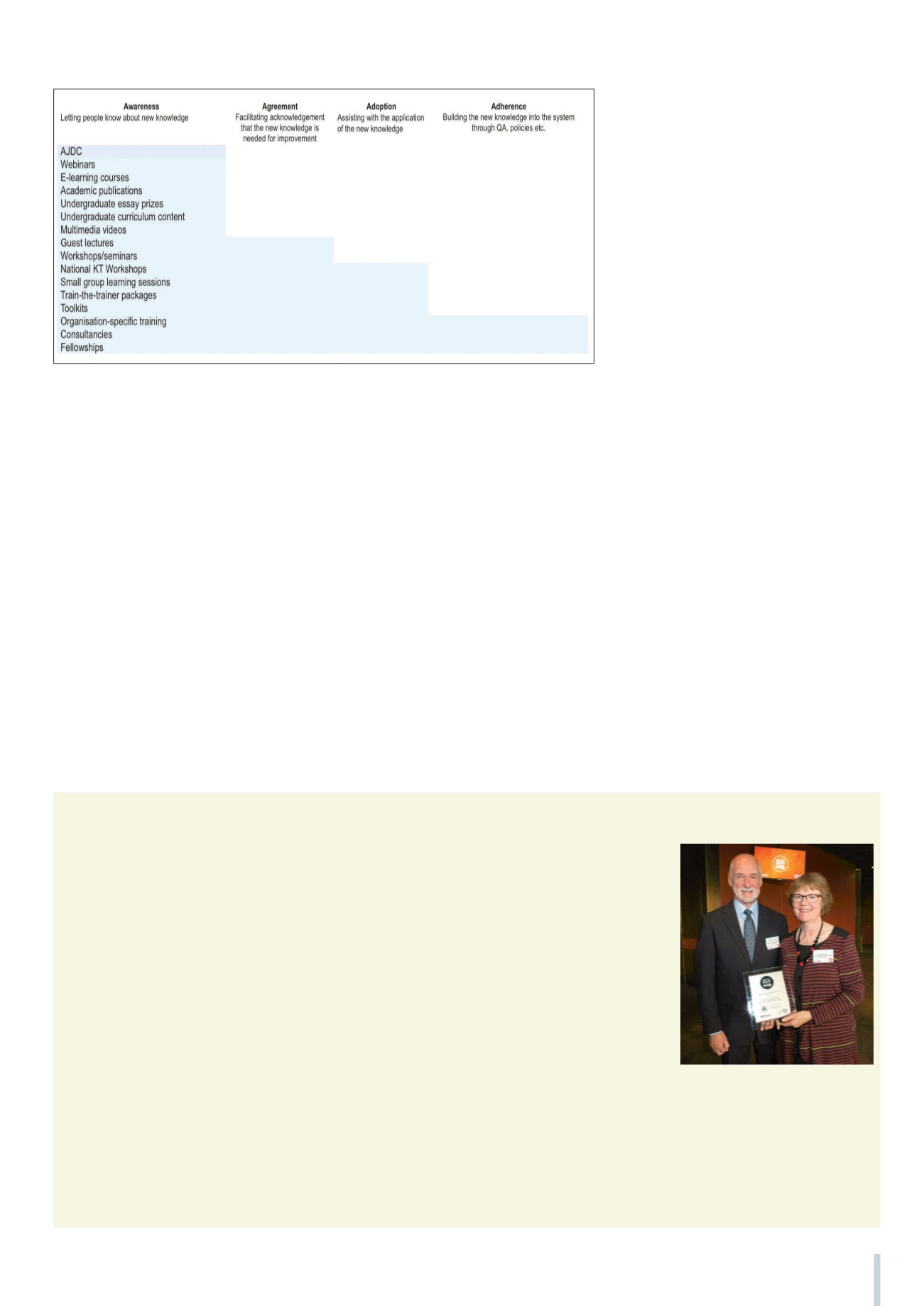
2014-2016 DTSC activity KT objectives: the graph shows how each of the DTSC activities,
at left, align with the knowledge translation (KT) objectives of Awareness, Agreement,
Adoption and Adherence