


 27 / 40

Vol 5 No 6 December 2016/January 2017
Australian Journal of Dementia Care
27
This call for tenders was accompanied
by another aimed at establishing a
national Dementia Behaviour
Management Advisory Service (DBMAS)
(see articles p34) and both called for the
establishment of close collaboration
between the two new organisations.
Developing learning pathways
The movement to a single, national
provider for the training services was not
unexpected. The DTSCs had been
developing a national approach to
service delivery for five years and had
demonstrated its advantages.
However, state boundaries were not
the only boundaries being challenged in
this new program. The DTSCs had been
focusing on tertiary qualified aged and
healthcare staff, while DCE focused on
vocational level training.
The new program has brought these
together and paved the way for an
approach to dementia training that will
enable the development of learning
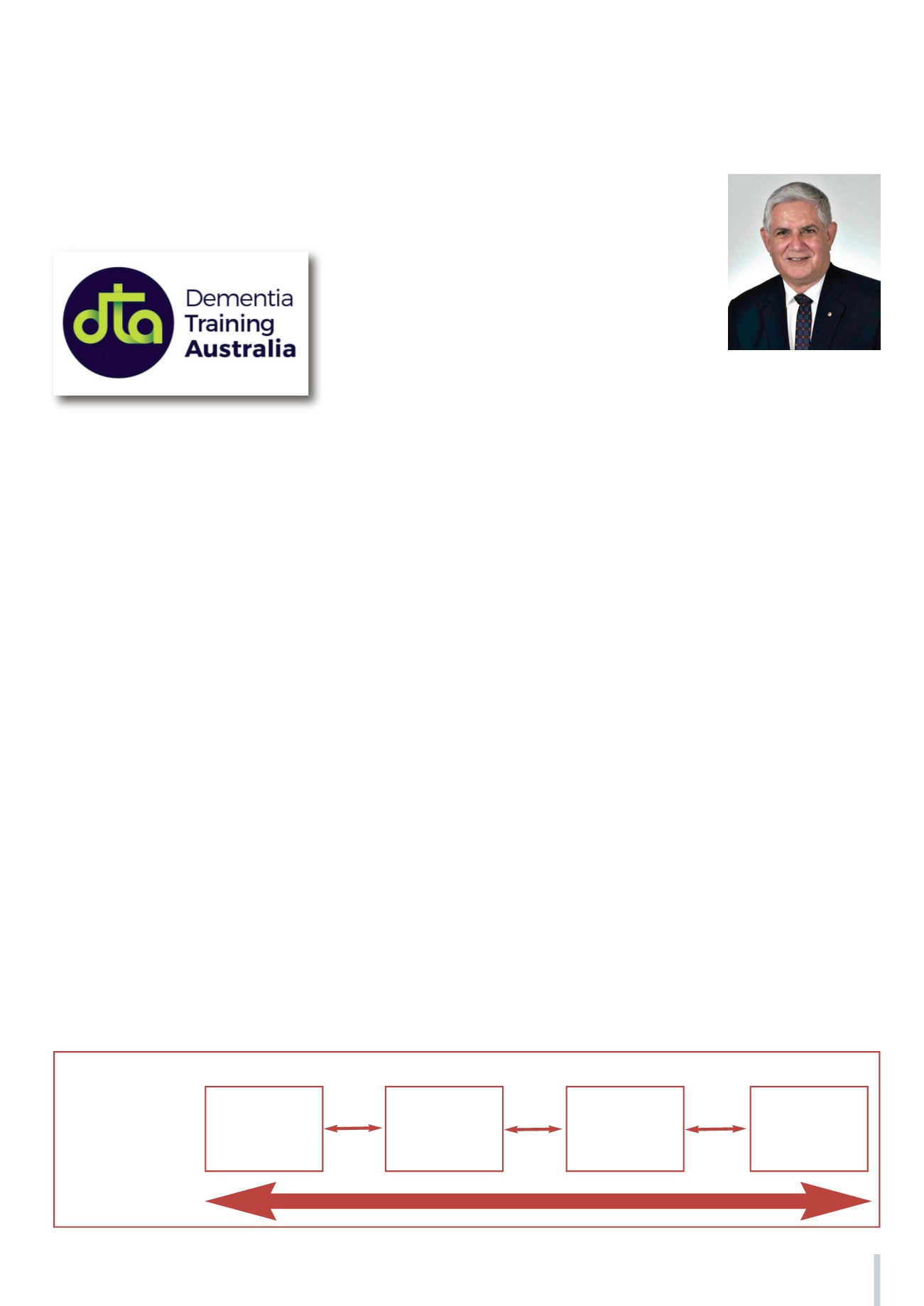
pathways (see below) that facilitate
progression from Certificate III
vocational training to Honours degrees
and on to professional development
courses.
The tender also called for the
incorporation of web-based training and
the provision of tailored training
packages carefully structured to meet the
needs of individual organisations.
All in all, a quiet revolution in the
provision of dementia training in
Australia. A revolution that needed a
response from experts in web-based
education, large-scale vocational training
and tertiary education.
But if this was to be a real revolution,
even more was needed. The collaboration
between these experts had to be based on
a firm grasp of knowledge translation
and strong links with the generators of
new knowledge – the research
community.
DTA partners
A consortium, known as Dementia
Training Australia (DTA), led by the
University of Wollongong, with partners
Alzheimer’s Australia, La Trobe
University, Queensland University of
Technology, the University of Tasmania
(UTAS) and the University of Western
Australia was formed and submitted a
tender to develop and operate the new
Dementia Training Program.
Alzheimer’s Australia brought to the
consortium extensive experience in large-
scale training; UTAS, in the form of
Professor Andrew Robinson from the
Wicking Dementia Research and
Education Centre, brought the
experience gained from developing the
world’s most successful health-related
Massive Open Online Course, the
Understanding Dementia MOOC; and
the remaining consortium members
brought the experience of delivering
tertiary-focused training through 10
years of operating the DTSCs. They also
brought their links with the research
community, the knowledge translation
framework and the experience of using it
to put research into practice.
On 16 September 2016, the Assistant
Minister for Health and Aged Care, Ken
Wyatt announced that Dementia Training
Australia had
been selected
to deliver the
Australian
Government
funded
Dementia
Training
Program.
First services
Dementia Training Australia began
operations on 1 October. The first
services to be offered are the vocational
training, now known as Dementia
Essentials, and the environmental design
services.
A full suite of workshops and events
will be announced by the end of the year
and discussions with organisations
requiring tailored training packages have
begun.
Each member of the DTAExecutive
Group has described an aspect of their
contribution to the consortium in the
brief articles presented on the following
pages.
DTAwill not be working alone to
improve the quality of care delivered to
people with dementia. The development
of close ties with DBMAS will see the
provision of training to those
organisations most in need of it.
However, one of the measures of the
success of Dementia Training Australia
will be how much it reduces the need for
organisations to call for the assistance of
DBMAS. Awell-trained workforce
should be able to provide the high-
quality care that people need and avoid
many of the situations that give rise to
responsive behaviours in people with
dementia.
For more information on the DTA programs go
to:
www.dementiatrainingaustralia.com.auor
.
Learning/
career level
Introduction to
dementia
and vocational
Undergraduate
Professional
development
activities
Post-graduate
Fellowships, Scholarships
Dementia Training Australia Learning Pathways
Ken Wyatt, Assistant
Minister for Health and
Aged Care
DTA offers new approach to
workforce education