


 4 / 40

4
Australian Journal of Dementia Care
December 2016/January 2017 Vol 5 No 6
N E W S
Kate Swaffer SA Aust of the Year
Dementia advocate and author Kate Swaffer is the 2017 South Australia
Australian of the Year. Kate will join recipients from each of the other States
and Territories as finalists for the national awards to be announced on 25
January 2017. Kate was diagnosed with younger onset dementia in 2008,
just before her 50
th
birthday. Since then she has completed three degrees
and his currently undertaking her PhD. She is Chair, CEO and Co-founder
of Dementia Alliance International and was the first person with dementia to
be a keynote speaker at a World Health Organisation conference.
Dementia-friendly Kiama takes award
Efforts by the community of Kiama, in NSW, to make their town dementia-
friendly were recognised with an Excellence in Community Partnerships Award
at the 2016 National Disability Awards in Canberra recently. Since it began in
2014 the Dementia-Friendly Kiama Project has seen more than 300
community members trained in dementia awareness and more than 150 as
dementia friends. The project is a collaboration between Kiama Municipal
Council, the University of Wollongong, Alzheimer’s Australia and the
community, with a strong dementia alliance including people with dementia.
Alzheimer’s Australia has recently been awarded $3.9 million by the Australian
Government to continue to build on the work done in communities like Kiama,
to create more dementia-friendly communities across Australia.
Double honour for Irish
The innovative work of Dr Muireann Irish continues to gain recognition, with the
Australian dementia researcher recently receiving two awards in the space of
two months. Dr Irish was presented with the prestigious 2016 NSW Early
Career Researcher of the Year award on 14 October, as part of the NSW
Premier’s Prizes for Science and Engineering, followed by the Paul Bourke
Award for Early Career Research by the Academy of Social Sciences on 8
November. Dr Irish’s work with Neuroscience Research Australia (NeuRA)
explores the mechanisms that enable us to remember the past and imagine
the future and how those processes are disrupted in dementia.
$34m for dementia and aged care research
Applications are now open for $34 million in Australian Government research
grants for innovative projects, including support for existing and emerging
challenges in dementia. The 2016 Dementia and Aged Care Services (DACS)
Research and Innovation funding round closes at 5pm (AEDT) Tuesday, 20
December 2016. Successful applicants will receive funding for time-limited
projects through to 30 June 2019. Other priority areas for grants are: better
support for services targeting people from diverse backgrounds;
developments that support innovation in aged care; support for activities that
focus on Aboriginal and Torres Strait Islander people; and seed funding for
adaptive technology projects to enable consumers to stay in their own home.
Details:
http://www.health.gov.au/internet/main/publishing.nsf/Content/Listing+of+Tenders+and+Grants-1
Aged care workforce ‘under threat’
At a time when the care needs of older Australians are growing, the proportion
of qualified nursing staff is declining across aged care, Alzheimer’s Australia
National President Professor Graeme Samuel told a recent public hearing into
the Future of the Aged Care Sector Workforce. This was extremely
concerning, most significantly for people with complex care needs such as
dementia, and particularly in residential care, Professor Samuel told the
Senate committee inquiry. “Staff training on how to best support a person with
dementia needs to be reviewed as a priority. Physical and chemical restraint
is used widely. Opportunities for meaningful social and physical engagement
for residents are limited and staff may not be trained on how to communicate
effectively with a person with dementia,” he said. Professor Samuel told the
inquiry that aged care services must have adequate numbers of skilled,
qualified staff, focused on providing person-centred care; the workforce must
have appropriate education and training, skills, and attributes; and equitable
pay, conditions and appropriate career paths and opportunities must be
offered to attract and maintain the right workforce. The inquiry is due to report
by April 2017.
News in brief
NSW care provider Carrington
Care’s multigenerational
reminiscence program has
been recognised in the
Meaningful Ageing Australia
national awards. The Quality
in Pastoral and Spiritual
Practice Awards celebrate
organisations who
demonstrate a sustained and
effective program or project
that meets the spiritual needs
of older people.
Since 2011, Carrington has
run the ‘Through Our Eyes’
program in partnership with
Year 11 students from a local
Catholic high school. Each year,
students are matched with a
resident who they visit every
week for three months, listening
to the resident’s story, learning
about their life and hearing
their wisdom. The students’
questions help residents
remember and explore
significant events in their lives
as well as the small things that
brought meaning. This
reminiscence is aided by
photographs of the residents’
lives, listening to music together
or discussion about the
residents’ families, work and
joys. At the end of the project
the students present the
residents with a booklet and
DVD of their life story.
Meaningful Ageing
Australia CEO Ilsa Hampton
said the judges appreciated
that the full life story of the
older person was explored in
the program.
“The judges commended
Carrington for their sensory
approach, which we know is
particularly important for
those with dementia,” she
said. “Carrington were also
acknowledged for relationship
building with family members,
students and residents; as well
as for providing a potential
career pathway for young
people into aged care.”
Reminiscence program
a winning partnership
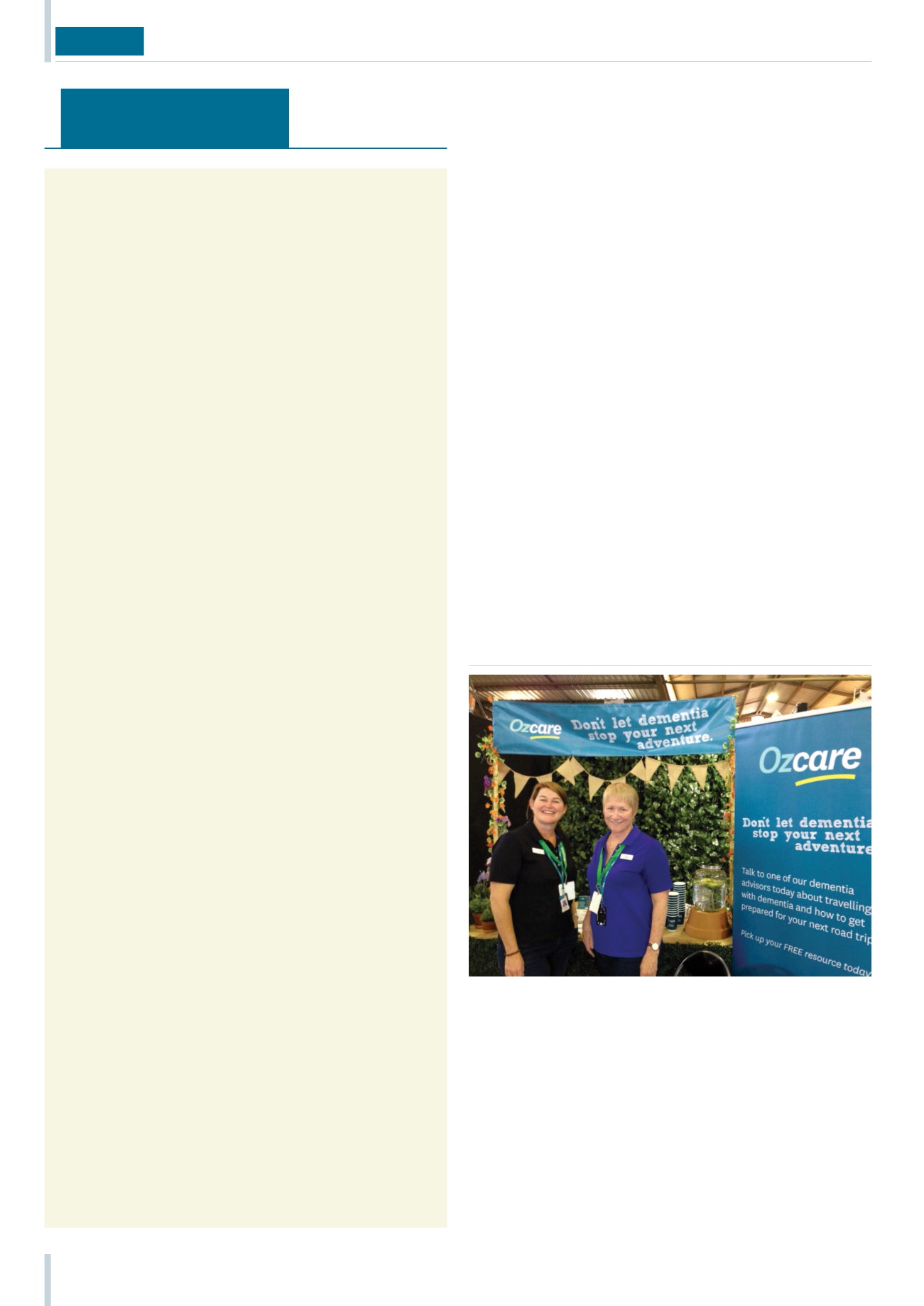
Advice for the road:
‘Don’t let dementia stop your next adventure’ was the
message promoted by Queensland care provider Ozcare at the Toowoomba
Spring Home Show and Caravan and Leisure Expo in October. Ozcare’s
Dementia Advisory and Support Service used the event to launch its new
resource, a 20-page booklet,
Road trips: with dementia in mind
, aimed at
helping people with dementia and family carers to better prepare for road trips
in Australia. The idea for the booklet came about when several clients reported
difficulties when setting out on their trip of a lifetime. The booklet covers
questions such as, ‘How should we travel?’, ‘When should we go?’, ‘What
should we check before we go?’, ‘What should we take?’ and ‘What should
we consider while travelling’. It is available on Ozcare’s website
(www.ozcare.org.au/dementiacare/)and in hard copy for free (contact
catherine.ross@ozcare.org.auto request copies). Pictured at the expo are
Ozcare dementia advisors Linda Porter (left) and Sue Radecker