


 11 / 40

Vol 5 No 6 December 2016/January 2017
Australian Journal of Dementia Care
11
C
larice has been living
with Alzheimer’s disease
for over 15 years. At first
she disguised her confusion
with a veil of phrases,
covering up her forgetfulness
with laughter: “Of course I
knew that, I was only joking,”
she would tell her family.
Alzheimer’s drowned
Clarice within waves of
confusion, muddling up her
thoughts and blending the
faces she had been surrounded
by all her life with those of
strangers, as she tried to tread
water in the relentless current.
However, she always wore a
smile that came accompanied
with jokes and quirky
musings.
She became known for the
eccentric catchphrases that she
would repeat to her
grandchildren: “How do you
spell
nachas
(happiness)?”, she
would ask. “C-L-A-R-I-C-E”,
they would melodiously
answer. At every family
gathering Clarice would tap
her glass with a fork and
announce, “with tears in my
eyes, I just want to say how
special it is to be here, no
itching or bitching, just all
together, as a family”. And
when she would leave, she
would gather everyone
together and depart with her
famous final words: “Go well,
go Shell, but don’t go to hell”.
“Go well, go Shell, but …
“Don’t ring the bell!” “Don’t
say farewell!” her family
would try to interject.
“No,” she would confirm
with a cheeky grin, “Don’t go
to hell!”
At Friday night meals
Clarice’s 13 grandchildren
would say the Jewish blessing
over food, in chronological
order from eldest to youngest.
With much humour Clarice
would exclaim “Our Father,
the Holy Spirit…” and
proceed to tap out the sign of
the cross on her body,
reminding them of her rich
childhood having attended a
Catholic boarding school as a
young Jewish girl, the daily
prayers and hymns staying
with her into old age. Clarice
grew up on a farm in what
was then Rhodesia (now
Zimbabwe) in southern Africa,
where she learnt Swahili. Her
family loved her Swahili
exclamations like
“sagabona
wena”
(
“hello, how are you?”
), to
which they would reply in
their own made-up language,
matching the sounds of her
youth.
As Clarice’s cognition
declined, her honesty and
humour sharpened and the
kindness, love and
compassion that overflowed
from her heart were amplified.
At times her honesty was
brutal, revealing hidden layers
about the people around her.
No longer aware of social cues
or the importance of privacy,
she would point out the sad
man sitting by himself, or the
distressed woman lost in
thought. While sometimes
uncomfortable, such honesty
only exposed her caring and
sensitive nature. She was
adept at identifying someone’s
hidden sadness and quick to
inquire why, offering her ear
and heart.
If her family had visitors at
their weekly
Shabbat
meals
who showed signs of fragility,
Clarice was the first to get up
and help. “Can I help you up
from the table?”, she would
ask. “You stay put and I’ll get
your food for you, what would
you like?” The irony of such
moments was heartrending,
this ability to help those who
were physically unwell, when
neither she, nor anyone else,
was able to help with the
illness that overwhelmed her
mind.
As the disease progressed,
Clarice’s sentences slipped
into nonsensical musings.
Moments from her childhood
featured more frequently as
she lost track of time. She
would refer to herself as a little
girl, telling her adult children
that she had to go home lest
her parents worry where she
was.
And yet there were
moments of pure happiness
that would occasionally peek
out: her genuine awe as she
watched the sunsets that
showered her balcony and the
raw happiness and surprise
she would experience when
her granddaughters kissed her
on the cheek for a ‘selfie’ were
moments of bliss.
Clarice’s family learnt what
made her happy and were able
to tap into such experiences to
change solemn moments into
happier ones. The more they
became desensitised to her
illogical talk and the more they
learnt how to laugh with her
rather than cry, the more they
were able to find joy and
beauty in her quirky musings
and disjointed sentences. The
more they distanced
themselves from her disease,
the more they were able to
appreciate her presence, her
warmth and her unconditional
love.
I am an undergraduate
medical student and have
dealt with patients like Clarice
since the start of my medical
studies. However, Clarice is
not and has never been my
patient. She is my
grandmother, my
Bobba
. At the
same time that I was dealing
with the sudden deterioration
of my Bobba’s cognition, I
Turning tears into laughter
Medical student
Gabrielle Cher
’s 2015 National Dementia Essay Competition entry recounts her
family’s personal journey with Alzheimer's disease and the impact it's had on her approach to caring for
people with dementia
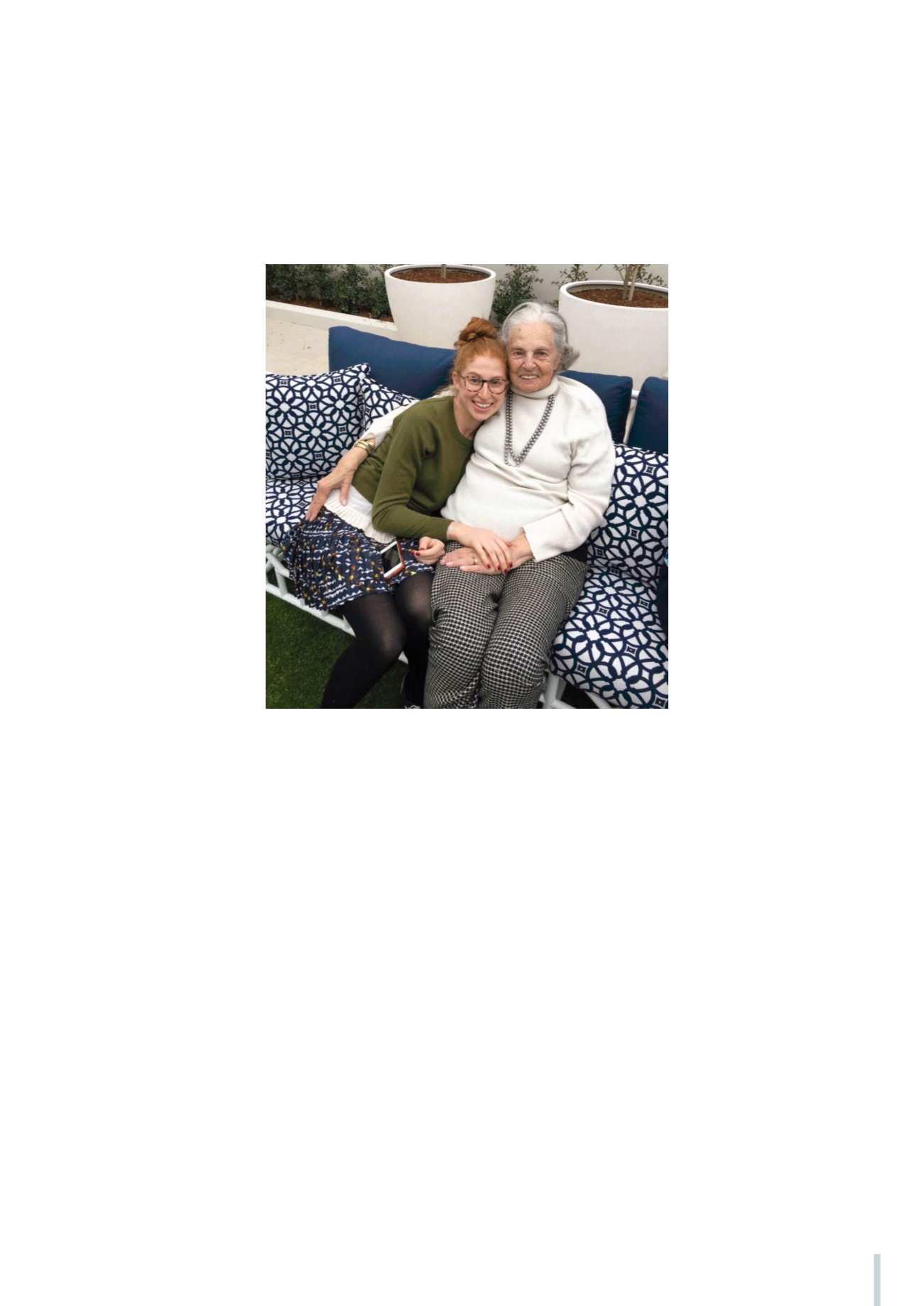
Gabrielle Cher with her ‘Bobba’ (grandmother) Clarice, who is living
with dementia