


 16 / 40

16
Australian Journal of Dementia Care
December 2016/January 2017 Vol 5 No 6
room’, ‘lounge’ and ‘toilet’) are in words
and pictures that are familiar to, and in the
language of, the residents living in the
facility – not just in English. In our care
villages this means signs in both Italian
and English.
Designing for CALD
people with dementia
At the core of all design decisions for our
new care home at Drummoyne is the
desire to create an enabling village for
daily living and normalised patterns of life
for residents, families and the community.
Reflecting Scalabrini’s Italian heritage, the
design embodies the Italian traditions of
family, gathering over good food and
coffee, respect for religious tradition and
absolute respect for our elders.
There are plenty of community and
social spaces over the four levels, balanced
with small, domestic-scale homes for 12-14
residents, each with lounge rooms, a
balcony, kitchen, two dining rooms with
large family-size tables, and private
bedrooms. There will also be 16 units for
couples (the person with dementia and
their partner).
The homes, along with all common
areas, are linked to a large central outdoor
village piazza. The lift to each house opens
directly into the piazza so residents can
move around the village as they please,
with no barriers to public areas or
corridors to navigate. It’s been well
documented that when care homes
‘unlock the doors’ and enable residents
with dementia to go outside their level of
agitation is reduced (Matteson & Linton
1996; Guite
et al
2006). Research by Mather,
Nemecek and Oliver (1997) suggests that
individuals who spent more time outdoors
engaged in less disruptive behaviour. They
theorised that gardens or outdoor spaces
can reduce the sense of confinement that
people may feel in a secure environment,
giving residents the opportunity to move
widely and feel and experience less
frustration, less need for pacing and lower
levels of agitation.
With easy access and lots of activity, the
piazza is designed to entice residents
outdoors to engage with family, friends
and the home’s community. Attractions
will include seating and large deciduous
trees, fresh aromas and sights of food and
coffee at the pizzeria and café and spaces
for lifestyle and entertainment including
art therapy, dance, craft, a library, chapel,
hair and beauty salons, and a cinema – all
featuring familiar Italian designs and
colours.
Making spaces for families, particularly
grandchildren, is also an important part of
the design. Providing a children’s play
area, along with the other attractions in the
piazza, will give families and residents a
familiar, welcoming space to interact,
similar to an Italian market place.
Conclusion
Professor TomKitwood suggested that
people with dementia (like all people)
have six psychological needs that must be
met in order to maintain a good sense of
well-being: love, comfort, identity,
occupation, inclusion and attachment. I
would argue that recognising these needs
is even more important when creating an
environment to support people from
CALD backgrounds with dementia.
Our ‘Sono Io’ philosophy of cultural
practice is about finding out what is
important for each resident, ensuring we
include the families in all matters – be it
medical or social – ensuring the built
environment meets the needs of all
residents, and providing continuous
education for staff on the importance of
resident choice, decision making,
spirituality and autonomy.
References
Calkins MP (1998)
Design for dementia. Planning
for the elderly and the confused.
Owing Mills, MD:
National Health Publishing.
Cohen U, Weisman GD (1991)
Holding on to
home. Designing environments for people with
dementia.
Baltimore, MD: Johns Hopkins
University Press.
Cohen U, Moore KD (1999)
Integrating cultural
heritage into assisted living environments.
In:
Schwartz B, Brent R (Eds)
Ageing, autonomy and
architecture: advances in assisted living.
Baltimore MD: John Hopkins University Press.
Connell CM, Gibson GD (1997) Racial, ethnic,
and cultural differences in dementia caregiving:
Review and analysis.
The Gerontologist
37 355-
364.
Cox C, Monk A (1993) Hispanic culture and family
care of Alzheimer’s patients.
Health and Social
Work
18 92-101.
Day K, Cohen U (2000)
Environment and
behaviour.
Available at:
www.eab.sagepub.com.
FECCA (Federation of Ethnic Communities’
Councils of Australia) (2015)
Review of Australian
research on older people from Culturally and
Linguistically Diverse Backgrounds
. Available at:
http://bit.ly/2f4H9AB.Guite H, Clark C, Ackrill G (2006) The impact of
the physical and urban environment on mental
well-being.
Public Health
120(12)1117-1126.
International Council on Monuments and Sites
(ICOMOS) International Cultural Tourism
Committee (2002)
ICOMOS international cultural
tourism charter: principles and guidelines for
managing tourism at places of cultural and
heritage significance
21. Available at:
http://bit.ly/2eDhm1Y.Mather JA, Nemeck D, Oliver K (1997) The effect
of a walled garden on behaviour of individuals
with Alzheimer’s.
American Journal of Alzheimer’s
Disease and Other Dementias
12(6) 252-257.
Matteson MA, Linton A (1996) Wandering
behaviors in institutionalised persons with
dementia.
Journal of Gerontological Nursing
22(9)
39-46.
Runci SJ, Redman JR, O’Connor DW (2006)
Language-relevant interventions for verbally
disruptive behaviours in dementia.
International
psychogeriatrics
118(1) 181-184.
Valle R (1989) Cultural and ethnic issues in
Alzheimer’s disease family research. In: Light E,
Lebowitz BD (Eds)
Alzheimer’s disease treatment
and family stress. Directions for research
122-
154. Rockville, MD: Department of Health and
Human Services.
Colin McDonnell is
Dementia Excellence
Practice Leader at
Scalabrini Village and
Honorary Fellow with
the Faculty of
Science, Medicine
and Health,
University of
Wollongong.
Contact him at:
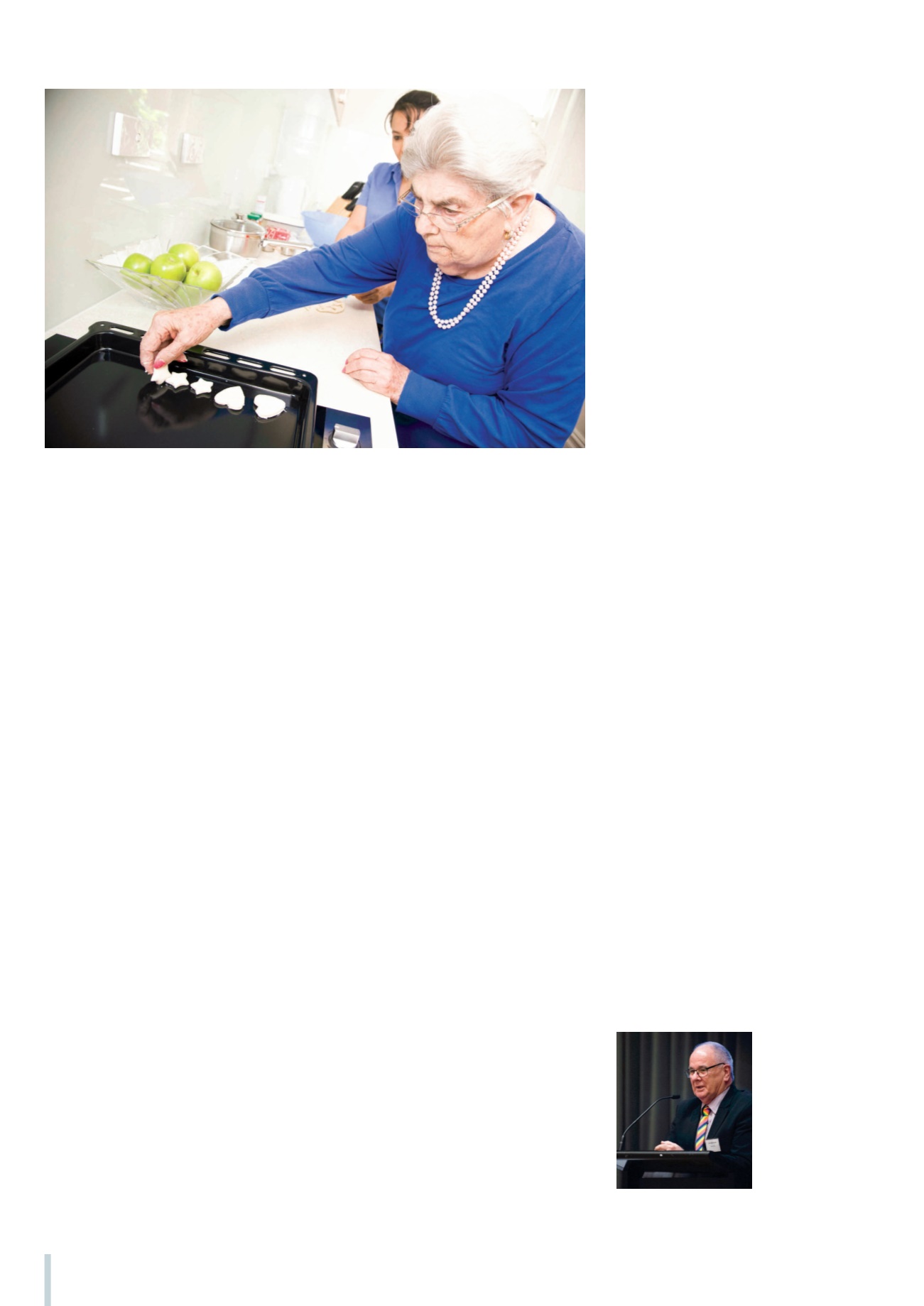
Colin.McDonnell@SCALABRINI.COM.AUBaking in one of the communal
kitchens at Scalabrini Village