


 13 / 40

Vol 5 No 6 December 2016/January 2017
Australian Journal of Dementia Care
13
C
ultural heritage is an important
aspect of self-identity for older adults
and an essential component of
preserving meaningful roles and
supporting healthy ageing among people
living with dementia (Day & Cohen 2000).
There is a direct relationship between a
person’s link to their cultural heritage – the
customs, practices, places, objects, artistic
expressions and values passed on from
generation to generation (ICOMOS 2002) –
and his/her health (Calkins1988). Cohen
&Weisman (1991) argue that when
responding to the many challenges
experienced by people living with
dementia, the environment can either
assist or hinder. An environment that is
culturally unfamiliar can have a negative
effect on the person with dementia.
Of the many variables known to
influence a person’s health beliefs and
practices, culture is the most forgotten and
sometimes the most misunderstood. There
is a myth that families fromCALD
backgrounds ‘look after their own’, and
thus do not require environments or
services for family members living with
dementia (Cox &Monk 1993). However,
the
Review of Australian research on older
people from culturally and linguistically
diverse backgrounds
(FECCA2015) report
stressed that the importance of CALD-
friendly facilities is clearly evidenced by
the fact that almost one in three
Australians were born overseas, many
with CALD backgrounds.
This article discusses the particular
needs of people with dementia from
CALD backgrounds and explains how an
understanding of these needs is
incorporated into the philosophy of care
for residents at Scalabrini Villages, and in
the planning and design of our new $70
million aged care facility which is being
built specifically for CALD people living
with dementia, and is due to open in late
2017 in Drummoyne, Sydney.
Scalabrini Village provides residential
aged care, including specialised dementia
care, primarily for residents from an Italian
background, but also for people from
other cultures. About 60% of our residents
are of Italian heritage. Our model of care is
focused on demonstrating knowledge and
understanding of our residents’ cultural
heritage, accepting and respecting cultural
differences, and adapting care accordingly.
The needs of CALD
people with dementia
Cultural heritage
People with dementia have
emotional/social and cognitive deficits as
well as memory loss, confusion, loss of
functional abilities and other losses (Cohen
&Weisman 1991). They can also exhibit
communication difficulties. It is therefore
vitally important they receive positive
emotional and environmental cues to help
maintain their dignity and autonomy. This
is where culture has a special significance.
Because people with dementia from
CALD communities retain beliefs and
behaviours from their culture of origin,
providing resources that reflect a person’s
cultural heritage is especially important to
help preserve their sense of identity,
maintain function, reduce confusion and
enhance social connections and well-
being. These resources include such things
as therapeutic cultural prompts,
environmental design, food, religious
practices and language. Environments,
which include staff with cultural
competence, should replicate as much as
possible residents’ traditional socio-
physical environments and cultural
considerations.
However, culture has been largely
forgotten and neglected in the design of
physical environments (Connell & Gibson
1997) and care planning for people living
with dementia, especially in mainstream,
culturally neutral aged care facilities
where English is the dominant language of
residents and staff. Many continue to base
their care philosophy on a model that is
task-oriented rather than person-centred,
with bland and culturally neutral physical
environments that are particularly foreign
Creating culturally appropriate
care for people with dementia
Colin McDonnell
explains how to create residential care environments that support the needs
of older people with dementia from culturally and linguistically diverse (CALD) backgrounds
An architect’s drawing of the Italian-style
piazza planned for Scalabrini Village’s new
care home in Sydney
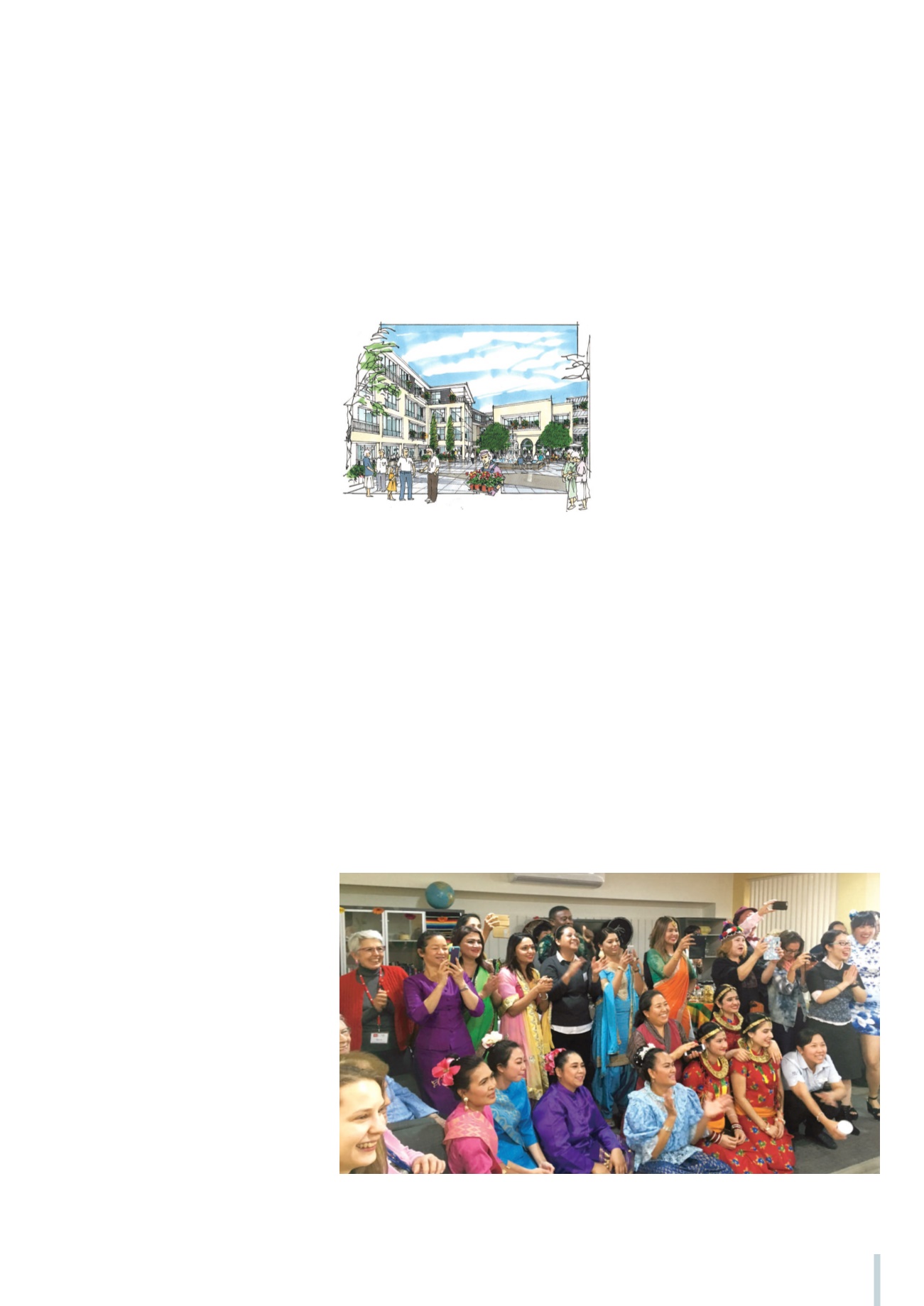
Scalabrini Village’s Foundation Day celebrates the organisation’s multicultural heritage and
cultural diversity with staff performing national dances for residents and relatives