


 17 / 40

Vol 5 No 6 December 2016/January 2017
Australian Journal of Dementia Care
17
Using sensory stories for
individuals with dementia
People with dementia are prone to sensory deprivation, but symptoms like irritability and
confusion may be reduced by using multisensory life stories.
Rebecca Leighton
,
Coralie
Oddy
and
Joanna Grace
describe two successful approaches to sensory life story work
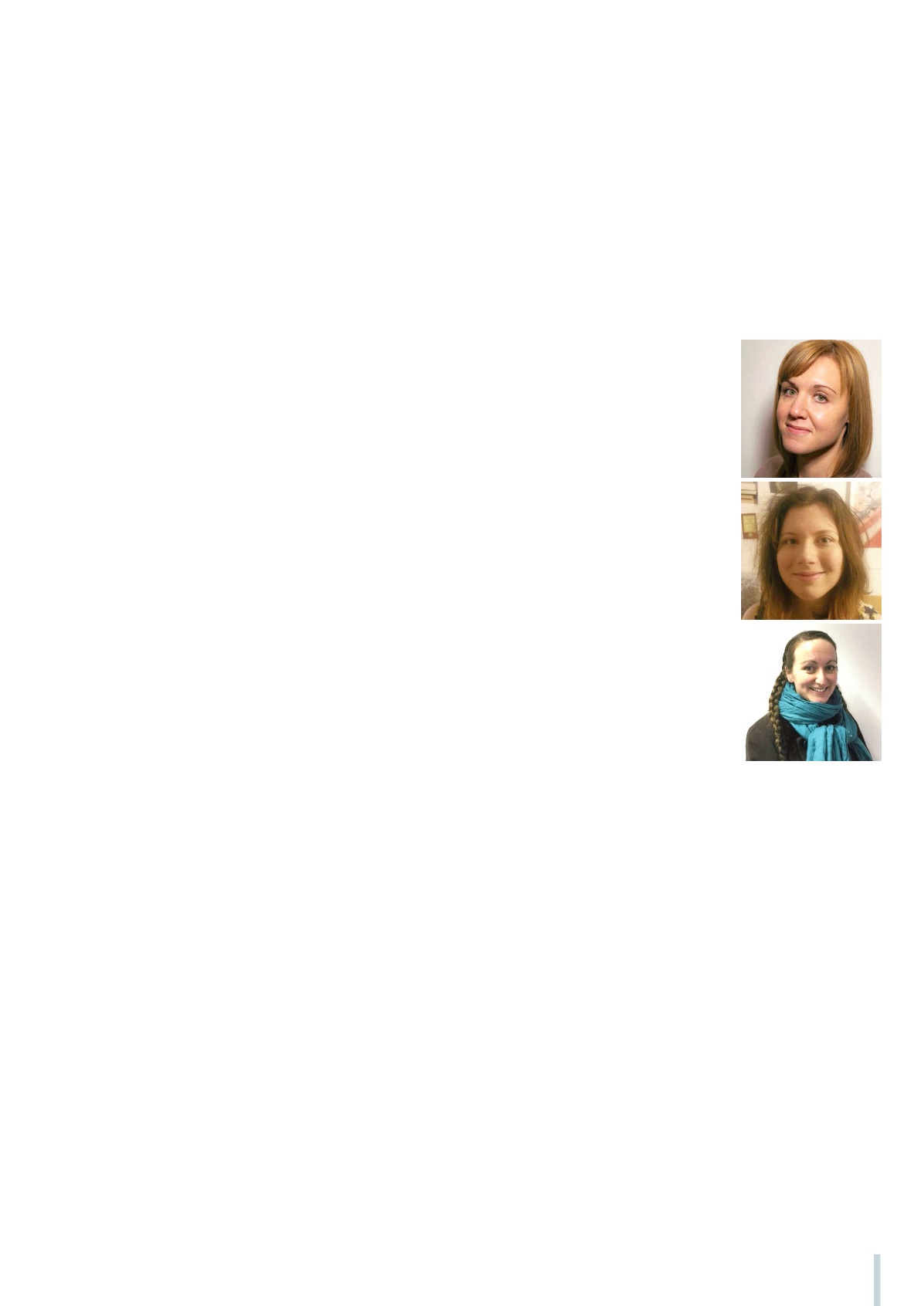
Rebecca Leighton
(top) is a specialist
speech and language
therapist, elenbi-uk
and Bradford District
Care NHS
Foundation Trust in
the UK; Coralie Oddy
(centre) is a student
speech and language
therapist and founder
of ReminiSense, a
project providing
group sensory
storyelling; and
Joanna Grace (above)
is a special
educational needs and
disabilities consultant
and founder of the
Sensory Project.
A
‘sensory story’ is a concise narrative in
which each section of the text is partnered
with a relevant sensory experience, each
story typically targeting a broad range of senses.
Story experiencers may engage with the narrative
through the text, the stimuli, or both; no part has
dominance. Individuals with limited
understanding of language can therefore be
included in storytelling and its benefits for well-
being and cognition (Grace 2014; Lacey 2006).
Sensory perceptions are key to memory
formation (Bogdashina 2003) and repeating a
sensory experience reinforces neural pathways
(Grace 2014; Longhorn 2011). Accordingly, when
sensory stories are told consistently over time,
listeners’ responses increase (Brug
et al
2012;
PAMIS 2002, 2006, 2010; Penne
et al
2012).
Sensory stories were originally created to support
individuals with profound disabilities (Deonarain
2010; Fuller 2013; Grove 1998; Lacey 2006; PAMIS
2002; Park 2004; Taylor 2006; Young & Lambe
2011) and have since been used effectively with
individuals with a range of needs. This paper
explores their application in the field of dementia.
Narrative and sensory interventions
Sensory loss associated with ageing is exacerbated
by dementia (Bakker 2003). Individuals with
dementia are especially vulnerable to sensory
deprivation, as difficulties with communication
and mobility create barriers to accessing desired
activities (Baker
et al
2003). Symptoms of sensory
deprivation – irritability, confusion,
disorientation, lethargy and hallucinations – are
common in later stage dementia (Collier 2007).
Providing appropriate sensory stimulation is
therefore crucial (Baker
et al
2003).
Though common in learning disability services,
the use of sensory stories in dementia care is not
reported in the literature and appears to be a
novel approach. Other narrative and sensory
interventions are used with both populations:
• Life story work benefits individuals with
dementia and/or learning disability and their
carers (Hewitt 2006; Kindell
et al
2014; McKeown
et al
2015).
• ‘Multisensory prompts for communication’
support individuals with learning disability and
dementia to transition between activities and
experience reduced anxiety (Johnson & Elliot
2006, 2008).
• Multisensory environments, frequently used
with individuals with profound and multiple
learning disabilities (PMLD), became popular in
dementia care in the 1990s (Baker
et al
2003; Hope
& Waterman 2004).
Individuals with PMLD and dementia are
certainly not a homogeneous group, but this
overlap in approaches reflects the fact that both
populations are vulnerable to sensory deprivation
(Baker
et al
2003; Bauer
et al
2015; Fowler 2007;
Grace 2014) and have an increased need for non-
verbal communication (Ellis & Astell 2008;
Mansell 2010; Mencap 2014). The parallels
suggest that ‘what works’ in sensory storytelling
for people with PMLD could be beneficial in
dementia. Through exploring this in practice, we
have developed two approaches: personalised
sensory life stories and group sensory
storytelling.
Sensory life stories
Traditional life stories are usually books (Kindell
et al
2014; McKeown
et al
2006) but other formats
exist. They may incorporate photos, documents,
objects or music (Hewitt 2006) and are thus
experienced via multiple senses. However, they
may “… lack a multisensory and embodied
dimension that requires further exploration in
research and practice” (Kindell
et al
2014 p158).
So, since 2013, we have had a multisensory focus,
implementing sensory life stories with
individuals with dementia.
In the format we have created (box 1, p18),
between eight and 10 key events are drawn from a
traditional life story and each is recreated as a
concise sentence with an accompanying sensory
experience. Chronological order is maintained. In
a second format (box 2, p18), one specific memory
(perhaps a favourite, memorable event) is retold
in eight-10 sentence/stimuli pairs. Reggie*, for
example, has a story about how his passion for art
began with winning a school competition. In both
cases, an identity-reaffirming narrative is told
through sensory experiences.
Most families have chosen to start with a
traditional life story, from which one or more
sensory stories are then developed. But where the
dementia is more advanced, families may choose
to start with the sensory format, given its non-
verbal emphasis.
Involving people with dementia in life story
work is complex (McKeown
et al
2015). The