


 15 / 40

Vol 5 No 6 December 2016/January 2017
Australian Journal of Dementia Care
15
ritualistically ingrained habits and
patterns of their past life history, but these
rituals can be seen as very ‘foreign’ and
‘odd’ behaviours for outsiders or those
who are not culturally competent. This
stigma is exaggerated if the person is
living with dementia and reverts to
communicating in their first language,
which is not familiar to those caring for
them, and is unable to explain their wishes
to maintain the practices of their youth
(such as religion and dining). As a result,
these cultural considerations are often
neglected by staff.
Creating a home for CALD residents
If an aged care facility has a dominant
culture and information about the
minority ethnic population is ignored or
not known and catered for, it can lead to
isolation, stigma, depression and
decreased health among residents in the
minority group (Valle 1989). Our board
and management have focused on
ensuring that the dominant Italian culture
and design of our care homes doesn’t lead
to social isolation for residents from other
cultures.
Daily activity programs provide
meaningful lifestyle options for residents
of all cultures, religion or shared life
experiences (eg refugees or war veterans).
The village cultural coordinator
establishes what each individual wants, in
collaboration with the resident and/or
relatives and by observing how they react
to different leisure and lifestyle activities.
We emphasise to all care staff,
contractors, architects and builders
working with the organisation the need for
culturally sensitive design and care
practices. The Italian phrase ‘sono io’
means ‘this is me’ and is a philosophy of
cultural practice that’s being rolled out
across all Scalabrini Villages and to all
staff. It is also included in all our lifestyle
programs and briefs for environmental
design, including the newDrummoyne
facility. Our CEO, Chris Rigby, and
Director of People, Learning and Culture,
Elaine Griffin, conduct workshops for staff
in every village to show that we are
committed, from the board down, to the
‘Sono Io/This is Me’ philosophy.
Keeping culture in mind
Cultural heritage assessment is an
important part of the admission process in
all our care villages. A23-question
assessment form is used to create a
personal profile of each resident and
ensure their cultural needs are captured
and included in daily practice. We look at
each person as an individual and know
their history, including where they
worked, where they lived, their spiritual
needs, what they like to do, how they best
like to relax etc.
We employ multilingual staff; set up
each person’s room in a style that is
culturally familiar to them; ensure lifestyle
activities suit their needs; give each staff
member a list of behaviours or actions we
expect them to display in every interaction
with residents; distribute dementia-
friendly language guides; and have trained
ambassadors in each village to promote
adoption of the ‘Sono Io’ approach.
This philosophy of meaningful cultural
competence helps prolong memory and
facilitate reminiscence, increases staff
awareness of the history of the person and
increases cultural pride for residents of all
nationalities (Cohen &Moore 1999).
Creating culturally appropriate
living environments
People living with dementia need an
environment they can relate to. The built
environment should enrich life and
provide opportunities for personal
growth. Aculturally familiar home-like
environment is generally the most
comforting and positive environment for a
person living with dementia.
People with dementia from non-English
speaking backgrounds often feel agitated
and restless in care homes that are not
culturally-specific because their
surroundings look and feel unfamiliar
compared to their own culturally-friendly
home.
It is often the practice for designers to
propose highly abstract and decorative
cultural references in aged care facilities,
but in my experience these have little
value for people living with dementia who
are unable to either recognise or appreciate
such abstract meanings in the art work or
design.
Accommodating cultural heritage in
residential aged care settings requires
sensitive spatial organisation. The physical
environment should support culturally-
based lifestyles and rituals. One of the
ways we do this is by providing kitchens
and living rooms where families can join
residents, volunteers and staff to cook and
gather together – just as they would in the
family home. For example, we now have
residents, who previously spent most of
their time sitting in front of a television,
involved in pasta making.
Another point to remember when
designing and decorating care
environments for CALD residents is don’t
assume that all people from a certain
culture like the same icons or observe the
same religion. For example an Italian
person may not feel that a picture of the
Colosseum has any relevance for them,
just as anAustralian may not be bothered
looking at photos of kangaroos.
We ensure that language, cultural
competence and relevant environments for
people with dementia are front of mind
when refurbishing our existing buildings
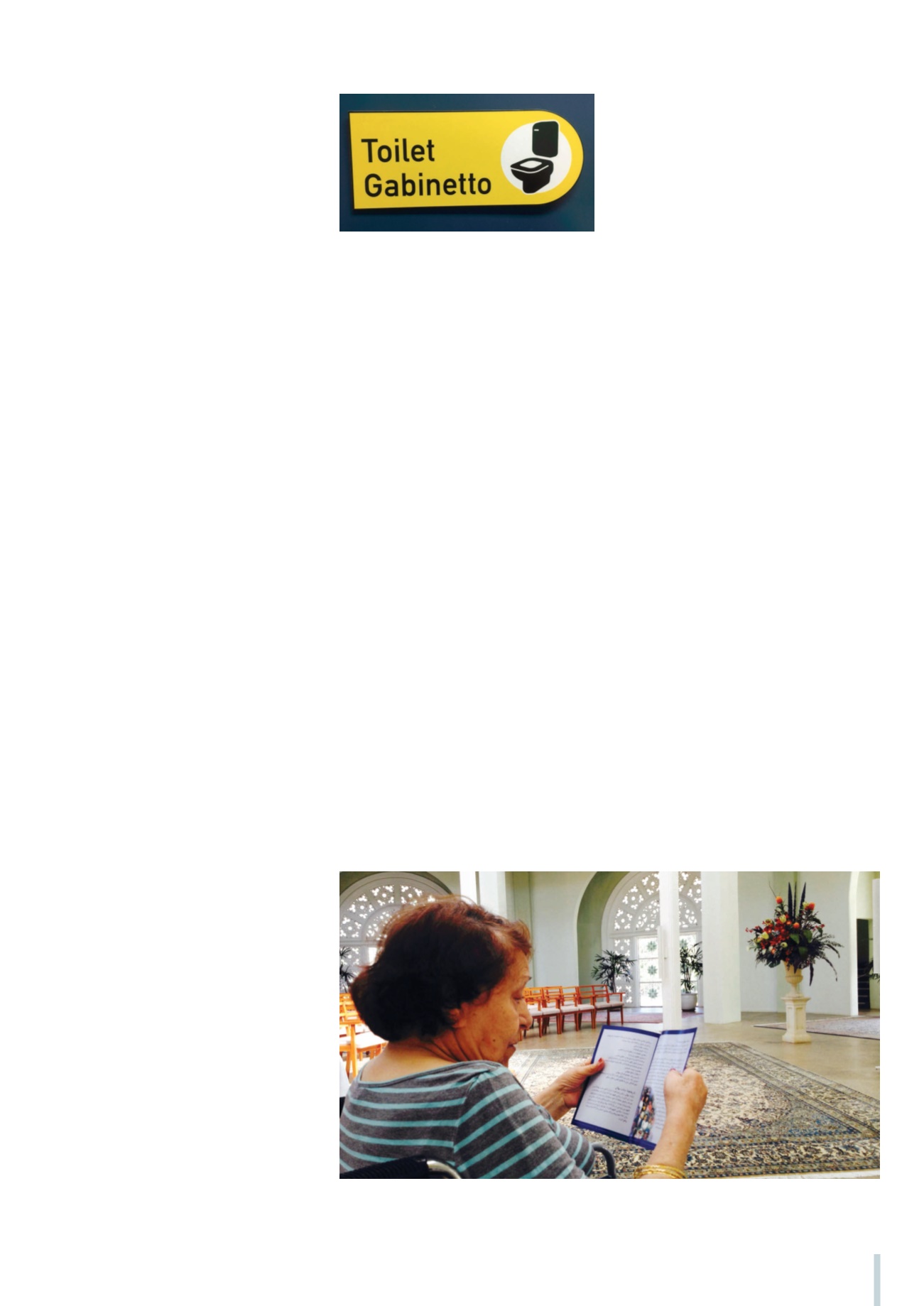
and designing new ones. Our signage
illustrates this. Signage assists residents
with wayfinding and navigation, thus
lessening anxiety and frustration.
However, these signs (eg ‘kitchen’, ‘dining
With the support of Scalabrini Village staff, this resident regularly attends the nearby
Australian Baha'i Temple in Sydney
Signage assists wayfinding, but must be in
words and pictures that are familiar to, and
in the language of, the care home residents
– not just in English.